A dentist’s mirror has a radius of curvature of 3cm. How far must it be placed from a small dental cavity to give a virtual image of the cavity that is magnified five times?
Download our app for free and get started
R = -3cm (concave mirror) m = (virtual image)$\text{f}=\frac{\text{R}}{2}=\frac{3}{2}=1.5\text{cm}$
and
$\text{m}=5=-\frac{\text{v}}{\text{u}}$
$\Rightarrow\text{v}=-5\text{u}$
We have$\frac{1}{\text{v}}+\frac{1}{\text{u}}=\frac{1}{\text{f}}$
$\Rightarrow \frac{1}{(5\text{u})}+\frac{1}{\text{u}}=\frac{1}{(-1.5)}$
$\Rightarrow \frac{4}{5\text{u}}=-\frac{1}{1.5}$
$\Rightarrow \text{u}=-\frac{4\times1.5}{5}=-1.2\text{cm}$
The mirror should be placed 1.2cm away from the dental cavity.
and
$\text{m}=5=-\frac{\text{v}}{\text{u}}$
$\Rightarrow\text{v}=-5\text{u}$
We have$\frac{1}{\text{v}}+\frac{1}{\text{u}}=\frac{1}{\text{f}}$
$\Rightarrow \frac{1}{(5\text{u})}+\frac{1}{\text{u}}=\frac{1}{(-1.5)}$
$\Rightarrow \frac{4}{5\text{u}}=-\frac{1}{1.5}$
$\Rightarrow \text{u}=-\frac{4\times1.5}{5}=-1.2\text{cm}$
The mirror should be placed 1.2cm away from the dental cavity.

Download our appand get started for free
Experience the future of education. Simply download our apps or reach out to us for more information. Let's shape the future of learning together!No signup needed.*
Similar Questions
- 1View SolutionAn object 2cm in size is placed 30cm in front of a concave mirror of focal length 15cm. At what distance from the mirror should a screen be placed in order to obtain a sharp image? What will be the nature and the size of the image formed? Draw a ray diagram to show the formation of the image in this case.
- 2View SolutionHow would a pencil look like if you saw it through (a) a concave lens, and (b) a convex lens? (Assume the pencil is close to the lens). Is the image real or virtual?
- 3View SolutionA man standing in front of a special mirror finds his image having a very small head, a fat body and legs of normal size. What is the shape of:
- Top part of the mirror?
- Middle part of the mirror?
- Bottom part of the mirror?
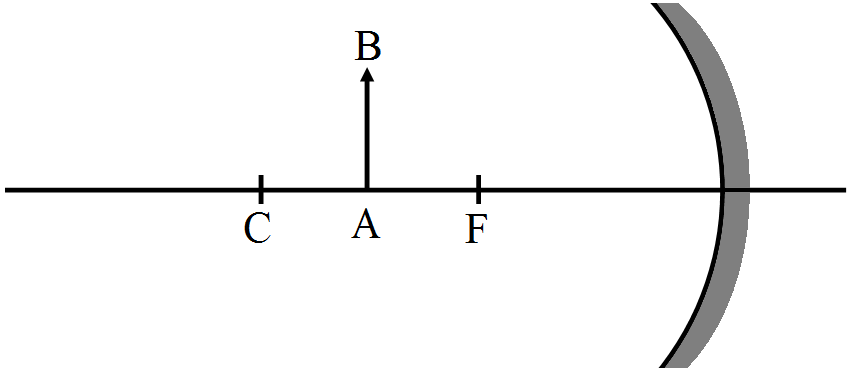
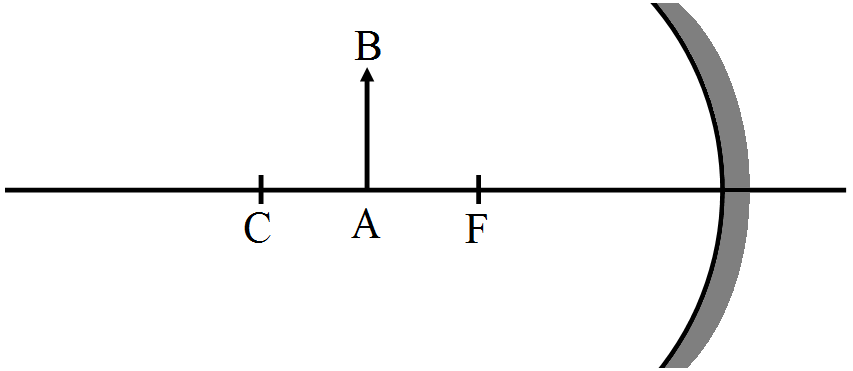
- 4View SolutionDraw the ray diagram in your answer book and show the formation of image of object AB with suitable rays. Mention the position and nature of image.
- 5View SolutionA concave mirror produces three times enlarged virtual image of an object placed at 10cm in front of it. Calculate the radius of curvature of the mirror.
- 6View SolutionGive two uses of concave mirrors. Explain why you would choose concave mirrors for these uses.
- 7View SolutionWhat is meant by the ‘angle of incidence’ and the ‘angle of refraction’ for a ray of light? Draw a labelled ray diagram to show the angle of incidence and the angle of refraction for a refracted ray of light.
- 8View SolutionGive three examples of materials that refract light rays. What happens to the speed of light rays when they enter these materials?
- 9View SolutionTwo lenses A and B have power of (i) + 2 D and (ii) -4D respectively. What is the nature and focal length of each lens?
- 10View SolutionState where an object must be placed so that the image formed by a concave mirror is:
- Erect and virtual.
- At infinity.
- The same size as the object.