Question
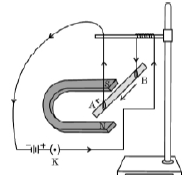
A student was asked to perform an experiment to study the force on a current carrying conductor in a magnetic field. He took a small aluminum rod AB, a strong horse shoe magnet, some connecting wires, a battery and a switch and connected them as shown. He observed that on passing current, the rod gets displaced. On reversing the direction of current, the direction of displacement also gets reversed. On the basis of your understanding of this phenomenon, answer the following questions :
Image
(a) State the condition under which the displacement of the rod is largest for the same magnitude of current flowing through it.
(b) State the rule that determines the direction of the force on the conductor AB.
(c) i. If the U shaped magnet is held vertically and the aluminum rod is suspended horizontally with its end B towards due north, then on passing current through the rod from B to A as shown, in which direction will the rod be displaced?
ii. Name any two devices that use current carrying conductors and magnetic field.
OR
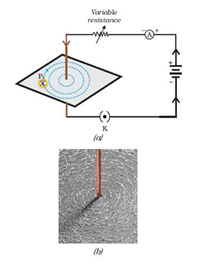
Draw the pattern of magnetic field lines produced around a current-carrying straight conductor held vertically on horizontal cardboard. Indicate the direction of the field lines as well as the direction of the current flowing through the conductor.
Answer

A student was asked to perform an experiment to study the force on a current carrying conductor in a magnetic field. He took a small aluminum rod AB, a strong horse shoe magnet, some connecting wires, a battery and a switch and connected them as shown. He observed that on passing current, the rod gets displaced. On reversing the direction of current, the direction of displacement also gets reversed. On the basis of your understanding of this phenomenon, answer the following questions:
Image

(i) The displacement of the conductor is maximum when the direction of the current is at right angles to the direction of the magnetic field.
ii) The rule that determines the direction of the force on the conductor AB is Fleming's left-hand rule. (
According to Fleming's left-hand rule, stretch the thumb, forefinger and middle finger of your left hand such that they are mutually perpendicular.
If the first finger points in the direction of the magnetic field and the second finger in the direction of current, then the thumb will point in the direction of motion or force.
(iii) i. According to Fleming's left-hand rule, the rod will get displaced upwards.
ii. Devices that use current-carrying conductors and magnetic fields are electric motors, electric generators, loudspeakers, microphones, etc.
OR
Image

Need a full question paper?

Generate a complete, print-ready paper with questions like this in minutes — across 16+ boards, with answer keys.

Start Generating Free

Similar questions

Read the following and answer any three questions from (i) to (iv).The electrical energy consumed by an electrical appliance is given by the product of its power rating and the time for which it is used. The SI unit of electrical energy is Joule. Actually, Joule represents a very small quantity of energy, and therefore it is inconvenient to use where a large quantity of energy is involved. So for commercial purposes we use a bigger unit of electrical energy which is called kilowatt-hour. 1 kilowatt-hour is equal to $3.6 × 10^6$ joules of electrical energy.
  1. The energy dissipated by the heater is E. When the time of operating the heater is doubled, the energy dissipated will?
     
  2. The power of a lamp is 60W. The energy consumed in 1 minute will?
     
  3. The electrical refrigerator rated 400W operates 8 hours a day. The cost of electrical energy is ₹ 5 per kWh. Find the cost of running the refrigerator for one day?
    OR
  4. Calculate the energy transformed by a 5A current flowing through a resistor of $2\Omega$ for 30 minutes?
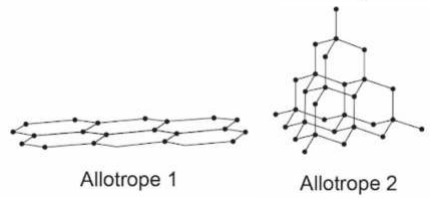
The picture shows the bonds between atoms in two allotropes of carbon.

Image
10. Which allotrope is harder? Explain your answer.

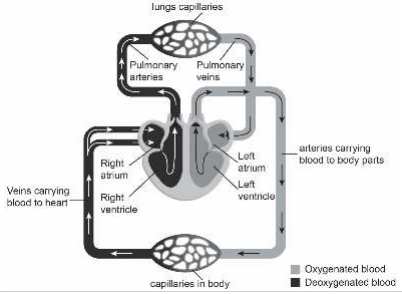
Blood transports oxygen and carbon dioxide to different parts of the human body.
The exchange of gases between blood and inhaled air takes place in the capillaries of lungs.
The diagram below shows how blood circulates in the human body.

Image
6. What statement is supported by the diagram?
A. All arteries carry oxygenated blood.
B. Capillaries are permeable to gases.
C. The wall between the left ventricle and the right ventricle is porous.
D. Blood can low back and forth between the right atrium and the right ventricle.
7. Which of these will be the immediate effect if gaseous exchange in the lung capillaries reduces?
A. Blood will low in the reverse direction.
B. Pulmonary veins will receive blood with less oxygen.
C. The space inside the left and the right atrium will increase.
D. The pressure of blood inside the capillaries will decrease.

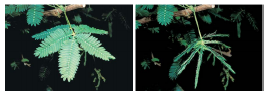
Animals have a nervous system for controlling and coordinating the activities of the body. But plants have neither a nervous system nor muscles. So, how do they respond to stimuli? When we touch the leaves of a chui- mui (the 'sensitive' or 'touch-me-not' plant of the Mimosa family), they begin to fold up and droop. When a seed germinates, the root goes down, the stem comes up into the air. What happens? Firstly, the leaves of the sensitive plant move very quickly in response to touch.
There is no growth involved in this movement. On the other hand, the directional movement of a seedling is caused by growth. If it is prevented from growing, it will not show any movement.
Image
(a) Write the types of movement.
(b) Give an example of a plant hormone that promotes growth.
(c) What is the function of the nervous system?
OR
How is the movement of leaves of the sensitive plant different from the movement of a shoot towards light?
Image
In order to help them understand the movements in the plants, answer the following questions:
Attempt either subpart A or B.
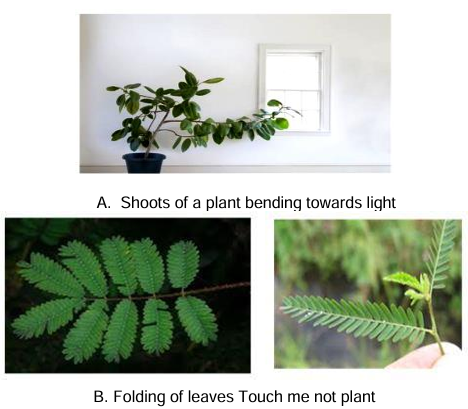
A. What causes the bending of shoots in the plants as shown in figure A?
OR
B. What causes the folding of the leaves in 'Touch me not' plant as shown
in figure B? (2)
C. Compare the movement of growth of the pollen tube towards ovule with the movements shown in part A of the above figure. (1)
D. Compare the movement shown in figure B with the movement of body parts in the animals. (1)
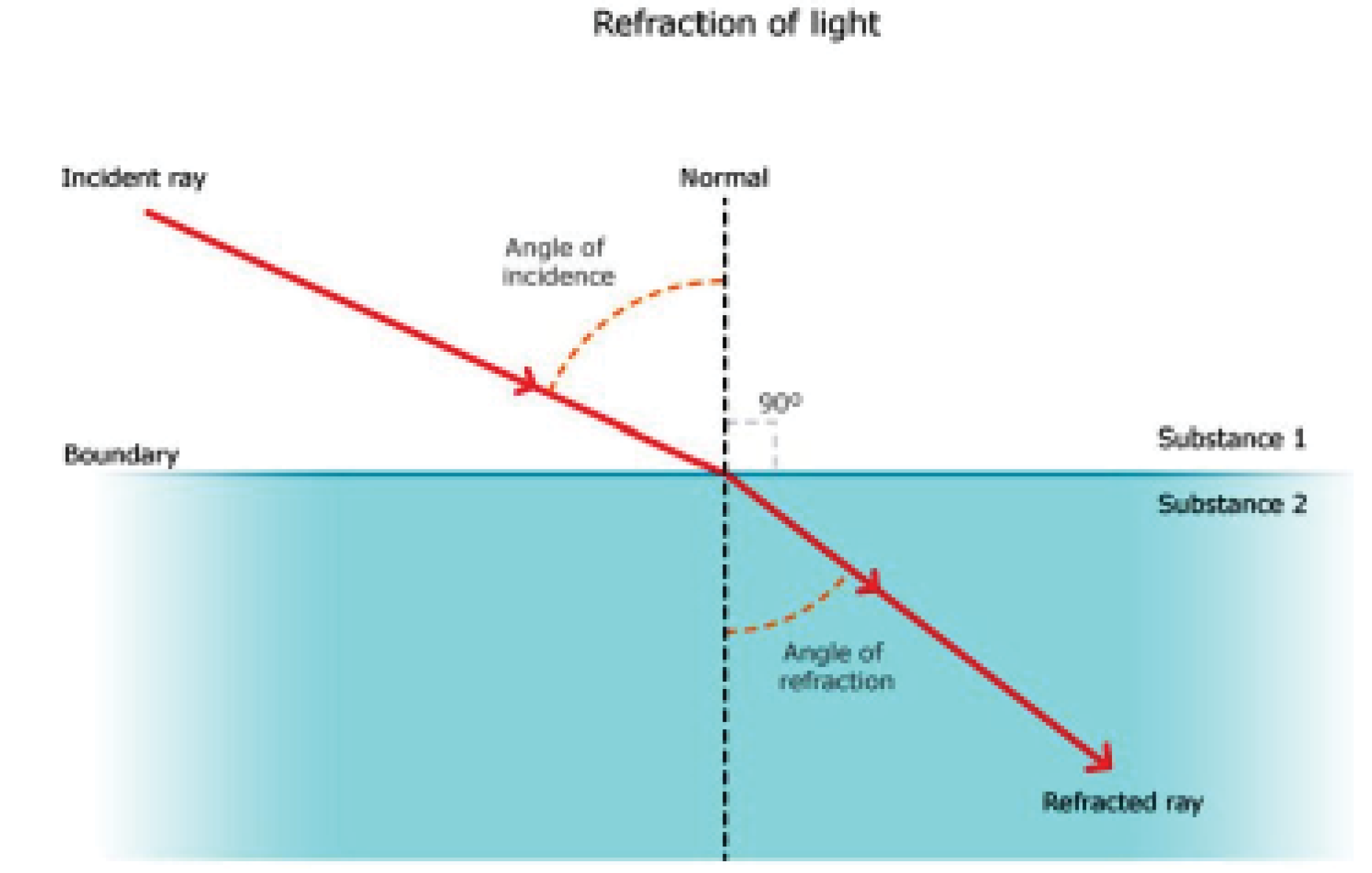
"Change in path of a light ray as it passes from one medium to another medium is called refraction of light."

When light travels from a rarer medium to a denser one, it bends towards the normal $(i>r)$ and when travels from a denser medium to a rarer one. it bends away from the normal $(i<r)$.
Where, $\quad i=$ Angle of incidence
and $\quad r=$ Angle of refraction
We can see refraction in our daily life, some of the examples are given below :
The bottom of a tank or pond containing water appears to be raised due to refraction of light which takes place when light rays pass from the pool of water into the air. The letters appear to be raised when viewed through a glass slab placed over the document because of refraction of light.
When a light ray enters in a glass slab, then the emergent ray is parallel to the incident ray but it is shifted sideward slightly.
In this case, refraction takes place twice, first when ray enters glass slab from air and second when exits from glass slab to air.
(i) What do you mean by optically rarer and denser medium ?
(ii) What is the cause of refraction?
(iii) Draw a ray diagram shotving refraction through a glass slab.
or
(iv) Give one example of refraction from our daily life experience other than the two examples given above.

Acids, bases and salts are three main categories of chemical compounds. These have certain definite properties which distinguish one class from the other.
The acids are sour in taste while bases are bitter in taste. Tasting a substance is not a good way of finding out if it is an acid or a base! Acids and bases can be better distinguished with the help of indicators. Indicators are substances that undergo a change of colour with a change of acidic, neutral or basic medium. Many of these indicators are derived from natural substances such as extracts from flower petals and barrier. Litmus, a purple dye is extracted from the lichen plant. Some indicators are prepared artificially. For example, methyl orange and phenolphthalein. Given below is a table of indicators and their colour change in acidic and basic medium.

IndicatorColour in AcidColour in Alkali
LitmusRedBlue
MethylPinkish redYellow
PhenolphthaleinColourlessPink

(i) Give two examples each of natural and artificial indicators.
(ii) An aqueous solution turns red litmus solution blue. Excess addition of which solution would reverse the change-ammonium hydroxide solution or hydrochloric acid?
(iii) What will be the change in colour when a few drops of phenolphthalein is added to a solution having pH 8.5.
or
(iv) What is universal indicator?

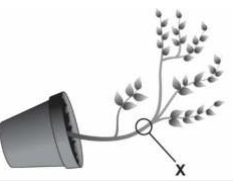
The igure shows the movement of a stem. X is a part of the stem.
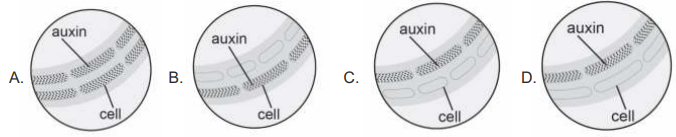
The movement of plant hormone auxin in cells regulates cell elongation and growth of plants in a
particular direction.

Image
1.What would the size of cells and the distribution of auxin at part X of the stem look like?

Image
2. How can the movement of the stem in a particular direction be described?
A. Against gravity
B. Away from touch
C. Away from chemicals
D. Towards a source of water
3. Cell division in plants is promoted by _______________________.
A. Auxin
B. Abscisic acid
C. Cytokinins
D. Gibberellins

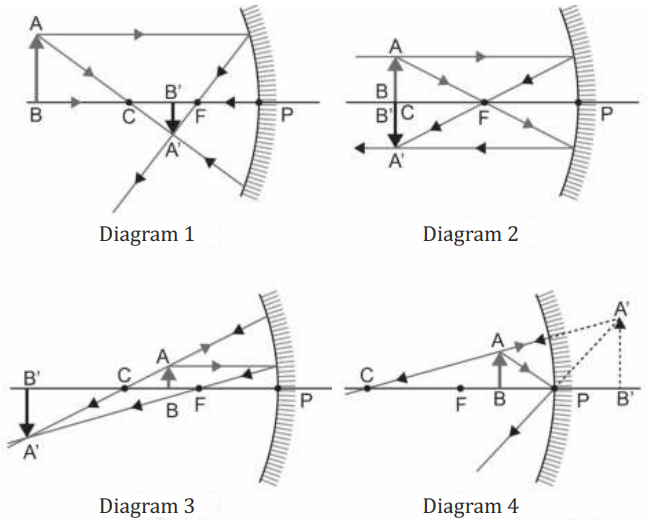
The pictures show four ray diagrams of images formed by concave mirrors.
P is the pole or centre of the relecting surface of the mirror.
F is the focus of the mirror.
C is the centre of curvature of the mirror.
AB is the object and A’B’ is the image of the object.

Image
1. Which of these can be concluded from diagram 1?
A. Image is formed at the focus.
B. Size of the image is equal to the size of the object.
C. Distance between pole and centre of curvature is twice the focal length.
D. Distance between the image and focus is half the distance between the object and focus.
2. Which diagram shows a real, inverted and enlarged image formed by the mirror?
A. Diagram 1
B. Diagram 2
C. Diagram 3
D. Diagram 4
3. In which condition does a concave mirror produce a virtual image?
A. When object is located within the focal length
B. When object is located at the centre of curvature
C. When object is located in between ininity and the centre of curvature
D. When object is located in between the centre of curvature and the focus
4. Solar cookers contain a concave mirror.
How does the concave mirror help in heating the food?
Circle ‘Yes’ or ‘No’ for the correct response.

How does the concave mirror heat the food?

Yes or No

Sun’s rays are absorbed by the mirror.

Yes/No

Sun’s rays relected by the mirror converge at a point.

Yes/No

Sun’s rays diverge out when relected by the mirror.

Yes/No


Read the following and answer any three questions from: (i) to (iv).
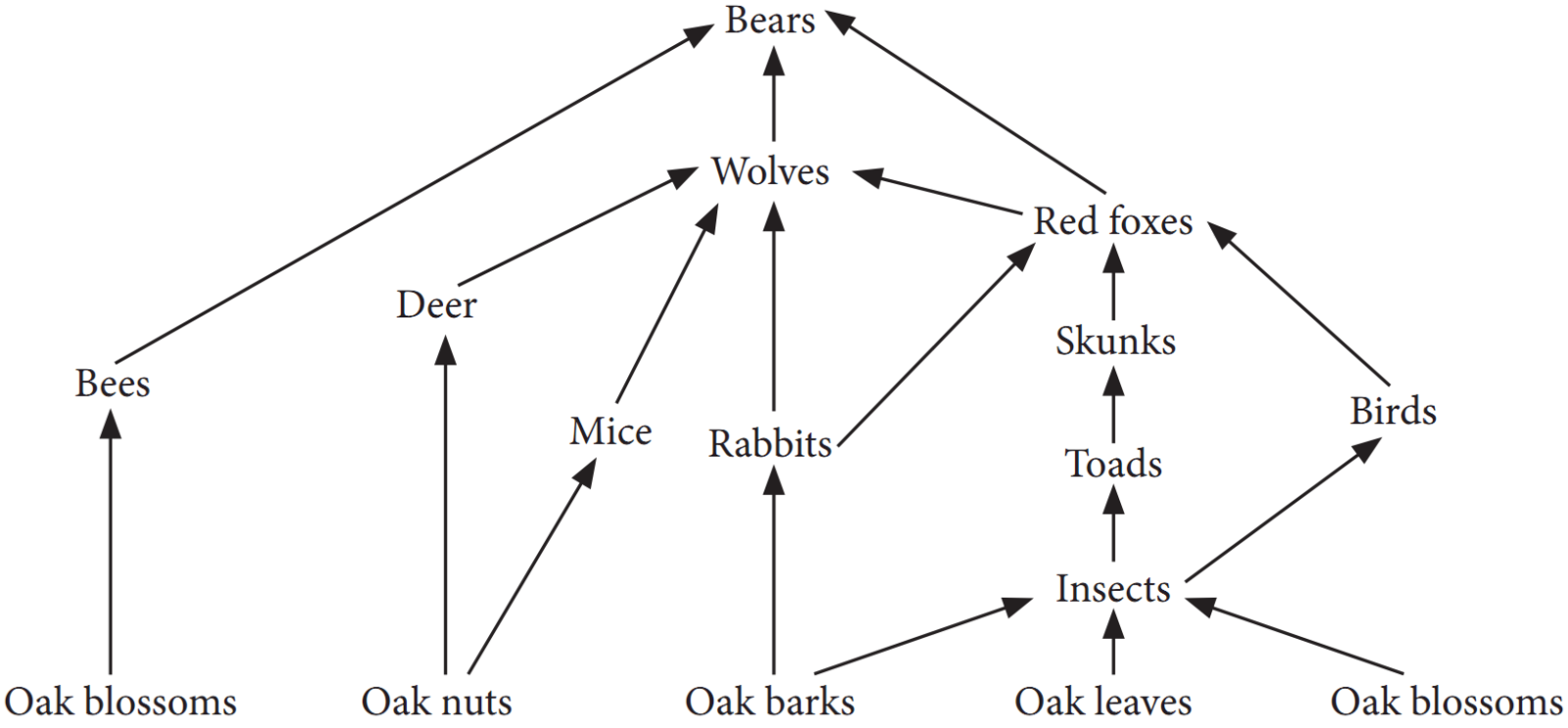
Food web is a network of food chains which become interconnected at various trophic levels so as to form a number of feeding connections amongst different organisms of a biotic community. Different food webs operate in different ecosystems. One such food web operating in an ecosystem is given ahead. Study it carefully and answer the following.
  1. What is the primary energy input in this food web?
     
  2. How many food chains are operating in the given food web?
     
  3. When a new species 'X' was introduced into the community, the population of toads rose and population of skunks fell over the subsequent two weeks. Species 'X' is most likely to be what?
    OR
     
  4. a) Which organisms in the food web passes most of its energy to the subsequent trophic levels?
    b) Which organisms would be most affected if the oak tree fails to flower?