Question 14 Marks
A student was asked to perform an experiment to study the force on a current carrying conductor in a magnetic field. He took a small aluminum rod AB, a strong horse shoe magnet, some connecting wires, a battery and a switch and connected them as shown. He observed that on passing current, the rod gets displaced. On reversing the direction of current, the direction of displacement also gets reversed. On the basis of your understanding of this phenomenon, answer the following questions :
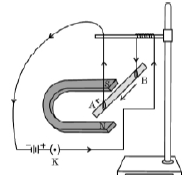
(a) State the condition under which the displacement of the rod is largest for the same magnitude of current flowing through it.
(b) State the rule that determines the direction of the force on the conductor AB.
(c) i. If the U shaped magnet is held vertically and the aluminum rod is suspended horizontally with its end B towards due north, then on passing current through the rod from B to A as shown, in which direction will the rod be displaced?
ii. Name any two devices that use current carrying conductors and magnetic field.
OR
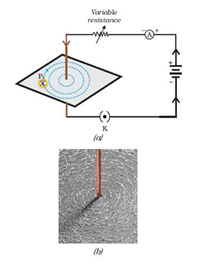
Draw the pattern of magnetic field lines produced around a current-carrying straight conductor held vertically on horizontal cardboard. Indicate the direction of the field lines as well as the direction of the current flowing through the conductor.
(a) State the condition under which the displacement of the rod is largest for the same magnitude of current flowing through it.
(b) State the rule that determines the direction of the force on the conductor AB.
(c) i. If the U shaped magnet is held vertically and the aluminum rod is suspended horizontally with its end B towards due north, then on passing current through the rod from B to A as shown, in which direction will the rod be displaced?
ii. Name any two devices that use current carrying conductors and magnetic field.
OR
Draw the pattern of magnetic field lines produced around a current-carrying straight conductor held vertically on horizontal cardboard. Indicate the direction of the field lines as well as the direction of the current flowing through the conductor.
Answer
View full question & answer→A student was asked to perform an experiment to study the force on a current carrying conductor in a magnetic field. He took a small aluminum rod AB, a strong horse shoe magnet, some connecting wires, a battery and a switch and connected them as shown. He observed that on passing current, the rod gets displaced. On reversing the direction of current, the direction of displacement also gets reversed. On the basis of your understanding of this phenomenon, answer the following questions:
(i) The displacement of the conductor is maximum when the direction of the current is at right angles to the direction of the magnetic field.
ii) The rule that determines the direction of the force on the conductor AB is Fleming's left-hand rule. (
According to Fleming's left-hand rule, stretch the thumb, forefinger and middle finger of your left hand such that they are mutually perpendicular.
If the first finger points in the direction of the magnetic field and the second finger in the direction of current, then the thumb will point in the direction of motion or force.
(iii) i. According to Fleming's left-hand rule, the rod will get displaced upwards.
ii. Devices that use current-carrying conductors and magnetic fields are electric motors, electric generators, loudspeakers, microphones, etc.
OR
(i) The displacement of the conductor is maximum when the direction of the current is at right angles to the direction of the magnetic field.
ii) The rule that determines the direction of the force on the conductor AB is Fleming's left-hand rule. (
According to Fleming's left-hand rule, stretch the thumb, forefinger and middle finger of your left hand such that they are mutually perpendicular.
If the first finger points in the direction of the magnetic field and the second finger in the direction of current, then the thumb will point in the direction of motion or force.
(iii) i. According to Fleming's left-hand rule, the rod will get displaced upwards.
ii. Devices that use current-carrying conductors and magnetic fields are electric motors, electric generators, loudspeakers, microphones, etc.
OR