Question
A sugar syrup of weight 214.2 g contains 34.2 g of sugar $\left( C _{12} H _{22} O _{11}\right)$. Calculate
i. molal concentration, and
ii. mole fraction of sugar in the syrup
Answer


$\begin{aligned} & \text { i. } \text { Weight of sugar syrup }=214.2 g \\ & \text { Weight of sugar in syrup }=34.2 g \\ & \text { weight of water in syrup }=214.2-34.2=180.0 g \\ & \text { Moles of sugar }=\frac{34.2}{342}=0.1(\text { Molar mass }=342) \\ & \text { Molality }=\frac{0.1}{180} \times 1000=0.56 m \\ & \text { ii. } \text { Moles of sugar }=\frac{34.2}{342}=0.1 \\ & \text { Moles of water }=\frac{180}{18}=10 \\ & \text { Mole fraction of sugar }=\frac{0.1}{10+0.1} \\ & =0.0099\end{aligned}$

Need a full question paper?

Generate a complete, print-ready paper with questions like this in minutes — across 16+ boards, with answer keys.

Start Generating Free

Similar questions

The solubility of $\mathrm{Sr}(\mathrm{OH})_2$ at 298 K is $19.23 \mathrm{~g} / \mathrm{L}$ of solution. Calculate the concentrations of strontium and hydroxyl ions and the pH of the solution.
What is the hybridisation of each carbon in $\mathrm{H}_2 \mathrm{C}=\mathrm{C}=\mathrm{CH}_2$.
Using the data (all values are in kilocalories per mole at $25^{\circ} C$ ) given below, calculate the bond energy of $C - C$ and C -
H bonds. $\Delta H ^{\circ}$ combustion (ethane) $=-372.0$
$\Delta H ^{\circ}$ combustion (propane) $=-530.0 \Delta H ^{\circ}$ for $C ($ graphite $) \rightarrow C ( g )=172.0$ Bond energy of $H - H =104.0 \Delta_{ f } H ^{\circ}$ of $H _2 O ( l )=-68.0 \Delta H ^{\circ}$ for $CO _2(g)=-94.0$
  1. How many gram atoms are there in $8.0g$ of S?
  2. The molarity of Solution of sulphuric acid is $1.35M$. Calculate its molality.
(The density of solution is $1.02g cm^{-3})$
MY and $\mathrm{NY}_3$ two nearly insoluble salts, have same $\mathrm{K}_{\text {sp }}$ values $6.2 \times 10^{-3}$ of non temperature. Calculate solubility of each salt. Which has more solubility.
What are the oxidation number of the underlined elements in the following and how do you rationalise your results?
$\mathrm{Fe}_3 \mathrm{O}_4$
Determine the molecular formula of an oxide of iron, in which the mass per cent of iron and oxygen are 69.9 and 30.1, respectively.
Note: Given that the molar mass of the oxide is $159.69 \mathrm{~g} \mathrm{~mol}^{-1}$
The pH of a sample of vinegar is 3.76. Calculate the concentration of hydrogen ion in it.
1. The fact that the enthalpy is a state function forms the basis of a very useful law. Name the law.
2. Two liters of an ideal gas at a pressure of 10 atm expands isothermally at $25^{\circ} C$ into a vacuum until its total volume is 10 liters. How much heat is absorbed and how much work is done in the expansion?
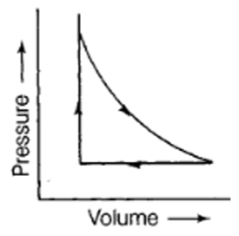
3. A sample of 1.0 mole of a monoatomic ideal gas is taken through a cyclic process of expansion and compression as shown in the figure. What will be the value of $\Delta H$ for the cycle as a whole?
Image
When aqueous solution of borax is acidified with hydrochloric acid, a white crystalline solid is formed which is soapy to touch. Is this solid acidic or basic in nature? Explain.