Question
1. The fact that the enthalpy is a state function forms the basis of a very useful law. Name the law.
2. Two liters of an ideal gas at a pressure of 10 atm expands isothermally at $25^{\circ} C$ into a vacuum until its total volume is 10 liters. How much heat is absorbed and how much work is done in the expansion?
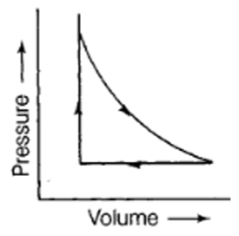
3. A sample of 1.0 mole of a monoatomic ideal gas is taken through a cyclic process of expansion and compression as shown in the figure. What will be the value of $\Delta H$ for the cycle as a whole?
Image

Answer

1. The name of the law is Hess's law of heat summation.
2. We have $q =- w = p _{ ex }(10-2)=0(8)=0$ No work is done; no heat is absorbed.
3. According to the question, 1 mole of a mono atomic ideal gas is taken through a cyclic process of expansion and compression.
Image
$\Delta H$ for a cyclic process is zero because enthalpy change is a state function.

Need a full question paper?

Generate a complete, print-ready paper with questions like this in minutes — across 16+ boards, with answer keys.

Start Generating Free

Similar questions

Write the Lewis dot structure of the CO molecule.
A gas at a pressure of 5atm is heated from 0°C to 546°C and is simultaneously compressed to one third of original volume. Find the final pressure.
Write structures of all the alkenes which on hydrogenation give 2-methylbutane.
$A 2.0L$ container at $25^\circC$ contain $1.25$ moles of $O_2$ and 3.2 moles of $C.$
  1. What is the initial pressure in the flask?
  2. If the carbon and oxygen react as completely as possible to form $CO$, what will be the final pressure in the container?
i. Explain, why $\mathrm{Be}_2$ molecule does not exist by using molecular orbital theory.
ii. Describe the state of hybridization in $\mathrm{PCl}_5$ Why are the axial bonds longer as compared to equatorial bonds?
Why hard water does not form lather with soap? What advantage has soap over detergents?
2 Arrange the following set of compounds in order of their decreasing relative reactivity with an electrophile, $\mathrm{E}^{+}$. Chlorobenzene, 2,4-dinitrochlorobenzene, p-nitrochlorobenzene.
An evacuated vessel weights 50 g when empty, 144 g when filled with liquid of density $0.47 \mathrm{~g} \mathrm{~mL}^{-1}$ and 50.5 g when filled with ideal gas at 760 mm Hg and 300 K . Calculate molar mass of ideal gas. $\left[R=0.08212\right.$ atom $\left.\mathrm{K}^{-1} \mathrm{~mol}^{-1}\right]$
Cone. HCl is $38 \% \mathrm{~HCl}$ by mass. What is the molarity of this solution if $\mathrm{d}=1.19 \mathrm{~g} \mathrm{~cm}^{-3}$ ? What volume of cone. HCl is required to make 1.00 L of 0.10 M HCl ?
In astronomical observations, signals observed from the distant starts are generally weak. If the photon detector receives a total of $=3.15 \times 10^{-18} J$ from the radiations of 600 nm . Calculate the number of photons received by the detector.