Question
A superconductor exhibits perfect:

Answer

  1. Diamagnetism.
Explanation:
A superconductor exhibits perfect diamagnetism.

Need a full question paper?

Generate a complete, print-ready paper with questions like this in minutes — across 16+ boards, with answer keys.
Start Generating Free

Similar questions

By corpuscular theory of light, the phenomenon which can be explained is(a) Refraction(b) Interference(c) Diffraction(d) Polarisation
       
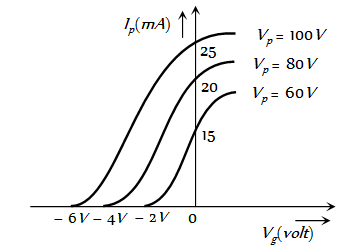
The variation of anode current in a triode corresponding to a change in grid potential at three different values of the plate potential is shown in the diagram. The mutual conductance of the triode is
The de$-$Broglie wavelength of a neutron at $27^\circ C$ is $l$. What will be its wavelength at $927^\circ C$
In the position of minimum deviation when a ray of yellow light passes through the prism, then its angle of incidence is(a) Less than the emergent angle(b) Greater than the emergent angle(c) Sum of angle of incidence and emergent angle is 90°(d) Equal to the emergent angle


An inductor, a resistance and a capacitor are joined in series with an $AC$ source. As the frequency of the source is slightly increased from a very low value, the reactance$:$
The magnetism of magnet is due to:
Which of the following is used in optical fibers?
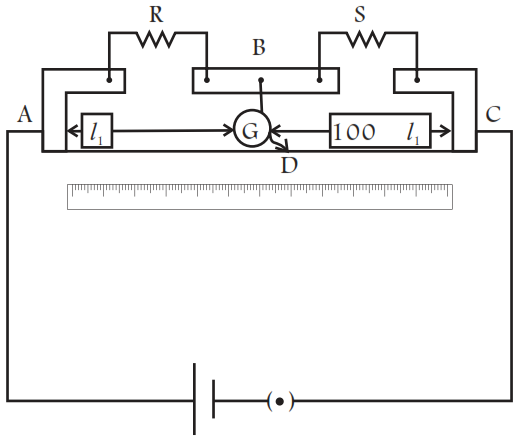
In a meter bridge the point D is a neutral point (Fig).
Assertion  :   When radius of circular loop carrying current is doubled, its magnetic moment becomes four times.
Reason      : Magnetic moment depends on area of the loop.(a) If both assertion and reason are true and the reason is the correct explanation of the assertion.(b) If both assertion and reason are true but reason is not the correct explanation of the assertion.(c) If assertion is true but reason is false.(d) If the assertion and reason both are false.


Angle of minimum deviation for a prism of refractive index 1.5 is equal to the angle of prism. The angle of prism is (cos 41° = 0.75)(a) 62°(b) 41°(c) 82°(d) 31°