Question
. A surface that has the same electrostatic potential at every point on it is known as _____________.

Answer

  1. Equipotential surface
Explanation:
Equipotential surface is a surface formed by the locus of all the points which are at the same potential. Equipotential surfaces do not intersect with each other and are closely spaced in the region of strong electric fields and vice-versa.

Need a full question paper?

Generate a complete, print-ready paper with questions like this in minutes — across 16+ boards, with answer keys.
Start Generating Free

Similar questions

The ratio of the refractive index of red light to blue light in air is(a) Less than unity(b) Equal to unity(c) Greater than unity(d) Less as well as greater than unity depending upon the experimental arrangement


The interference of light was first demonstrated experimentally by:
Photons of energies 1 eV and 2 eV are successively incident on a metallic surface of work function 0.5 eV. The ratio of kinetic energy of most energetic photoelectrons in the two cases will be :
Two statements are given$-$one labelled Assertion $(A)$ and the other labelled Reason $(R).$ Select the correct answer to these questions from the codes $(a), (b), (c)$ and $(d)$ as given below.
Assertion $(A):$ Magnetic moment is measured in joule/ tesla or amp $m^2.$
Reason $(R):$ Joule/ tesla is equivalent to amp $m^2.$
No. of magnetic lines of force present per unit volume is called.
Two insulated rings, one of slightly smaller diameter than the other are suspended along their common diameter as shown. Initially the planes of the rings are mutually perpendicular. When a steady current is set up in each of them
The potential difference applied to an X-ray tube is increased. As a result, in the emitted radiation:
  1. The intensity increases.
  2. The minimum wavelength increases.
  3. The intensity remains unchanged.
  4. The minimum wavelength decreases.
The velocity of light in a medium is half its velocity in air. If ray of light emerges from such a medium into air, the angle of incidence, at which it will be totally internally reflected, is
The resistance of a wire is 20 ohms. It is so stretched that the length becomes three times, then the new resistance of the wire will be(a) 6.67 ohms(b) 60.0 ohms(c) 120 ohms(d) 180.0 ohms
       
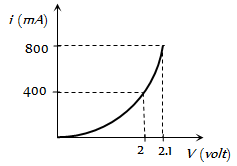
The $i-V$ characteristic of a $P-N$ junction diode is shown below. The approximate dynamic resistance of the $P-N$ junction when a forward bias of $2$ volt is applied