MCQ
A system is oscillating with undamped simple harmonic motion. Then the
  • A
    average total energy per cycle of the motion is its maximum kinetic energy.
  • B
    average total energy per cycle of the motion is $\frac{1}{\sqrt{2}}$ times its maximum kinetic energy.
  • C
    root mean square velocity is $\frac{1}{\sqrt{2}}$ times its maximum velocity
  • $(A)$ and $(C)$ both

Answer

Correct option: D.
$(A)$ and $(C)$ both
d
Total energy of system is $P E+K E$ remains constant, when system is at mean position, $x=0 \Rightarrow P E=0,$ and $K E=$ max. so average of total energy is equal to total energy at mean position which is maximum kinetic energy.

similarly, at extreme points, $K E=0$ and $P E=$ $max.$

so average of total energy is equal to total energy at extreme position which is maximum potential energy.

Now, if $x=A \sin \omega t \Rightarrow v=A \omega \cos \omega t$

Maximum velocity is $v_{\max }=A \omega$ and $\mathrm{rms}$ value of velocity is $A \omega / \sqrt{2}=v_{\max } / \sqrt{2}(\because \mathrm{rms}$ value of $\cos \theta$ is $1 / \sqrt{2}$ )

Need a full question paper?

Generate a complete, print-ready paper with questions like this in minutes — across 16+ boards, with answer keys.

Start Generating Free

Similar questions

One litre of Helium gas at a pressure $76\, cm$ of $Hg$ and temperature ${27}^\circ$ is heated till its pressure and volume are doubled. The final temperature attained by the gas is ..... $^oC$
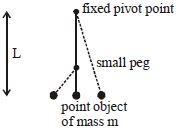
A simple pendulum of length $L$ is constructed from a point object of mass $m$ suspended by a massless string attached to a fixed pivot point. $A$ small peg is placed a distance $2L/3$ directly below the fixed pivot point so that the pendulum would swing as shown in the figure below. The mass is displaced $5$ degrees from the vertical and released. How long does it take to return to its starting position?
The velocity of a particle is $v = v _{0}+ gt + Ft ^{2}$. Its position is $x=0$ at $t=0$; then its displacement after time $( t =1)$ is :
For $z=a^{2} x^{3} y^{\frac{1}{2}}$, where $a$ is a constant. If percentage error in measurement of $x$ and $y$ are $4 \%$ and $12 \%$, respectively, then the percentage error for $z$ will be $%$
An engineer claims to have made an engine delivering $10 kW$ power with fuel consumption of $1\,g\,{s^{ - 1}}$. The calorific value of fuel is $2k cal/g$. His claim
When stopping potential is applied in an experiment on photoelectric effect, no photocurrent is observed. This means that:
  1. The emission of photoelectrons is stopped.
  2. The photoelectrons are emitted but are reabsorbed by the emitter metal.
  3. The photoelectrons are accumulated near the collector plate.
  4. The photoelectrons are dispersed from the sides of the apparatus.
If a body $A$ of mass $M$ is thrown with velocity $v$ at an angle of ${30^o}$ to the horizontal and another body $B$ of the same mass is thrown with the same speed at an angle of ${60^o}$ to the horizontal. The ratio of horizontal range of $A$ to $B$ will be
Three samples of the same gas $A, B$ and $C(\gamma = 3/2)$ have initially equal volume. Now the volume of each sample is doubled. The process is adiabatic for $A$ isobaric for $B $ and isothermal for $C$. If the final pressures are equal for all three samples, the ratio of their initial pressures are
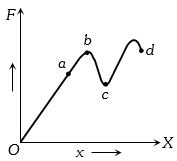
The graph is drawn between the applied force $F$ and the strain $(x)$ for a thin uniform wire. The wire behaves as a liquid in the part
In a p-n junction with open ends:
  1. There is no systematic motion of charge carriers.
  2. Holes and conduction electrons systematically go from the p-side to the n-side and from the n side to the p-side respectively.
  3. There is no net charge transfer between the two sides.
  4. There is a constant electric field near the junction.