Question
A table with smooth horizontal surface is fixed in a cabin that rotates with a uniform angular velocity $\omega$ in a circular path of radius R (In figure). A smooth groove AB of length L(<<R) is made on the surface of the table. The groove makes an angle $\theta$ with the radius OA of the circle in which the cabin rotates. A small particle is kept at the point A in the groove and is released to move along AB. Find the time taken by the particle to reach the point B.

Answer


The cabin rotates with angular velocity $\omega$ & radius R

$\therefore$ The particle experiences a force $\text{mR}\omega^2$

The component of $\text{mR}\omega^2$ along the groove provides the required force to the particle to move along AB.

$\therefore$ $\text{mR}\omega^2\cos\theta=\text{ma}$

$\Rightarrow\text{a}=\text{R}\omega^2\cos\theta$

length of groove = L

$\text{L}=\text{ut}+\frac{1}{2}\text{at}^2$

$\Rightarrow\text{L}=\frac{1}{2}\text{R}\omega^2\cos\theta\text{ t}^2$

$\Rightarrow\text{t}^2=\frac{2\text{L}}{\text{R}\omega^2\cos\theta}$

$\Rightarrow\text{t}=\sqrt{\frac{2\text{L}}{\text{R}\omega^2\cos\theta}}$

Need a full question paper?

Generate a complete, print-ready paper with questions like this in minutes — across 16+ boards, with answer keys.

Start Generating Free

Similar questions

Two friends A and B (each weighing 40kg) are sitting on a frictionless platform some distance d apart. A rolls a ball of mass 4kg on the platform towards B which B catches. Then B rolls the ball towards A and A catches it. The ball keeps on moving back and forth between A and B. The ball has a fixed speed of 5m/s on the platform.
  1. Find the speed of A after he rolls the ball for the first time.
  2. Find the speed of A after he catches the ball for the first time.
  3. Find the speeds of A and B after the ball has made 5 round trips and is held by A.
  4. How many times can A roll the ball?
  5. Where is the centre of mass of the system ''A + B + ball'' at the end of the nth trip?
A metal ball of mass 1kg is heated by means of a 20W heater in a room at 20°C. The temperature of the ball becomes steady at 50°C.
  1. Find the rate of loss of heat to the surrounding when the ball is at 50°C.
  2. Assuming Newton's law of cooling, calculate the rate of loss of heat to the surrounding when the ball is at 30°C.
  3. Assume that the temperature of the ball rises uniformly from 20°c to 30°C in 5 minutes. Find the total loss of heat to the surrounding during this period.
  4. Calculate the specific heat capacity of the metal.
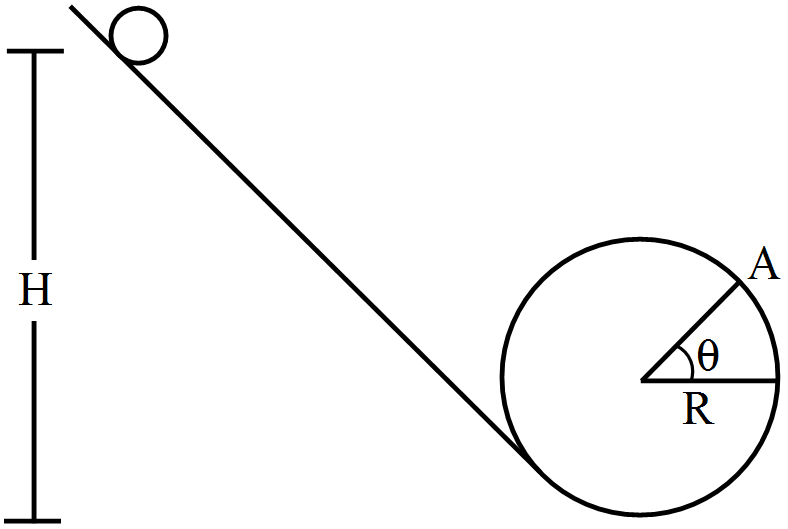
Figure shows a small spherical ball of mass m rolling down the loop track. The ball is released on the linear portion at a vertical height H from the lowest point. The circular part shown has a radius R.
  1. Find the kinetic energy of the ball when it is at a point A where the radius makes an angle $\theta$ with the horizontal.
  2. Find the radial and the tangential accelerations of the centre when the ball is at A.
  3. Find the normal force and the frictional force acting on the ball if H = 60cm, R = 10cm, $\theta=0 $ and m = 70g.

  1. Define isothermal process. Derive an expression for work done during isothermal process.
  2. A refrigerator is to remove heat from the eatables kept inside at 10°C. Calculate the coefficient of performance if room temperature is 36°C.
A neutron moving with a speed υ strikes a hydrogen atom in ground state moving towards it with the same speed. Find the minimum speed of the neutron for which inelastic (completely or partially) collision may take place. The mass of neutron = mass of hydrogen = 1.67 × 10⁻²⁷kg.
A 14.5kg mass, fastened to the end of a steel wire of unstretched length 1.0m, is whirled in a vertical circle with an angular velocity of 2rev/s at the bottom of the circle. The cross-sectional area of the wire is 0.065cm2. Calculate the elongation of the wire when the mass is at the lowest point of its path.
An aircraft executes a horizontal loop at a speed of 720km/h with its wings banked at 15°. What is the radius of the loop?
A parallel beam of white light is incident normally on a water film 1.0 × 10-4cm thick. Find the wavelength in the visible range (400nm - 700nm) which are strongly transmitted by the film. Refractive index of water = 1.33.
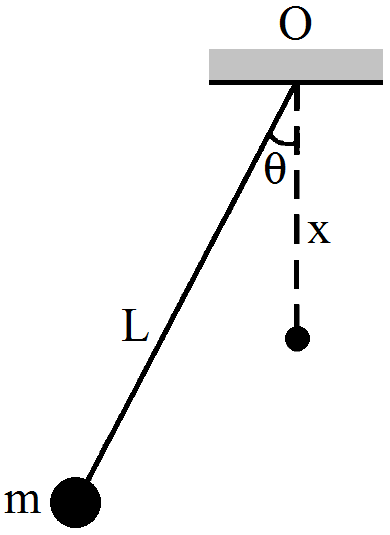
A simple pendulum of length L having a bob of mass m is deflected from its rest position by an angle $\theta$ and released (figure). The string hits a peg which is fixed at a distance x below the point of suspension and the bob starts going in a circle centred at the peg.
  1. Assuming that initially the bob has a height less than the peg, show that the maximum height reached by the bob equals its initial height.
  2. If the pendulum is released with $\theta=90^\circ$ and $\text{x}=\frac{\text{L}}{2}$ find the maximum height reached by the bob above its lowest position before the string becomes slack.
  3. Find the minimum value of $\frac{\text{x}}{\text{L}}$ for which the bob goes in a complete circle about the peg when the pendulum is released from $\theta=90^\circ.$

Show that for a particle in linear SHM the average kinetic energy over a period of oscillation equals the average potential energy over the same period.