Question
  1. Define isothermal process. Derive an expression for work done during isothermal process.
  2. A refrigerator is to remove heat from the eatables kept inside at 10°C. Calculate the coefficient of performance if room temperature is 36°C.

Answer

  1. Isothermal process is a change in pressure and volume of a gas without any change in its temperature. In such a change, there is a free exchange of heat between the gas and its surroundings.

For a small change in volume, work done is given by

dW = PdV

We know, PV = nRT

$\therefore\text{P}=\frac{\text{nRT}}{\text{V}}$

For T = constant,

$\text{dW}=\text{nRT}\frac{\text{dV}}{\text{V}}$

Net work done under isothermal condition to change the volume from Vi to Vf is,

$\text{W}=\int\limits^{\text{V}_\text{f}}_{\text{V}_\text{i}}\text{dW}=\text{nRT}\int\limits^{\text{V}_\text{f}}_{\text{V}_\text{i}}\frac{\text{dV}}{\text{V}}$

$=\text{nRT}\big|\log_\text{e}\text{V}\big|^{\text{V}_\text{f}}_{\text{V}_\text{i}}$

$\text{W}=\text{nRT }\log_\text{e}\Big(\frac{\text{V}_\text{f}}{\text{V}_\text{i}}\Big)$

$\therefore\text{W}=2.3026\text{ nRT }\log_\text{10}\Big(\frac{\text{V}_\text{f}}{\text{V}_\text{i}}\Big)$

Where n is the number of moles. If Pf and Pi are the pressures, we can also write,

$\text{W}=2.3026\ \text{nRT }\log_{10}\Big(\frac{\text{P}_\text{i}}{\text{P}_\text{f}}\Big)$

  1. Coefficient of performance, $\beta=\frac{\text{T}_2}{\text{T}_1-\text{T}_2}$

$\because\text{T}_1=36 +273=309\text{K}$

and $\text{T}_2=10+273=283\text{K}$

$\therefore\beta=\frac{283}{309-283}=\frac{283}{26}=10.8$

Need a full question paper?

Generate a complete, print-ready paper with questions like this in minutes — across 16+ boards, with answer keys.
Start Generating Free

Similar questions

The transverse displacement of a string (clamped at its both ends) is given by
$\text{y}(\text{x, t})=0.06\sin\Big(\frac{2\pi}{3}\text{x}\Big)\cos(120\pi\text{ t})$
where x and y are in m and t in s. The length of the string is 1.5m and its mass is 3.0 × 10–2kg.
Answer the following:
Interpret the wave as a superposition of two waves travelling in opposite directions. What is the wavelength, frequency, and speed of each wave?
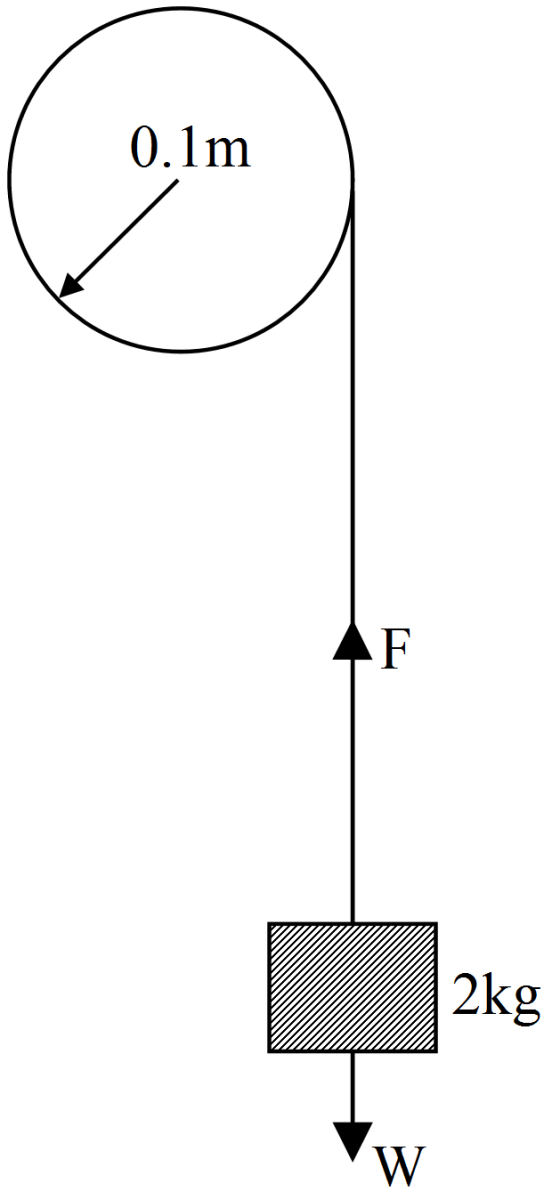
The moment of inertia of a solid flywheel about its axis is 0.1kg-m2. A tangential force of 2kg/ wt is applied round the circumference of the flywheel with the help of a string and mass arrangement as shown in Fig. If the radius of the wheel is 0.1m, find the acceleration of the mass.

  1. Define viscosity. Write SI units of coefficient of viscosity.
  2. Define terminal velocity. Establish an expression for it.
A particle executes simple harmonic motion of amplitude A.
i. At what distance from the mean position is its kinetic energy equal to its potential energy?
ii. At what points is its speed half the maximum speed?
Prove that the distance covered by a uniformly accelerated body in $n ^{\text {th }}$ second
$
s_n=u+\frac{1}{2} a(2 n-1)
$
A source of sound emitting a 1200Hz note travelg along a straight line at a speed of 170m/s. A detector is placed at a distance of 200m from the line of motion of the source.
  1. Find the frequency of sound received by the detector at the instant when the source gets closest to it.
  2. Find the distance between the source and the detector at the instant it detects the frequency 1200Hz. Velocity of sound in air = 340m/s.
One end of a long string of linear mass density 8.0 × 10⁻³kg m–1 is connected to an electrically driven tuning fork of frequency 256Hz. The other end passes over a pulley and is tied to a pan containing a mass of 90kg. The pulley end absorbs all the incoming energy so that reflected waves at this end have negligible amplitude. At t = 0, the left end (fork end) of the string x = 0 has zero transverse displacement (y = 0) and is moving along positive y-direction. The amplitude of the wave is 5.0cm. Write down the transverse displacement y as function of x and t that describes the wave on the string.
Derive the formula for work done of stretched a wire.### The length of a wire is $L$, when a weight Mg is suspended on it, it length is increased by $\Delta L$ then prove that the work done is
$ W =\frac{1}{2} \text { Stress } \times \text { Strain }$
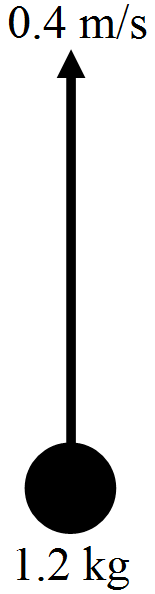
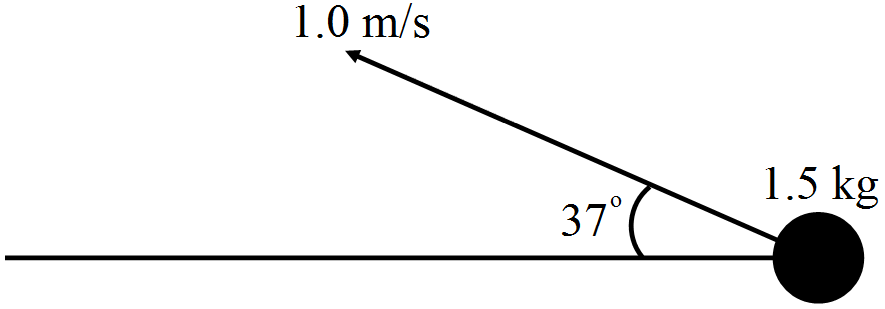
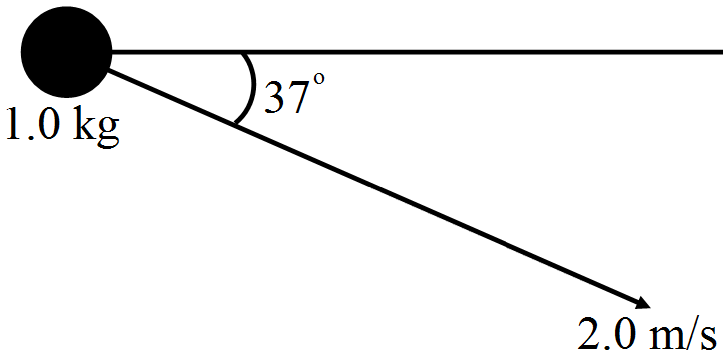
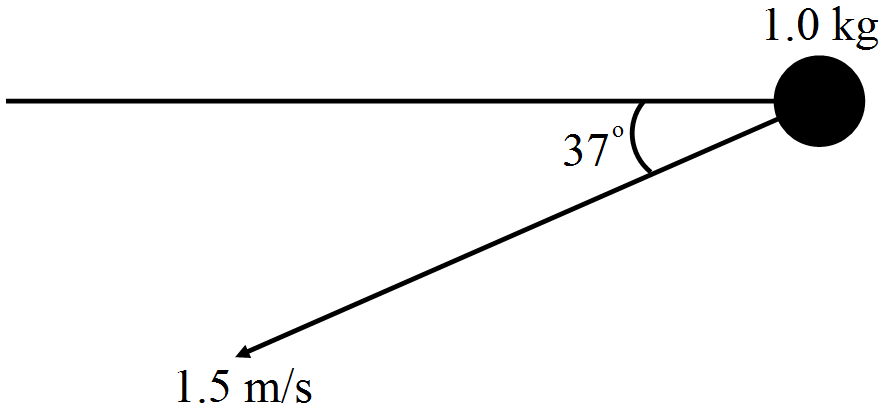
Calculate the velocity of the centre of mass of the system of particles shown in figure.


A truck is pulling a car out of a ditch by means of a steel cable that is 9.1m long and has a radius of 5mm. When the car just begins to move, the tension in the cable is 800N. How much has the cable stretched?
(Young’s modulus for steel is 2 × 10¹¹N m–2.)