MCQ
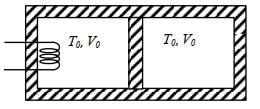
A thermally insulating cylinder has a thermally insulating and frictionless movable partition in the middle, as shown in the figure below. On each side of the partition, there is one mole of an ideal gas, with specific heat at constant volume, $C_v=2 R$. Here, $R$ is the gas constant. Initially, each side has a volume $V_0$ and temperature $T_0$. The left side has an electric heater, which is turned on at very low power to transfer heat $Q$ to the gas on the left side. As a result the partition moves slowly towards the right reducing the right side volume to $V_0 / 2$. Consequently, the gas temperatures on the left and the right sides become $T_L$ and $T_R$, respectively. Ignore the changes in the temperatures of the cylinder, heater and the partition.

($1$) The value of $\frac{T_R}{T_0}$ is

$(A)$ $\sqrt{2}$ $(B)$ $\sqrt{3}$ $(C)$ $2$ $(D)$ $3$

($2$) The value of $\frac{Q}{R T_0}$ is

$(A)$ $4(2 \sqrt{2}+1)$ $(B)$ $4(2 \sqrt{2}-1)$ $(C)$ $(5 \sqrt{2}+1)$ $(D)$ $(5 \sqrt{2}-1)$

Give the answer or qution ($1$) and ($2$)
  • A
    $A,C$
  • B
    $A,D$
  • $A,B$
  • D
    $A,B,C$

Answer

Correct option: C.
$A,B$
c
$\text { Finally } V _{ L }=\frac{3 V _0}{2}, V _{ R }=\frac{ V _0}{2}$

$C _{ V }=\frac{ R }{\gamma-1}=2 R \Rightarrow \gamma-1=\frac{1}{2}$

$\gamma=\frac{3}{2}$

$T _0 V _0^{\gamma-1}= T _{ R }\left(\frac{ V _0}{2}\right)^{\gamma-1}$

$\frac{ T _{ R }}{ T _0}=\sqrt{2}$

$\rho\left(\frac{ V _0}{2}\right)^\gamma= P _0 V _0^\gamma \Rightarrow P = P _0 \times 2^{\frac{3}{2}}$

$\frac{ PV }{ T _{ L }}=\frac{ P _0 V _0}{ T _0} \Rightarrow T _{ L }=2^{\frac{3}{2}} \times \frac{3}{2} T _0=3 \sqrt{2} T _0$

$Q = nC C _{ V } \Delta T _1+ nC V _{ V } \Delta T _2$

$=1 \times 2 R \times(3 \sqrt{2}-1) T _0+1 \times 2 R \times(\sqrt{2}-1) T _0$

$\frac{ Q }{ R }=2(3 \sqrt{2}-1)+2(\sqrt{2}-1)=8 \sqrt{2}-4$

Need a full question paper?

Generate a complete, print-ready paper with questions like this in minutes — across 16+ boards, with answer keys.

Start Generating Free

Similar questions

To show that a simple pendulum executes simple harmonic motion, it is necessary to assume that
A solid body of constant heat capacity $1\,J /{ }^{\circ} C$ is being heated by keeping it in contact with reservoirs in two ways :

$(i)$ Sequentially keeping in contact with $2$ reservoirs such that each reservoir supplies same amount of heat.

$(ii)$ Sequentially keeping in contact with 8 reservoirs such that each reservoir supplies same amount of heat.

In both the cases body is brought from initial temperature $100^{\circ}\,C$ to final temperature $200^{\circ}\,C$. Entropy change of the body in the two cases respectively is :

How much amount of energy is liberated to convert $1\ kg$ of coal into energy?
Sound wave travels with a velocity of $300\, m\, s^{-1}$ through a gas. $9\, beats$ are produced in $3\, s$ when two waves pass through it simultaneously. If one of the waves has $2\, m$ wavelength, the wavelength of the other wave is ..... $m$
When a gas is in thermal equilibrium, its molecules:
A source of sound $S$ having frequency $f.$ Wind is blowing from source to observer $O$ with velocity $u$. If speed of sound with respect to air is $C,$ the wavelength of sound detected by $O$ is: 
When a tuning fork $A$ of unknown frequency is sounded with another tuning fork $B$ of frequency $256 Hz$, then $3$ beats per second are observed. After that $A$ is loaded with wax and sounded, the again $3$ beats per second are observed. The frequency of the tuning fork $A$ is ..... $Hz$
A solid cube of wood of side $2 a$ and mass $M$ is resting on a horizontal surface as shown in the figure below. The cube is free to rotate about a fixed axis $A B . A$ bullet of mass $m( < < M)$ and speed $v$ is shot horizontally at the face opposite to $A B C D$ at a height of $4 a / 3$ from the surface to impart the cube an angular speed $\omega$. It strikes the face embeds in the cube. Then, $\omega$ is close to (Note : The moment of inertia of the cube about an axis perpendicular to the face and passing through the centre of mass is $\left.2 M a^2 / 3\right)$
A light planet is revolving around a massive star in a circular orbit of radius $R$ with a period of revolution $T$. If the force of attraction between planet and star is proportional to $\mathrm{R}^{-3 / 2}$ then choose the correct option :
The component of a vector is: