MCQ
A thermo-dynamical system is changed from state $({P_1},\,{V_1})$ to $({P_2},\,{V_2})$ by two different process. The quantity which will remain same will be
  • A
    $\Delta \,Q$
  • B
    $\Delta \,W$
  • C
    $\Delta Q + \Delta W$
  • $\Delta Q - \Delta W$

Answer

Correct option: D.
$\Delta Q - \Delta W$
d
Change in internal energy does not depend upon path so $\Delta U = \Delta Q - \Delta W$ remain constant.

Need a full question paper?

Generate a complete, print-ready paper with questions like this in minutes — across 16+ boards, with answer keys.
Start Generating Free

Similar questions

A projectile of mass $M$ is fired so that the horizontal range is $4\, km$. At the highest point the projectile explodes in two parts of masses $M/4$ and $3M/4$ respectively and the heavier part starts falling down vertically with zero initial speed. The horizontal range (distance from point of firing) of the lighter part is .................. $\mathrm{km}$
A body of mass $1\, kg$ is under a force, which causes a displacement in it is given by $x = \frac{{{t^3}}}{3}$ (in $m$). Find the work done by the force in first second ............ $\mathrm{J}$
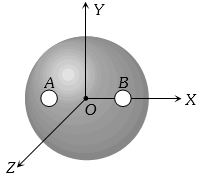
A solid sphere of uniform density and radius $4$ units is located with its centre at the origin $O$ of coordinates. Two spheres of equal radii $1$ unit with their centres at $A(-2, 0, 0)$ and $B(2, 0, 0)$ respectively are taken out of the solid leaving behind spherical cavities as shown in figure
The dimensions of impulse are equal to that of
$c_P$ and $c_V$ are specific heats at constant pressure and constant volume respectively. It is observed that

$c_P - c_V = a$ for hydrogen gas

$c_P - c_V = b$ for nitrogen gas

The correct relation between $a$ and $b$ is

$List I$ describes thermodynamic processes in four different systems. $List II$ gives the magnitudes (either exactly or as a close approximation) of possible changes in the internal energy of the system due to the process.

$List-I$ $List-II$
($I$) $10^{-3} kg$ of water at $100^{\circ} C$ is converted to steam at the same temperature, at a pressure of $10^5 Pa$. The volume of the system changes from $10^{-6} m ^3$ to $10^{-3} m ^3$ in the process. Latent heat of water $=2250 kJ / kg$. ($P$) $2 kJ$
($II$) $0.2$ moles of a rigid diatomic ideal gas with volume $V$ at temperature $500 K$ undergoes an isobaric expansion to volume $3 V$. Assume $R=8.0 Jmol ^1 K^{-1}$. ($Q$) $7 kJ$
($III$) On mole of a monatomic ideal gas is compressed adiabatically from volume $V=\frac{1}{3} m^3$ and pressure $2 kPa$ to volume $\frac{v}{8}$ ($R$) $4 kJ$
($IV$) Three moles of a diatomic ideal gas whose molecules can vibrate, is given $9 kJ$ of heat and undergoes isobaric expansion. ($S$) $5 kJ$
  ($T$) $3 kJ$

Which one of the following options is correct?
Longitudinal stress of $1\,kg/m{m^2}$ is applied on a wire. The percentage increase in length is $(Y = {10^{11}}\,N/{m^2})$
A rod is fixed between two points at $20°C$. The coefficient of linear expansion of material of rod is $1.1 \times {10^{ - 5}}/^\circ C$ and Young's modulus is $1.2 \times {10^{11}}\,N/m$. Find the stress developed in the rod if temperature of rod becomes $10°C$
In a coaxial, straight cable, the central conductor and the outer conductor carry equal currents in opposite directions. The magnetic field is zero:
  1. Outside the cable.
  2. Inside the inner conductor.
  3. Inside the outer conductor.
  4. In between the tow conductors.
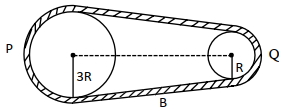
In the given figure, two wheels $P$ and $Q$ are connected by a belt $B$. The radius of $P$ is three times as that of $Q$. In case of same rotational kinetic energy, the ratio of rotational inertias $\left(\frac{{I}_{1}}{{I}_{2}}\right)$ will be ${x}: 1$. The value of ${x}$ will be $.....\, .$