MCQ
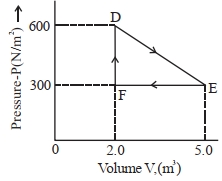
A thermodynamic system is taken from an original state $D$ to an intermediate state $E$ by the linear process shown in the figure. Its volume is then reduced to the original volume from $E$ to $F$ by an isobaric process. The total work done by the gas from $D$ to $E$ to $F$ will be $......J$
  • A
    $-450$
  • $450$
  • C
    $900$
  • D
    $1350$

Answer

Correct option: B.
$450$
b
$W _{ DE }=\frac{1}{2}(600+300) 3\,J$

$=1350\,J$

$W _{ EF }=-300 \times 3=-900\,J$

$W _{ DEF }=450\,J$

Need a full question paper?

Generate a complete, print-ready paper with questions like this in minutes — across 16+ boards, with answer keys.

Start Generating Free

Similar questions

A block of mass $1\,kg$ lies on a horizontal surface in a truck. The coefficient of static friction between the block and the surface is $0.6$ . If the acceleration of the truck is $5\,m\,s^{-2}$ . The frictional force acting on the block is ........ $N$ 
Two waves of lengths $50 \;cm$ and $51\; cm$ produced $12$ beats per second. The velocity of sound is .... $m/s$
If Planck’s constant (h) and speed of light in vacuum (c) are taken as two fundamental quantities, which one of the following can, in addition, be taken to express length, mass and time in terms of the three chosen fundamental quantities?
How many times is escape velocity $({V_e})$, of orbital velocity $({V_0})$ for a satellite revolving near earth
A particle which is simultaneously subjected to two perpendicular simple harmonic motions represented by; $x = {a_1}\,\cos \,\omega t$ and $y = {a_2}\,\cos \,2\,\omega t$ traces a curve given by
A particle executes simple harmonic motion with a frequency v. The frequency with which the kinetic energy oscillates is:
  1. $\frac{\text{v}}{2}$
  2. v
  3. 2v
  4. zero
The average translational kinetic energy of a hydrogen gas molecules at $NTP$ will be

[Boltzmann’s constant ${k_B} = 1.38 \times {10^{ - 23}}J/K]$

A solid sphere and a disc of same mass and radius starts rolling down a rough inclined plane, from the same height the ratio of the time taken in the two cases is
In an inelastic collision:
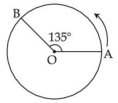
A person moved from $A$ to $B$ on a circular path as shown in figure. If the distance travelled by him is $60 \,m$, then the magnitude of displacement would be$.....\,m$ (Given $\left.\cos 135^{\circ}=-0.7\right)$