MCQ
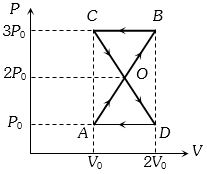
A thermodynamic system undergoes cyclic process $ABCDA $ as shown in figure. The work done by the system in the cycle is
  • A
    ${P_0}{V_0}$
  • B
    $2{P_0}{V_0}$
  • C
    $\frac{{{P_0}{V_0}}}{2}$
  • Zero

Answer

Correct option: D.
Zero
d
(d) $W_{BCOB} = -$ Area of triangle $BCO   = - \frac{{{P_0}{V_0}}}{2}$ 

$W_{AODA} = + $ Area of triangle $AOD  = + \frac{{{P_0}{V_0}}}{2}$

Need a full question paper?

Generate a complete, print-ready paper with questions like this in minutes — across 16+ boards, with answer keys.

Start Generating Free

Similar questions

The intensity of sound after passing through a slab decreases by $30\%$. On passing through two such slabs, the intensity will decrease by ..... $\%$
A black body calorimeter filled with hot water cools from $60^o C$ to $50^o C$ in $4 \,\,min$ and $40^o C$ to $30^o C$ in $8 \,\min$. The approximate temperature of surrounding is  ........ $^oC$
A mosquito is moving with a velocity $\overrightarrow{ v }=0.5 t ^{2} \hat{ i }+3 t \hat{ j }+9 \hat{ k }\, m / s$ and accelerating in uniform conditions. What will be the direction of mosquito after $2 \,s$ ?
A projectile is fired at a speed of $100\, m/sec$ at an angle of $37^o$ above the horizontal. At the highest point, the projectile breaks into two parts of mass ratio $1:3$, the smaller coming to rest. Then the distance of heavier part from the launching point is ........... $m$.
Find the quantity of heat required to convert $40\; gm$ of ice at $-20^{\circ} C$ into water at $20^{\circ} C$. Given $L _{\text {ice }}$ $=0.336 \times 10^6 J / kg$.

specific heat of ice $=2100 \;J / kg - K$ sp heat of water= $4200\; J / kg - K$
A particle is revolving in a circular path of radius $25 \,m$ with constant angular speed $12 \,rev/min$. Then the angular acceleration of particle is .......... $rad / s ^2$
If the temperature increases, the modulus of elasticity
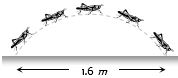
A grasshopper can jump maximum distance $1.6\; m$. It negligible time of the ground. How far can it go in $10 \;s$?
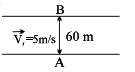
A man is crossing a river flowing with velocity of $5\,\, m/s$. He reaches a point directly across at a distance of $60\,\, m$ in $5 \,\,sec$. His velocity in still water should be ........ $m/s$
A spherical ball of radius $r$ and relative density $0.5$ is floating in equilibrium in water with half of it immersed in water. The work done in pushing the ball down so that whole of it is just immersed in water is : (where $\rho $ is the density of water)