MCQ
A thick $-$ walled hollow sphere has outside radius $R_0$. It rolls down an incline without slipping and its speed at the bottom is $v_0$. Now the incline is waxed, so that it is practically frictionless and the sphere is observed to slide down $($without any rolling$)$. Its speed at the bottom is observed to be $5{v_0}/4$. The radius of gyration of the hollow sphere about an axis through its centre is
  • A
    $3R_0/2$
  • B
    $3R_0/4$
  • C
    $9R_0/16$
  • D
    $3R_0$

Answer

When body rolls dawn on inclined plane with velocity $V_0$ at bottom then body has both rotational and translational kinetic energy.
Thereforce, by law of conservation of energy,
$P.E\, = \,K.{E_\text{ trans}} + K.{E_\text{ rotational}}$
$= \frac{1}{2}mV_0^2 + \frac{1}{2}I{\omega ^2}$
$= \frac{1}{2}mV_0^2 + \frac{1}{2}m{k^2}\frac{{V_0^2}}{{R_0^2}},...\left( i \right)$
$\left[ {I = m{k^2},\omega = \frac{V}{{{R_0}}}} \right]$
When body is sliding down then body has only translatory motion.
$\therefore P.E = K.{E_\text{ trans}}$
$ = \frac{1}{2}m{\left( {\frac{5}{4}{v_0}} \right)^2}...\left( {ii} \right)$
Dividing $(i)$ by $(ii)$ we get
$\frac{{P.E}}{{P.E}} = \frac{{\frac{1}{2}mv_0^2\left[ {1 + \frac{{{K^2}}}{{R_0^2}}} \right]}}{{\frac{1}{2} \times \frac{{25}}{{16}} \times mV_0^2}}$
$= \frac{{25}}{{16}} = 1 + \frac{{{K^2}}}{{R_0^2}} $
$\Rightarrow \frac{{{K^2}}}{{R_0^2}} = \frac{9}{{16}}$
or $,K = \frac{3}{4}\,{R_{0.}}$

Need a full question paper?

Generate a complete, print-ready paper with questions like this in minutes — across 16+ boards, with answer keys.

Start Generating Free

Similar questions

A metal ball of density $7800\  kg/m^3$ is suspected to have a large number of cavities . It weighs $9.8$ $kg$ when weighed directly on a balance and $1.5$ $kg$ less when immersed in water . The fraction by volume of the cavities in the metal ball is approximately ....... $\%$
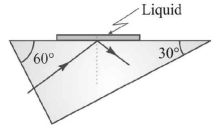
On a hypotenuse of a right angle prism $\left(30^{\circ}-60^{\circ}\right.$ $-90^{\circ}$ ) of refractive index $1.50$, a drop of liquid is placed as shown in figure. Light is allowed to fall normally on the short face of the prism. In order that the ray of light may get totally reflected, the maximum value of refractive index is:
The nucleus $_{48}^{115}Cd$ after two successive ${\beta ^ - }$ decays will give
The tension in the spring is ............ $N$
A student is performing the experiment of resonance column. The diameter of the column tube is $6 \,cm$. The frequency of the tuning fork is $504\, Hz$. Speed of the sound at the given temperature is $336\, m / s$. The zero of the meter scale coincides with the top end of the resonance column tube. The reading of the water level in the column when the first resonance occurs is..........$cm$
Two simple harmonic motions of angular frequency $100$ and $1000\,\,rad\,s^{-1}$ have the same displacement amplitude. The ratio of their maximum acceleration is
An external pressure $P$ is applied on a cube at $0^o C$ so that it is equally compressed from all sides. $K$ is the bulk modulus of the material of the cube and a is its coefficient of linear expansion. Suppose we want to bring the cube to its original size by heating. The temperature should be raised by
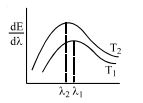
The spectral emissive power $E_\lambda $ for a body at temperature $T_1$ is plotted against the wavelength and area under the curve is found to be $A$. At a different temperature $T_2$ the area is found to be $9A$. Then $\lambda _1/\lambda _2 =$
A small steel ball is dropped into a long cylinder containing glycerine. Which one of the following is the correct representation of the velocity time graph for the transit of the ball?
A ray of light suffers minimum deviation when incident on a $60^o$ prism of refractive index $\sqrt 2$ . The angle of incidence is......$^o$