MCQ
The tension in the spring is ............ $N$

  • A
    $0$
  • B
    $2.5$
  • $5$
  • D
    $10$

Answer

Correct option: C.
$5$
c
(c) $5\,N$ force will not produce any tension in spring without support of other $5\,N$ force. So here the tension in the spring will be $5\,N$ only.

Need a full question paper?

Generate a complete, print-ready paper with questions like this in minutes — across 16+ boards, with answer keys.

Start Generating Free

Similar questions

In Bohr’s model, if the atomic radius of the first orbit is ${r_0}$, then the radius of the fourth orbit is
A helicopter reises from rest on the ground vertically upwards with a constant acceleration $g.$ A food packet is dropped from the helicopter when it is a height $h$. The time taken by the packet to reach the ground is close to $[ g$ is the acceleration due to gravity]
Two identical charged spheres are suspended by string of equal lengths. The string make an angle of $37^{\circ}$ with each other. When suspended in a liquid of density $0.7 \mathrm{~g} / \mathrm{cm}^3$, the angle remains same. If density of material of the sphere is $1.4 \mathrm{~g} / \mathrm{cm}^3$, the dielectric constant of the liquid is_____$\left(\tan 37^{\circ}=\frac{3}{4}\right)$.
A motor boat is travelling with a speed of $3.0\, m/sec$. If the force on it due to water flow is $500\, N$, the power of the boat is
$Assertion$ : $n$ small balls each of mass $m$ colliding elastically each second on surface with velocity $u$. The force experienced by the surface is $2\,mnu$.

$Reason$ : On elastic collision, the ball rebounds with the same velocity.

Which of the following is a unit that of force?
Statement $I :$Two forces $(\overrightarrow{{P}}+\overrightarrow{{Q}})$ and $(\overrightarrow{{P}}-\overrightarrow{{Q}})$ where $\overrightarrow{{P}} \perp \overrightarrow{{Q}}$, when act at an angle $\theta_{1}$ to each other, the magnitude of their resultant is $\sqrt{3\left({P}^{2}+{Q}^{2}\right)}$, when they act at an angle $\theta_{2}$, the magnitude of their resultant becomes $\sqrt{2\left({P}^{2}+{Q}^{2}\right)}$. This is possible only when $\theta_{1}<\theta_{2}$.

Statement $II :$ In the situation given above. $\theta_{1}=60^{\circ} \text { and } \theta_{2}=90^{\circ}$ In the light of the above statements, choose the most appropriate answer from the options given below

Two rails of a railway track insulated from each other and the ground are connected to a milli voltmeter. What is the reading of voltmeter, when a train travels with a speed of $180$ $km/hr$ along the track. Given that the vertical component of earth's magnetic field is $0.2 \times {10^{ - 4}}\,weber/{m^2}$ and the rails are separated by $1$ metre
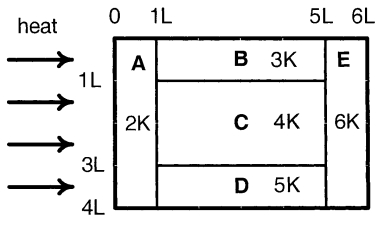
A composite block is made of slabs $A, B, C, D$ and $E$ of different thermal conductivities (given in terms of a constant $K$ ) and sizes (given in terms of length, $L$ ) as shown in the figure. All slabs are of same width. Heat $'Q'$ flows only from left to right through the blocks. Then in steady state $Image$

$(A)$ heat flow through $A$ and $E$ slabs are same.

$(B)$ heat flow through slab $E$ is maximum.

$(C)$ temperature difference across slab $E$ is smallest.

$(D)$ heat flow through $C =$ heat flow through $B +$ heat flow through $D$.
Match List$-I$ with List$-II$
  $LIST-I$   $LIST-II$
$A.$ Torque $I.$ $[M^1 L^1 T^{-2}A^{-2} ]$
$B.$ Magnetic field $II.$ $[L^2 A^1 ]$
$C.$ Magnetic moment $III.$ $[M^1T^{-2} A^{-1} ]$
$D.$ Permeability of free space $IV.$ $[M^1 L^2 T^{-2} ]$
Choose the correct answer from the options given below :