A thick wire is stretched so that its length become two times. Assuming that there is no change in its density, then what is the ratio of change in resistance of wire to the initial resistance of wire
Medium
Download our app for free and get started
(c) In stretching $R \propto {l^2}$ $ \Rightarrow $ $\frac{{{R_2}}}{{{R_1}}} = \frac{{{l_2}^2}}{{{l_1}^2}}$ $ \Rightarrow $ $\frac{{{R_2}}}{{{R_1}}} = {\left( {\frac{2}{1}} \right)^2}$
$ \Rightarrow $${R_2} = 4{R_1}$. Change in resistance $ = {R_2} - {R_1} = 3{R_1}$
Now, $\frac{{{\rm{Change}}\,\,{\rm{in}}\,\,{\rm{resistance}}}}{{{\rm{Original}}\,\,{\rm{resistance}}}} = \frac{{3{R_1}}}{{{R_1}}} = \frac{3}{1}$

Download our appand get started for free
Experience the future of education. Simply download our apps or reach out to us for more information. Let's shape the future of learning together!No signup needed.*
Similar Questions
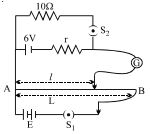
- 1In the arrangement shown in figure when the switch $S_2$ is open, the galvanometer shows no deflection for $l = L/2$. When the switch $S_2$ is closed, the galvanometer shows no deflection for $l = 5L /12$ . The internal resistance $(r)$ of $6\, V$ cell, and the $\mathrm{emf}$ $E$ of the other battery are respectivelyView Solution
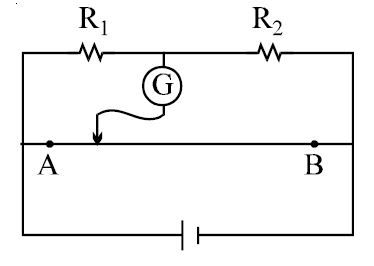
- 2In the figure shown for gives values of $R_1$ and $R_2$ the balance point for Jockey is at $40\,cm$ from $A$. When $R_2$ is shunted by a resistance of $10\, \Omega$ , balance shifts to $50\,cm.$ $R_1$ and $R_2$ are $(AB = 1 \,m)$View Solution
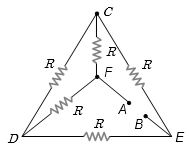
- 3Five equal resistances each of resistance $R$ are connected as shown in the figure. A battery of $V\, volts$ is connected between $A$ and $B$. The current flowing in $AFCEB$ will beView Solution
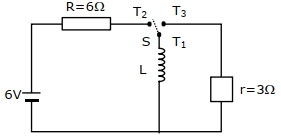
- 4Consider an electrical circuit containing a two way switch $^{\prime}{S}^{\prime}$. Initially ${S}$ is open and then ${T}_{1}$ is connected to ${T}_{2} .$ As the current in ${R}=6 \,\Omega$ attains a maximum value of steady state level, ${T}_{1}$ is disconnected from ${T}_{2}$ and immediately connected to ${T}_{3} .$ Potential drop across ${r}=3\, \Omega$ resistor immediately after $T_{1}$ is connected to $T_{3}$ is $....\,V.$ (Round off to the Nearest Integer)View Solution
- 5$n$ equal resistors are first connected in series and then connected in parallel. What is the ratio of the maximum to the minimum resistanceView Solution
- 6The internal resistance of a $2.1\, V$ cell which gives a current of $0.2\, A$ through a resistance of $10\,\Omega$ is ............. $\Omega$View Solution
- 7If resistance of voltmeter is $10000 \,\Omega$ and resistance of ammeter is $2 \,\Omega$ then find $R$ when voltmeter reads $12\,V$ and ammeter reads $0.1\, A$ ............... $\Omega$View Solution
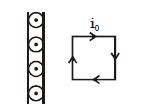
- 8Figure shows a cross-section of a large-section of an infinite metal sheet carrying an electric current along its surface. The current per unit length is $J$ . A current carrying square loop is placed nearby the metal sheet such that the plane of square is perpendicular to the plane of sheet thenView Solution
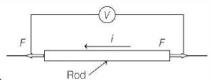
- 9As shown in the schematic below, a rod of uniform cross-sectional area $A$ and length $l$ is carrying a constant current $i$ through it and voltage across the rod is measured using an ideal voltmeter. The rod is stretched by the application of a force $F$. Which of the following graphs would show the variation in the voltage across the rod as function of the strain $\varepsilon$ when the strain is small. Neglect Joule heating.View Solution
- 10In order to increase the resistance of a given wire of uniform cross section to four times its value, a fraction of its length is stretched uniformly till the full length of the wire becomes $\frac{3}{2}$ times the original length what is the value of this fraction?View Solution