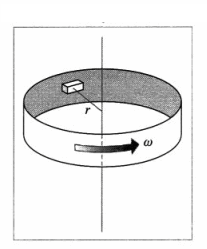
A thin cylindrical shell of inner radius 1.5 m rotates horizontally, about a vertical axis, at an angular speed ω. A wooden block rests against the inner surface and rotates with it. If the coefficient of static friction between block and surface is 0.3, how fast must the shell be rotating if the block is not to slip and fall ?
Q 47.6
Download our app for free and get started
Data : $\mathrm{r}=1.5 \mathrm{~m}, \mu_{\mathrm{s}}=0.3$ The normal force $\vec{N}$ of the shell on the block is the centripetal force which holds the block in place. $\vec{N}$ determines the friction on the block, which in turn keeps it from sliding downward. If the block is not to slip, the friction force $\overrightarrow{f_{\mathrm{s}}}$ must balance the weight $m \vec{g}$ of the block. $ \begin{aligned} & \therefore N=m \omega^2 r \text { and } f_s=\mu_s N=m g \\ & \therefore \mu_s\left(\omega^2 r\right)=m g \\ & \therefore \omega=\sqrt{\frac{g}{\mu_s r}}=\sqrt{\frac{10}{(0.3)(1.5)}}=\sqrt{\frac{10}{0.45}} \\ & \quad=\sqrt{22.22}=4.714 \mathrm{rad} / \mathrm{s}=\frac{4.714}{2 \pi}=0.75 \mathrm{rev} / \mathrm{s} \end{aligned} $ This gives the required angular speed.
Download our app
and get started for free
Experience the future of education. Simply download our apps or reach out to us for more information. Let's shape the future of learning together!No signup needed.*
A solid sphere of radius $R$, rotating with an angular velocity $\omega$ about its diameter, suddenly stops rotating and $75 \%$ of its $\mathrm{KE}$ is converted into heat. If $\mathrm{c}$ is the specific heat capacity of the material in SI units, show that the temperature of $3 \mathrm{R}^2 \mathrm{CO}^2$ the sphere rises by $\frac{3 R^2 \omega^2}{20 c}$.
A flywheel of mass $4 \mathrm{~kg}$ and radius $10 \mathrm{~cm}$, rotating with a uniform angular velocity of $5 \mathrm{rad} / \mathrm{s}$, is subjected to a torque of $0.01 \mathrm{~N}$.m for 10 seconds. If the torque increases the speed of rotation, find (i) the final angular velocity of the flywheel (ii) the change in its angular velocity (iii) the change in its angular momentum (iv) the change in its kinetic energy.
A string of length $0.5 \mathrm{~m}$ carries a bob of mass $0.1 \mathrm{~kg}$ at its end. If this is to be used as a conical pendulum of period $0.4 \pi \mathrm{s}$, calculate the angle of inclination of the string with the vertical and the tension in the string.
Find the moment of inertia of a hydrogen molecule about its centre of mass if the mass of each hydrogen atom is $m$ and the distance between them is $R$.
Define the period and frequency of revolution of a particle performing uniform circular motion (UCM) and state expressions for them. Also state their SI units.
A horizontal disc is rotating about a transverse axis through its centre at $100 \mathrm{rpm}$. A $20 \mathrm{gram}$ blob of wax falls on the disc and sticks to it at $5 \mathrm{~cm}$ from its axis. The moment of inertia of the disc about its axis passing through its centre is $2 \times 10^{-4} \mathrm{~kg} \cdot \mathrm{m}^2$. Calculate the new frequency of rotation of the disc.
A small body of mass $0.3 \mathrm{~kg}$ oscillates in a vertical plane with the help of a string $0.5 \mathrm{~m}$ long with a constant speed of $2 \mathrm{~m} / \mathrm{s}$. It makes an angle of $60^{\circ}$ with the vertical. Calculate the tension in the string.