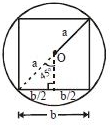
A thin circular frame of radius $'a'$ is made of insulating material. A square loop is constructed with in it. If loop carrying current $I$ , then magnetic induction at geometrical centre $'O'$ will be
A$\frac{{2{\mu _0}I}}{{\pi a}}$
B$\frac{{\sqrt 3 {\mu _0}I}}{{2\pi a}}$
C$\frac{{2\sqrt 2 {\mu _0}I}}{{\pi a}}$
D$\frac{{3\sqrt 3 {\mu _0}I}}{{2\pi a}}$
Medium
Download our app for free and get started
A$\frac{{2{\mu _0}I}}{{\pi a}}$
a $\mathrm{B}_{0}=\frac{2 \sqrt{2} \mu_{0} \mathrm{I}}{\pi \mathrm{b}}$
Experience the future of education. Simply download our apps or reach out to us for more information. Let's shape the future of learning together!No signup needed.*
The coil of a galvanometer consists of $100$ $turns$ and effective area of $1\, square-cm$. The restoring couple is ${10^{ - 8}}\,N - m/radian$. The magnetic field between the pole pieces is $5\, T$. The current sensitivity of this galvanometer will be
Two long current carrying conductors are placed parallel to each other at a distance of $8 \,cm$ between them. The magnitude of magnetic field produced at mid-point between the two conductors due to current flowing in them is $300 \,\mu T$. The equal current flowing in the two conductors is ...............
A charge moving with velocity $v$ in $X$-direction is subjected to a field of magnetic induction in the negative $X$-direction. As a result, the charge will
A long straight wire of radius a carries a steady current I. The current is uniformly distributed across its cross section. The ratio of the magnetic field at $\frac{a}{2}$ and $2$a from axis of the wire is:
To convert a $800\, mV$ range milli voltmeter of resistance $40 \,\Omega$ into a galvanometer of $100\, mA$ range, the resistance to be connected as shunt is .............. $\Omega $
A conducting loop carrying a current $I$ is placed in a uniform magnetic field pointing into the plane of the paper as shown. The loop will have a tendency to
A particle of specific charge (charge/mass) $\alpha$ starts moving from the origin under the action of an electric field $\vec E = {E_0}\hat i$ and magnetic field $\vec B = {B_0}\hat k$. Its velocity at $(x_0 , y_0 , 0)$ is ($(4\hat i + 3\hat j)$ . The value of $x_0$ is: