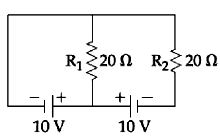
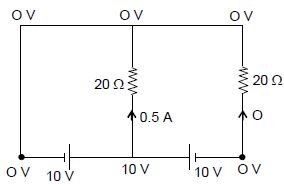
In the given circuit the cells have zero internal resistance. The currents (in Amperes) passing through resistance $R_1$ and $R_2$ respectively, are
JEE MAIN 2019, Medium


Download our appand get started for free
Experience the future of education. Simply download our apps or reach out to us for more information. Let's shape the future of learning together!No signup needed.*
Similar Questions
- 1A current of $5\; {A}$ is passing through a non-linear magnesium wire of cross-section $0.04\; {m}^{2}$. At every point the direction of current density is at an angle of $60^{\circ}$ with the unit vector of area of cross-section. The magnitude of electric field at every point of the conductor is ....${V} / {m}$ (Resistivity of magnesium is $\rho=44 \times 10^{-8}\, \Omega m$)View Solution
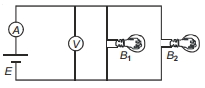
- 2Two identical bulbs are connected in parallel across an ideal source of emf $E$. The ammeter $A$ and voltmeter $V$ are ideal. If bulb $B_2$ gets fused, thenView Solution
- 3A railway compartment is lit up by thirteen lamps each taking $2.1\, amp$ at $15\, volts$. The heat generated per second in each lamp will be ............ $cal$View Solution
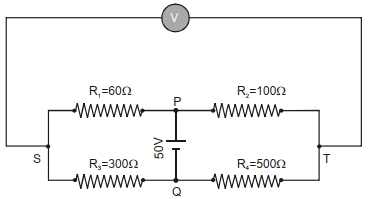
- 4In the balanced condition, the values of the resistances of the four arms of a Wheatstone bridge are shown in the figure below. The resistance $R_3$ has temperature coefficient $0.0004{ }^{\circ} C ^{-1}$. If the temperature of $R_3$ is increased by $100{ }^{\circ} C$, the voltage developed between $S$ and $T$ will be. . . . . . . volt.View Solution
- 5When two resistance $R_1$ and $R_2$ connected in series and introduced into the left gap of a meter bridge and a resistance of $10 \Omega$ is introduced into the right gap, a null point is found at $60 cm$ from left side. When $R_1$ and $R_2$ are connected in parallel and introduced into the left gap, a resistance of $3 \Omega$ is introduced into the right-gap to get null point at 40 cm from left end. The product of $R_1 R_2$ is $.............\Omega$View Solution
- 6View SolutionThe figure shows a network of four resistances and three batteries Which of the battery is getting charged.
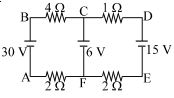
- 7View SolutionThe reading of the ammeter as shown in figure
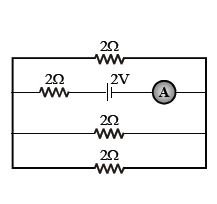
- 8Thomson coefficient of a conductor is $10\,\mu V/K$. The two ends of it are kept at ${50\,^o}C$ and ${60\,^o}C$ respectively. Amount of heat absorbed by the conductor when a charge of $10\,C$ flows through it isView Solution
- 9If you are provided three resistances $2 \,\Omega$, $3 \,\Omega$ and $6 \,\Omega$. How will you connect them so as to obtain the equivalent resistance of $4 \,\Omega$View Solution
- 10A potentiometer circuit has been set up for finding the internal resistance of a given cell. The main battery, used across the potentiometer wire, has an emf of $2.0\,V$ and a negligible internal resistance. The potentiometer wire itself is $4\,m$ long. When the resistance $R,$ connected across the given cell, has values of $(i)$ infinity $(ii)$ $9.5\,\Omega$ the balancing lengths on the potentiometer wire are found to be $3\,m$ and $2.85\,m,$ respectively. The value of internal resistance of the cell is ............... $\Omega$View Solution