Question
A thin circular loop of radius R rotates about its vertical diameter with an angular frequency $\omega.$ Show that a small bead on the wire loop remains at its lowermost point for $\omega\le\sqrt{\frac{\text{g}}{\text{R}}}.$ What is the angle made by the radius vector joining the centre to the bead with the vertical downward direction for $\omega=\sqrt{\frac{2\text{g}}{\text{R}}}?$ Neglect friction.
Answer

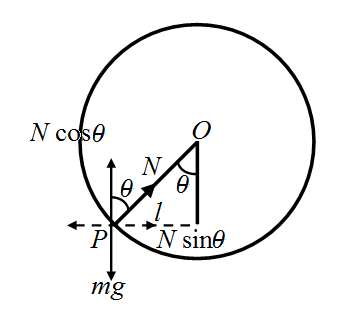
Let the radius vector joining the bead with the centre make an angle $\theta,$ with the vertical downward direction.

OP = R = Radius of the circle
N = Normal reaction
The respective vertical and horizontal equations of forces can be written as:
$\text{mg}=\text{N}\cos\theta\ ....(\text{i})$
$\text{ml}\omega=\text{N}\sin\theta\ ...(\text{ii})$
In $\triangle\text{OPQ},$ we have:
$\sin\theta=\frac{\text{l}}{\text{R}}$
$\text{l}=\text{R}\sin\theta\ ...(\text{iii})$
Substituting equation (iii) in equation (ii), we get:
$\text{m}(\text{R}\sin\theta)\omega^2=\text{N}\sin\theta$
$\text{mR}\omega^2=\text{N}\ ...(\text{iv})$
Substituting equation (iv) in equation (i), we get:
$\text{mg}=\text{mR}\omega^2\cos\theta$
$\cos\theta=\frac{\text{g}}{\text{R}\omega^2}\ ...(\text{v})$
Since $\cos\theta\le1,$ the bead will remain at its lowermost point for $\frac{\text{g}}{\text{R}\omega^2\le1},$ i.e., for $\omega\le\Big(\frac{\text{g}}{\text{R}}\Big)^{1/2}$
For $\omega=\Big(\frac{2\text{g}}{\text{R}}\Big)^{1/2}\ \text{or}\ \omega^2=\frac{2\text{g}}{\text{R}}\ ...(\text{vi})$ 
On equating equations (v) and (vi), we get:
$\frac{2\text{g}}{\text{R}}=\frac{\text{g}}{\text{R}\cos\theta}$
$\cos\theta=\frac{1}{2}$
$\therefore\theta=\cos^{-1}(0.5)=60^\circ$

Need a full question paper?

Generate a complete, print-ready paper with questions like this in minutes — across 16+ boards, with answer keys.

Start Generating Free

Similar questions

The volume of an ideal gas $(\gamma=1.5)$ is changed adiabatically from 4.00 litres to 3.00 litres. Find the ratio of,
  1. The final pressure to the initial pressure.
  2. The final temperature to the initial temperature.
A sound wave of frequency 100Hz is travelling in air. The speed of sound in air is 350m/s.
  1. By how much is the phase changed at a given point in 2.5ms?
  2. What is the phase difference at a given instant between two points separated by a distance of 10.0cm along the direction of propagation?
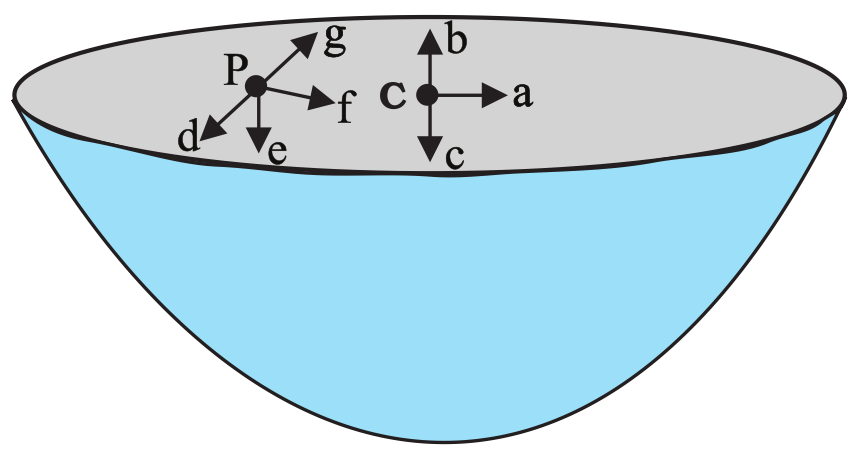
In the following two exercises, choose the correct answer from among the given ones: The gravitational intensity at the centre of a hemispherical shell of uniform mass density has the direction indicated by the arrow (see Fig.) (i) a, (ii) b, (iii) c, (iv) 0.

A wave travelling along a string is described by equation y (x, t) = 0.05 sin(40x - 5t) in which the numerical constants are in SI units (0.05m, 40 radm-1 and 5 rad s-1).
Calculate the (a) amplitude (b) wavelength (c) time period (d) frequency of wave. Also calculate the displacement at distance 35cm and time 10 sec.
A person of mass 60kg wants to lose 5kg by going up and down a 10m high stairs. Assume he burns twice as much fat while going up than coming down. If 1kg of fat is burnt on expending 7000 kilo calories, how many times must he go up and down to reduce his weight by 5kg?
If an object of mass $M$ moving with velocity $\mu$ has a direct elastic collision with an other stable object of mass $m$ then prove that the energy loss of the object of mass $M$ and the result of its intial energy will be $\frac{4 m M }{( M +m)^2}$
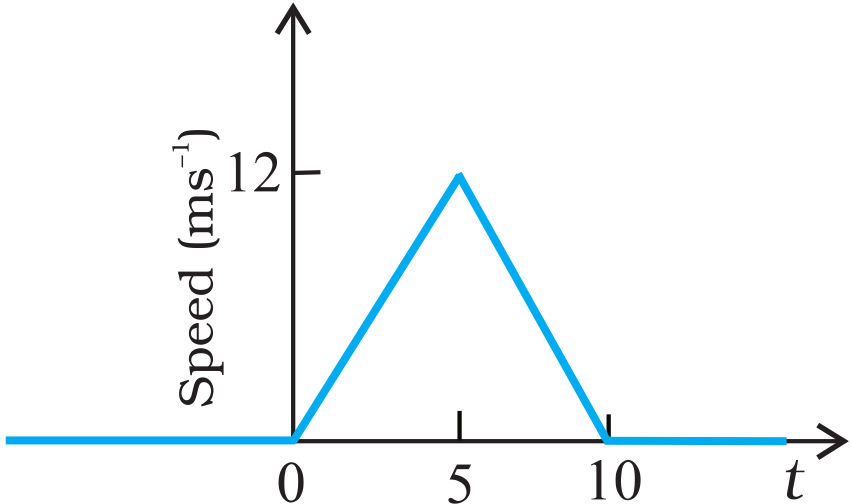
The speed-time graph of a particle moving along a fixed direction is shown in. Obtain the distance traversed by the particle between.
  1. t = 0s to 10s,
  2. t = 2s to 6s.

What is the average speed of the particle over the intervals in (a) and (b)?
Positive charge Q is distributed uniformly over a circular ring of radius R. A particle having a mass m and a negative charge q, is placed on its axis at a distance x from the centre. Find the force on the particle. Assuming x << R, find the time period of oscillation of the particle if it is released from there.
A vector has both magnitude and direction. Does it mean that anything that has magnitude and direction is necessarily a vector? The rotation of a body can be specified by the direction of the axis of rotation, and the angle of rotation about the axis. Does that make any rotation a vector?
One end of a U-tube containing mercury is connected to a suction pump and the other end to atmosphere. A small pressure difference is maintained between the two columns. Show that, when the suction pump is removed, the column of mercury in the U-tube executes simple harmonic motion.