Question
A vector has both magnitude and direction. Does it mean that anything that has magnitude and direction is necessarily a vector? The rotation of a body can be specified by the direction of the axis of rotation, and the angle of rotation about the axis. Does that make any rotation a vector?
Answer

No. A physical quantity having both magnitude and direction need not be considered a vector. For example, despite having magnitude and direction, current is a scalar quantity. The essential requirement for a physical quantity to be considered a vector is that it should follow the law of vector addition.
Generally speaking, the rotation of a body about an axis is not a vector quantity as it does not follow the law of vector addition. However, a rotation by a certain small angle follows the law of vector addition and is therefore considered a vector.

Need a full question paper?

Generate a complete, print-ready paper with questions like this in minutes — across 16+ boards, with answer keys.

Start Generating Free

Similar questions

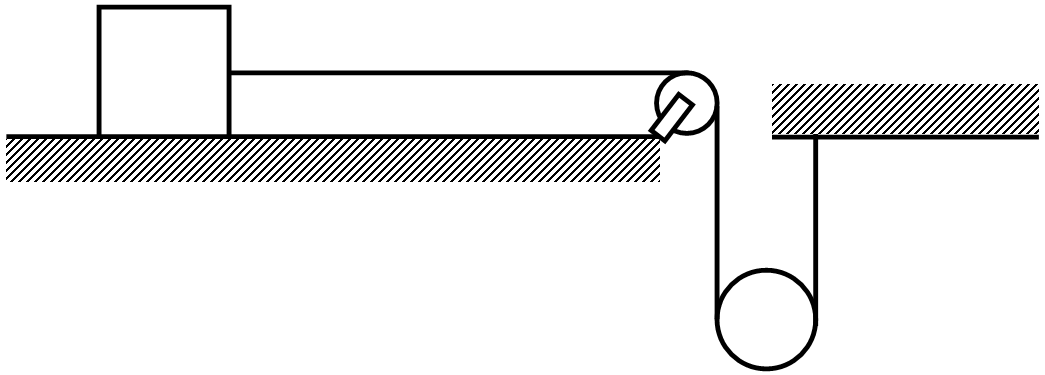
The descending pulley shown in figure has a radius 20cm and moment of inertia 0.20kg-m2. The fixed pulley is light and the horizontal plane frictionless. Find the acceleration of the block if its mass is 1.0kg.

The separation between the objective and the eyepiece of a compound microscope can be adjusted between 9.8cm to 11.8cm. If the focal lengths of the objective and the eyepiece are 1.0cm and 6cm respectively, find the range of the magnifying power if the image is always needed at 24cm from the eye.
A glass vessel measures exactly 10cm × 10cm × 10cm at 0°C. It is filled completely with mercury at this temperature. When the temperature is raised to 10°C, 1.6cm3 of mercury overflows. Calculate the coefficient of volume expansion of mercury. Coefficient of linear expansion of glass = 6.5 × 10⁻⁶ °C.
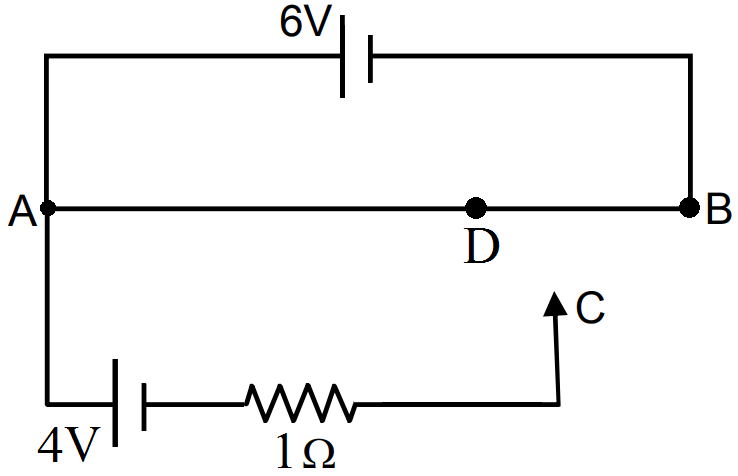
A 6 volt battery of negligible internal resistance is connected across a uniform wire AB of length 100cm. The positive terminal of another battery of emf 4V and internal resistance $1\Omega$ is joined to the point A, as shown in the figure. Take the potential at B to be zero. (a) What are the potentials at the points A and C? (b) At which point D of the wire AB, the potential is equal to the potential at C? (c) If the points C and D are connected by a wire, what will be the current through it? (d) If the 4V battery is replaced by a 7.5V battery, what would be the answers of parts (a) and (b)?

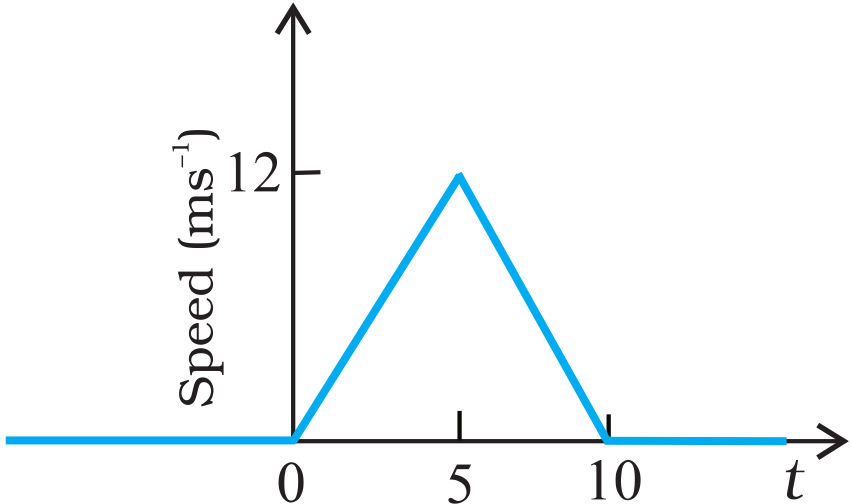
The speed-time graph of a particle moving along a fixed direction is shown in. Obtain the distance traversed by the particle between.
  1. t = 0s to 10s,
  2. t = 2s to 6s.

What is the average speed of the particle over the intervals in (a) and (b)?
A pipe 20cm long is closed at one end. Which harmonic mode of the pipe is resonantly excited by a 430Hz source? Will the same source be in resonance with the pipe if both ends are open? (speed of sound in air is 340m s–1).
A slightly tapering wire of length I and end radii a and b on both sides is subjected to the stretching forces F on both sides as shown in figure. If Y is the Young's modulus of the wire, calculate the extension produced in the wire.
A truck is pulling a car out of a ditch by means of a steel cable that is 9.1m long and has a radius of 5mm. When the car just begins to move, the tension in the cable is 800N. How much has the cable stretched?
(Young’s modulus for steel is 2 × 10¹¹N m–2.)
A 100kg block is started with a speed of 2.0ms-1 on a long, rough belt kept fixed in a horizontal position. The coefficient of kinetic friction between the block and the belt is 0.20.
  1. Calculate the change in the internal energy of the block-belt system as the block comes to a stop on the belt.
  2. Consider the situation from a frame of reference moving at 2.0ms-1 along the initial velocity of the block. As seen from this frame, the block is gently put on a moving belt and in due time the block starts moving with the belt at 2.0ms-1 Calculate the increase in the kinetic energy of the block as it stops slipping past the belt.
  3. Find the work done in this frame by the external force holding the belt.
From a uniform disk of radius R, a circular hole of radius $\frac{\text{R}}{2}$ is cut out. The centre of the hole is at $\frac{\text{R}}{2}$ from the centre of the original disc. Locate the centre of gravity of the resulting flat body.