MCQ
A thin circular ring first slips down a smooth incline then rolls down a rough incline of identical geometry from same height. Ratio of time taken in the two motion is ........
  • A
    $\frac{1}{2}$
  • B
    $1$
  • $\frac{1}{\sqrt{2}}$
  • D
    $\frac{1}{4}$

Answer

Correct option: C.
$\frac{1}{\sqrt{2}}$
c
(c)

case $(i)$ Transitional motion

acceleration $=g \sin \theta$

case $(ii)$ acceleration $=\frac{ g \sin \theta}{1+\frac{1}{ MR ^2}}$

$I = MR ^2$

$a =\frac{ g \sin \theta}{2}$

Now using $\rho=u t+\frac{1}{2} at ^2$

$a _1 t _1^2= a _2 t _2^2 \quad \theta$ and $\rho$ same for both are and $v =0$

$\frac{ t _1{ }^2}{ t _2^2}=\frac{ a _2}{ a _1}=\frac{ g \sin \theta}{2 g \sin \theta}$

$\frac{t_1}{t_2}=\frac{1}{\sqrt{2}}$

$\therefore \frac{t_1}{t_2}=\frac{1}{\sqrt{2}}$

Need a full question paper?

Generate a complete, print-ready paper with questions like this in minutes — across 16+ boards, with answer keys.
Start Generating Free

Similar questions

When acrobat bends his body (assume no external torque):
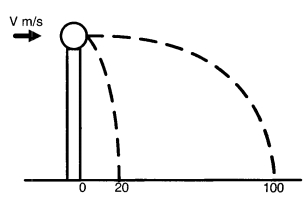
A ball of mass $0.2 \ kg$ rests on a vertical post of height $5 m$. A bullet of mass $0.01 \ kg$, traveling with a velocity $V / s$ in a horizontal direction, hits the centre of the ball. After the collision, the ball and bullet travel independently. The ball hits the ground at a distance of $20 \ m$ and the bullet at a distance of $100 \ m$ from the foot of the post. The initial velocity $V$ of the bullet is
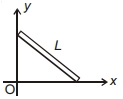
A rod of length $L$ leans against a smooth vertical wall while its other end is on a smooth floor. The end that leans against the wall moves uniformly vertically downward. Select the correct alternative
A body is falling freely under the action of gravity alone in vacuum. Which of the following quantities remain constant during the fall?
Find the acceleration of $B$.
A particle is moving along a circular path with a constant speed of $10\,ms^{-1}.$ What is the magnitude of the change in velocity of the particle, when it moves through an angle of $60^{o}$ around the centre of the circle .......... $m/s$
A body of mass $10\, kg$ is lying on a rough plane inclined at an angle of $30^o$ to the horizontal and the coefficient of friction is $0.5$. the minimum force required to pull the body up the plane is ........ $N$
A simple pendulum executing $S.H.M.$ is falling freely along with the support. Then
In the determination of Young's modulus $\left(Y=\frac{4 MLg }{\pi / d ^2}\right)$ by using Searle's method, a wire of length $L=2 \ m$ and diameter $d =0.5 \ mm$ is used. For a load $M =2.5 \ kg$, an extension $\ell=0.25 \ mm$ in the length of the wire is observed. Quantities $d$ and $\ell$ are measured using a screw gauge and a micrometer, respectively. They have the same pitch of $0.5 \ mm$. The number of divisions on their circular scale is $100$ . The contributions to the maximum probable error of the $Y$ measurement
$C{O_2}(O - C - O)$ is a triatomic gas. Mean kinetic energy of one gram gas will be (If $N-$Avogadro's number, $k-$Boltzmann's constant and molecular weight of $C{O_2} = 44$)