MCQ
When acrobat bends his body (assume no external torque):
  • A
    Acrobat decreases.
  • B
    Acrobat increases.
  • C
    Acrobat increases.
  • D
    Both (a) and (c).

Answer

  1. Both (a) and (c).

Need a full question paper?

Generate a complete, print-ready paper with questions like this in minutes — across 16+ boards, with answer keys.
Start Generating Free

Similar questions

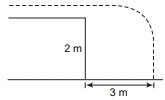
Water is flowing from a horizontal pipe fixed at a height of $2\,m$ from the ground. If it falls at a horizontal distance of $3\,m$ as shown in figure, the speed of water when it leaves the pipe is $............\,ms^{-1}$ (take $g=9.8\,ms ^{-2}$ )
Which of the following is true for elastic potential energy density
A source of sound of frequency $450$ cycles/sec is moving towards a stationary observer with $34\, m/sec$ speed. If the speed of sound is $340\, m/sec,$ then the apparent frequency will be ..... $cycles/sec$
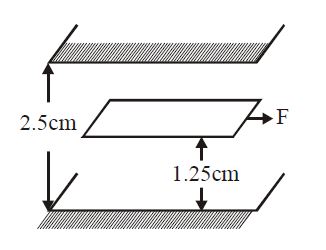
A space $2.5\ cm$ wide between two large plane surfaces is filled with oil. Force required to drag very thin plate of area $0.5\ m^2$ just midway the surfaces at a speed of $0.5\ m/sec$ is $1\ N$ The coefficient of viscosity in $kg-s/m^2$ is :
For a gas $\gamma = 7/5.$ The gas may probably be
A heated body maintained at $T\,K$ emits thermal radiation of total energy $E$ with a maximum intensity at frequency $v$ . The emissivity of the material is $0.5$ . If the temperature of the body be increased and maintained at temperature $3T\,K$ , then

$(i)$ The maximum intensity of the emitted radiation will occur at frequency $v /3$

$(ii)$ The maximum intensity of the emitted radiation will occur at frequency $3v $

$(iii)$ The total energy of emitted radiation will become $81\,E$

$(iv)$ The total energy of emitted radiation will become $27\,E$
What change in surface energy will be noticed when a drop of radius R splits up into 1000 droplets of radius r, surface tension is T.
The black body spectrum of an object $O _1$ is such that its radiant intensity (i.e. intensity per unit wavelength interval) is maximum at a wavelength of $200\,nm$. Another object $O _2$ has the maximum radiant intensity at $600\,nm$. The ratio of power emitted per unit area by source $O _1$ to that of source $O _2$ is
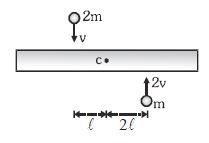
A uniform bar of length $'6l'$ and mass $'8m'$ lies on a smooth horizontal table. Two point masses $m$ and $2m$ moving in the same horizontal plane with speed $2v$ and $v$ respectively, strike the bar (as shown in the fig.) and stick to the bar after collision. Total energy after collision (about the center of mass, $c$) will be :-
A particle performing uniform circular motion has angular momentum L. If its angular frequency is doubled and its kinetic energy halved, then the new angular momentum is: