MCQ
Pressure is a scalar quantity because:
  • A
    it is the ratio of force to area and both force and area are vectors.
  • B
    It is the ratio of the magnitude of the force to area.
  • C
    It is the ratio of the component of the force normal to the area.
  • D
    It does not depend on the size of the area chosen.
Answer

  1. It is the ratio of the component of the force normal to the area.

Explanation:

What makes pressure a scalar quantity is the fact that it is the component of force along the direction of area that is taken into account while defining pressure. Thus the direction of quantities involved remain fixed and pressure becomes a scalar quantity.

Need a full question paper?

Generate a complete, print-ready paper with questions like this in minutes — across 16+ boards, with answer keys.

Start Generating Free

Similar questions

A man standing on a road hold his umbrella at $30^° $ with the vertical to keep the rain away. He throws the umbrella and starts running at $10\, km/hr$. He finds that raindrops are hitting his head vertically, the speed of raindrops with respect to the road will be......... $km/hr$
Which one of the following substances possesses the highest elasticity
A ball thrown by one player reaches the other in $2$ sec. the maximum height attained by the ball above the point of projection will be about ....... $m$
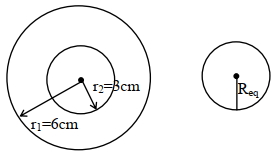
A soap bubble of radius $3\, {cm}$ is formed inside the another soap bubble of radius $6\, {cm}$. The radius of an equivalent soap bubble which has the same excess pressure as inside the smaller bubble with respect to the atmospheric pressure is .......... ${cm}$ 
Consider a ring rolling down a smooth inclined plane of vertical height 'h' and inclination $\theta$. Then the true statement in the following is?
A transverse pulse generated at the bottom of a uniform rope of length $L$, travels in upward direction. The time taken by it to travel the full length of rope will be
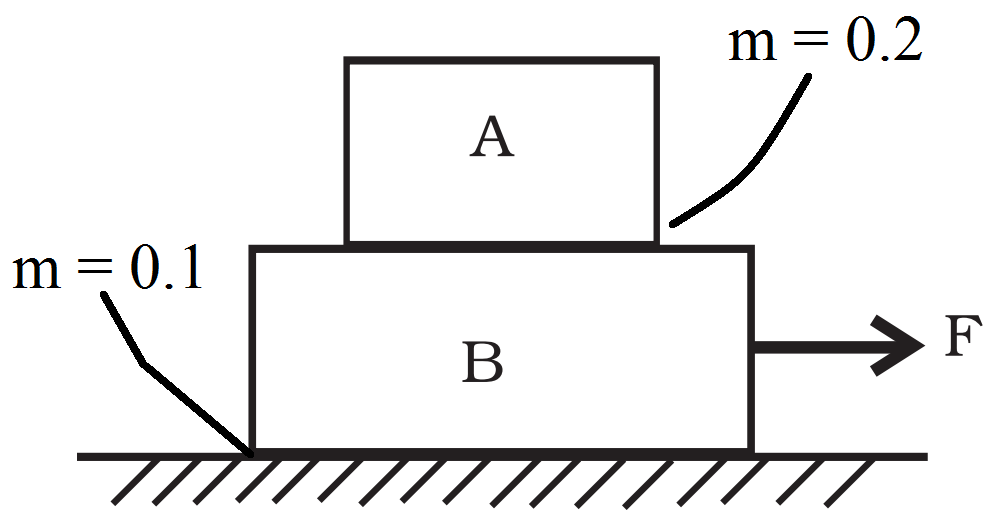
In the co-efficient of friction between the floor and the body B is 0.1. The co-efficient of friction between the bodies B and A is 0.2. A force F is applied as shown on B. The mass of A is m/ 2 and of B is m. Which of the following statements are true?

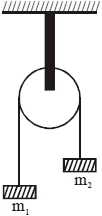
A uniformly thick wheel with moment of inertia $I$ and radius $R$ is free to rotate about its centre of mass (see fig). A massless string is wrapped over its rim and two blocks of masses $\mathrm{m}_{1}$ and $\mathrm{m}_{2}\left(\mathrm{m}_{1}>\mathrm{m}_{2}\right)$ are attached to the ends of the string. The system is released from rest. The angular speed of the wheel when $\mathrm{m}_{1}$ descents by a distance $h$ is
A wire of cross section $4 \;mm^2$ is stretched by $0.1\, mm$ by a certain weight. How far (length) will be wire of same material and length but of area $8 \;mm^2$ stretch under the action of same force......... $mm$
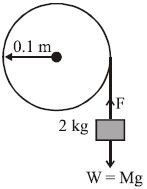
The moment of inertia of a solid flywheel about its axis is $0.1\,kg-m^2$. A tangential force of $2\,kg\,wt$. is applied round the circumference of the flyweel with the help of a string and mass arrangement as shown in the figure. If the radius of the wheel is $0.1\,m,$ find the angular acceleration of the solid fly wheel (in $rad/sec^2$)