A thin circular wire carrying a current $I$ has a magnetic moment $M$. The shape of the wire is changed to a square and it carries the same current. It will have a magnetic moment
Medium
Download our app for free and get started
$M=I\left(\pi r^{2}\right)$
$\pi=\frac{\mathrm{L}}{2 \pi}$
$\mathrm{M}=\mathrm{I}\left(\frac{\pi \times \mathrm{L}^{2}}{4 \pi^{2}}\right)=\frac{\mathrm{IL}^{2}}{4 \pi}$
$\mathrm{m}^{\prime}=\frac{\mathrm{IL}^{2}}{16}$
$\mathrm{m}^{\prime}=\frac{4 \pi \mathrm{M}}{16}=\frac{\pi \mathrm{M}}{4}$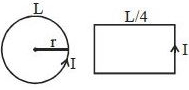

Download our appand get started for free
Experience the future of education. Simply download our apps or reach out to us for more information. Let's shape the future of learning together!No signup needed.*
Similar Questions
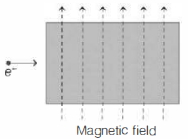
- 1View SolutionAn electron enters a chamber in which an uniform magnetic field is present as shown in figure. Ignore gravity. During its motion inside the chamber
- 2The dipole moment of a circular loop carrying a current $I$, is $m$ and the magnetic field at the centre of the loop is $B_1$ . When the dipole moment is doubled by keeping the current constant, the magnetic field at the centre of the loop is $B_2$ . The ratio $\frac{{{B_1}}}{{{B_2}}}$ isView Solution
- 3A uniform conducting wire of length $12 \mathrm{a}$ and resistance $'R'$ is wound up as a current carrying coil in the shape of,View Solution
$(i)$ an equilateral triangle of side $'a'.$
$(ii)$ a square of side $'a'.$
The magnetic dipole moments of the coil in each case respectively are:
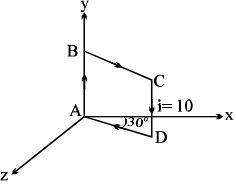
- 4Figure shows a square current carrying loop $ABCD$ of side $10\,\, cm$ and current $i = 10\,A$. The magnetic moment $\vec M$ of the loop isView Solution
- 5A long straight wire of radius a carries a steady current $i$. The current is uniformly distributed across its cross section. The ratio of the magnetic field at $ a/2$ and $2a$ isView Solution
- 6A proton of energy $8\, eV$ is moving in a circular path in a uniform magnetic field. The energy of an alpha particle moving in the same magnetic field and along the same path will be.....$eV$View Solution
- 7A long straight wire in the horizontal plane carries a current of $50\, A$ in north to south direction. Give the magnitude and direction of $B$ at a point $2.5\,m$ east of the wireView Solution
- 8A $50\, ohm$ galvanometer gets full scale deflection when a current of $0.01\, A$ passes through the coil. When it is converted to a $10\, A$ ammeter, the shunt resistance is ........... $\Omega $View Solution
- 9An electron is accelerated by a potential difference of $12000\, volts$. It then enters a uniform magnetic field of ${10^{ - 3}}\,T$ applied perpendicular to the path of electron. Find the radius of path. Given mass of electron $ = 9 \times {10^{ - 31}}\,kg$ and charge on electron $ = 1.6 \times {10^{ - 19}}\,C$View Solution
- 10Given below are two statements:View Solution
Statement $(I)$: When an object is placed at the centre of curvature of a concave lens, image is formed at the centre of curvature of the lens on the other side.
Statement $(II)$: Concave lens always forms a virtual and erect image.
In the light of the above statements, choose the correct answer from the options given below: