MCQ
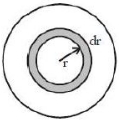
A thin disc of mass $M$ and radius $R$ has mass per unit area $\sigma (r) = kr^2$ where $r$ is the distance from its centre. Its moment of inertia about an axis going through its centre of mass and perpendicular to its plane is
  • A
    $\frac{{M{R^2}}}{2}$
  • B
    $\frac{{M{R^2}}}{3}$
  • C
    $\frac{{M{R^2}}}{6}$
  • $\frac{{2M{R^2}}}{3}$

Answer

Correct option: D.
$\frac{{2M{R^2}}}{3}$
d
${I_{Disc}} = \int\limits_0^R {\left( {dm} \right){r^2} \Rightarrow {I_{Disc}} = \int\limits_0^R {\left( {\sigma 2\pi rdr} \right){r^2}} } $

${I_{Disc}} = \int\limits_0^R {\left( {k{r^2}2\pi rdr} \right)} {r^2}\,\,\,\,\,\,\,\,\,Mass\,of\,disc$

${I_{Disc}} = 2\pi k\int\limits_0^R {{r^2}dr\,\,\,\,\,\,\,\,\,\,\,\,\,\,\,\,\,\,\,M = } \int\limits_0^R {2\pi rdr\,k{r^2}} $

${I_{Disc}} = 2\pi k\left( {\frac{{{r^6}}}{6}} \right)_0^R\,\,\,\,\,\,\,\,\,\,\,\,\,\,\,\,\,M = 2\pi k\int\limits_0^R {{r^3}dr} $

${I_{Disc}} = 2\pi k\frac{{{R^6}}}{6}\,\,\,\,\,\,\,\,\,\,\,\,\,\,\,\,\,\,\,\,\,\,\,M = 2\pi k\left. {\frac{{{r^4}}}{4}} \right|_0^R$

${I_{Disc}} = \frac{{\pi k{R^6}}}{3} = \left( {\frac{{\pi k{R^4}}}{2}} \right)\frac{{{R^2}2}}{3}\,M = 2\pi k\left. {\frac{{{r^4}}}{4}} \right|_0^R$

${I_{Disc}} = \frac{{M2{R^2}}}{3}\,\,\,\,\,;\,\,\,\,\,\,\,\,{I_{Disc}} = \frac{2}{3}M{R^2}$
Need a full question paper?

Generate a complete, print-ready paper with questions like this in minutes — across 16+ boards, with answer keys.

Start Generating Free

Similar questions

Two particles are projected in air with speed $v_o$ at angles $\theta_1$ and $\theta_2 ($both acute$)$ to the horizontal, respectively. If the height reached by the first particle is greater than that of the second, then tick the right choices
  1. angle of projection: $q_1 > q_2$
  2. time of flight: $T_1 >T_2$
  3. horizontal range: $R_1 > R_2$
  4. total energy: $U_1 > U_2$
The diagram showing the variation of gravitational potential of earth with distance from the centre of earth is
Two cars are approaching each other at an equal speed of $7.2\, km / hr$. When they see each other, both blow horns having frequency of $676\, Hz$. The beat frequency heard by each driver will be $.....\, Hz$. [Velocity of sound in air is $340\,m / s .]$
You lift a suitcase from the floor and keep it on a table. The work done by you on the suitcase does not depend on:
A mass of $6 \times {10^{24}}kg$ is to be compressed in a sphere in such a way that the escape velocity from the sphere is $3 \times {10^8}m\,/s$. Radius of the sphere should be $(G = 6.67 \times {10^{ - 11}}N - {m^2}/k{g^2})$
A block of mass $m$ is pulled along a horizontal surface by applying a force at an angle $\theta $ with the horizontal. The friction coefficient between the block and surface is $\mu$. If the block travels at a uniform velocity , then work-done during its displacement $d$ is
When no current is passed through a conductor:
  1. The free electrons do not move.
  2. The average speed of a free electron over a large period of time is zero.
  3. The average velocity of a free electron over a large period of time is zero.
  4. The average of the velocities of all the free electrons at an instant is zero.
A body dropped from height $‘H’$ reaches the ground with a speed of $1.1 \sqrt {gH}$ . Calculate the work done by air friction? .............. $\mathrm{mgH}$
Distance of the centre of mass of a solid uniform cone from its vertex is $z_0$ . If the radius of its base is $R$ and its height is $h$ then $z_0$ is equal to
A satellite with kinetic energy ${E_k}$ is revolving round the earth in a circular orbit. How much more kinetic energy should be given to it so that it may just escape into outer space