Question
A thin horizontal circular disc is rotating about a vertical axis passing through its centre. An insect is at rest at a point near the rim of the d isc. The insect now moves along a diameter of the disc to reach its other end . During the journey of the insect, the angular speed of the disc.
Answer

As insect moves along a diameter, the effective mass and hence the $M.I.$ first decreases then increases so from principle of conservation of angular momentum, angular speed, first increases then decreases. 

Need a full question paper?

Generate a complete, print-ready paper with questions like this in minutes — across 16+ boards, with answer keys.

Start Generating Free

Similar questions

A current $I$ flows along the length of a thin walled, long metallic hollow cylinder of radius $R$, distributed uniformly on its surface then pressure on the wall will be
A step-down transformer is connected to main supply $200\,V$ to operate a $6\,V$, $30\,W$ bulb. The current in primary is.....$A$
In a transformer, the coefficient of mutual inductance between the primary and the secondary coil is $0.2 \,henry$. When the current changes by $5$ $ampere/second$ in the primary, the induced $e.m.f$. in the secondary will be......$V$
What is the $r.m.s$. value of an alternating current which when passed through a resistor produces heat which is thrice of that produced by a direct current of $2$ amperes in the same resistor......$amp$
Intensities of the two waves of light are $I$ and $4\,I$. The maximum intensity of the resultant wave after superposition is
The bulk modulus of a gas is defined as $B=-V d p / d V$. For an adiabatic process the variation of $B$ is proportional to $p^n$. For an ideal gas $n$ is
To determine the Young's modulus of a wire, the formula is $Y = \frac{FL}{A\Delta L};$ where $L$ = length, $A = $area of cross-section of the wire, $\Delta L = $change in length of the wire when stretched with a force $F$. The conversion factor to change it from $CGS$ to $MKS$ system is .............. $10^{-1}\mathrm{N/m}^{2}$
A physical quantity $A$ is related to four observable $a,b,c$ and $d$ as follows, $A = \frac{{{a^2}{b^3}}}{{c\sqrt d }}$, the percentage errors of measurement in $a,b,c$ and $d$ are $1\%,3\%,2\% $ and $2\% $ respectively. What is the percentage error in the quantity $A$ ......... $\%$
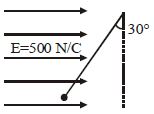
The tiny ball at the end of the thread shown in figure has a mass of $0.5 \, g$ and is  placed in a horizontal electric field of intensity $500\, N/C$. It is in equilibrium in the  position shown. The magnitude and sign of the charge on the ball is .....$\mu C$
A charge $q$ is distributed uniformly on the surface of a sphere of radius $R$. It is covered by a concentric hollow conducting sphere of radius $2 R$. Charge on the outer suiface of the hollow sphere will be, if it is earthed