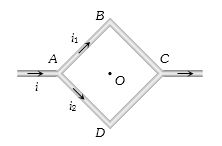
A current $I$ flows along the length of a thin walled, long metallic hollow cylinder of radius $R$, distributed uniformly on its surface then pressure on the wall will be
Diffcult
Download our app for free and get started
At the diametrically opposite section force on the diametrically opposite element
$\mathrm{dF}=\frac{\mu_{0} \mathrm{i}_{1} \times \mathrm{i}_{1} \times \mathrm{i}}{2 \pi \mathrm{a}}(\mathrm{a}=2 \mathrm{R})$
$\because i_{1}=\frac{i}{2 \pi R} d x$
$\mathrm{dF}=\frac{\mu_{0}}{2 \pi \mathrm{a}}\left(\frac{\mathrm{i}}{2 \pi \mathrm{R}} \mathrm{dx}\right)^{2} \mathrm{I}=\frac{\mu_{0}}{2 \pi \times 2 \mathrm{R}} \cdot \frac{\mathrm{i}^{2}}{4 \pi^{2} \mathrm{R}^{2}} \cdot \mathrm{dx} . \mathrm{dx} . \mathrm{I}$
Pressure on the element $=\frac{\mu_{0}}{2 \pi \cdot 2 R} \cdot \frac{\mathrm{i}^{2} \mathrm{d} \mathrm{x}}{4 \pi^{2} \mathrm{R}^{2}} \cdot \frac{\mathrm{d} \mathrm{x} . \mathrm{l}}{\mathrm{d} \mathrm{x} . \mathrm{l}}$
Since area of element $= \mathrm{dxl}$
$\mathrm{dp}=\frac{\mu_{0} \mathrm{i}^{2}}{2 \pi \cdot 2 \mathrm{R} \cdot 4 \pi^{2} \cdot \mathrm{R}^{2}} \times \mathrm{d} \mathrm{x}$
Effective pressure $=\frac{\mu_{0} \mathrm{i}^{2}}{2 \pi \cdot 2 \mathrm{R} \cdot 4 \pi^{2} \cdot \mathrm{R}^{2}} \times 2 \pi \mathrm{r}$
Since $\int \mathrm{d} \mathrm{x}=2 \pi \mathrm{R}$
$P=\frac{\mu_{0} i^{2}}{8 \pi^{2} R^{2}}$

Download our appand get started for free
Experience the future of education. Simply download our apps or reach out to us for more information. Let's shape the future of learning together!No signup needed.*
Similar Questions
- 1View SolutionWhich of the following gives the value of magnetic field according to, Biot-Savart’s law’
- 2A particle with ${10^{ - 11}}\,coulomb$ of charge and ${10^{ - 7}}\,kg$ mass is moving with a velocity of ${10^8}\,m/s$ along the $y$-axis. A uniform static magnetic field $B = 0.5\,Tesla$ is acting along the $x$-direction. The force on the particle isView Solution
- 3A positive, singly ionized atom of mass number $A_M$ is accelerated from rest by the voltage $192 V$. Thereafter, it enters a rectangular region of width $w$ with magnetic field $B_0=0.1 \hat{k}$ Tesla, as shown in the figure. The ion finally hits a detector at the distance $x$ below its starting trajectory.View Solution
[Given: Mass of neutron/proton $=(5 / 3) \times 10^{-27} kg$, charge of the electron $=1.6 \times 10^{-19} C$.]
Which of the following option($s$) is(are) correct?
$(A)$ The value of $x$ for $H^{+}$ion is $4 cm$.
$(B)$ The value of $x$ for an ion with $A_M=144$ is $48 cm$.
$(C)$ For detecting ions with $1 \leq A_M \leq 196$, the minimum height $\left(x_1-x_0\right)$ of the detector is $55 cm$.
$(D)$ The minimum width $w$ of the region of the magnetic field for detecting ions with $A_M=196$ is $56 cm$.
- 4An electron moves in a circular orbit with a uniform speed $v$. It produces a magnetic field $B$ at the centre of the circle. The radius of the circle is proportional toView Solution
- 5A long, straight wire of radius $a$ carries a current distributed uniformly over its cross-section. The ratio of the magnetic fields due to the wire at distance $\frac{a}{3}$ and $2 a,$ respectively from the axis of the wire isView Solution
- 6For a moving coil galvanometer, the deflection in the coil is $0.05\,rad$ when a current of $10\,mA$ is passed through it. If the torsional constant of suspension wire is $4.0 \times 10^{-5}\,Nm\,rad ^{-1}$, the magnetic field is $0.01\,T$ and the number of turns in the coil is $200$,the area of each turn (in $cm ^2$ ) is :View Solution
- 7View SolutionIf the current is doubled, the deflection is also doubled in
- 8At a specific instant emission of radioactive compound is deflected in a magnetic field. The compound can emitView Solution
$(i)$ Electrons $(ii)$ Protons $(iii)$ $H{e^{2 + }}$ $(iv)$ Neutrons
The emission at the instant can be
- 9A long solenoid has a radius $a$ and number of turns per unit length is $n$. If it carries a current $i$, then the magnetic field on its axis is directly proportional toView Solution
- 10Figure shows a square loop $ABCD$ with edge length $a$. The resistance of the wire $ABC$ is $r$ and that of $ADC$ is $2r$. The value of magnetic field at the centre of the loop assuming uniform wire isView Solution