Question

A thin metal plate P is inserted half way between the plates of a parallel plate capacitor of capacitance C in such a way that it is parallel to the two plates. The capacitance now becomes

(a) C 

(b) C/2

(c) 4C       

(d) None of these

Answer

(a) C 

Need a full question paper?

Generate a complete, print-ready paper with questions like this in minutes — across 16+ boards, with answer keys.

Start Generating Free

Similar questions

Wave nature of light is verified by ___________.
Matter waves are:
Which of the following is not true for electromagnetic waves?

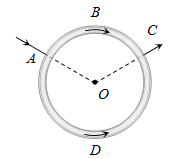
A uniform wire is bent in the form of a circle of radius R. A current I enters at A and leaves at C as shown in the figure :

If the length ABC is half of the length ADC, the magnetic field at the centre O will be

(a) Zero

(b)  

(c)

(d)

Insulation breakdown may occur at _______?

Assertion :   The force with which one plate of a parallel plate capacitor is attracted towards the other plate is equal to square of surface density per e per unit area.

Reason     : The electric field due to one charged plate of the capacitor at the location of the other is equal to surface density per e.

(a) If both assertion and reason are true and the reason is the correct explanation of the assertion.

(b) If both assertion and reason are true but reason is not the correct explanation of the assertion.

(c) If assertion is true but reason is false.

(d) If the assertion and reason both are false.

If the velocity of a charged particle is made twice and that of magnetic field is made half then the radius of the circular path of the charged particle in the magnetic field will become :
In an ac circuit, potential differenc is $V =10 \cos \omega t$ and current flowing through is $I =2 \sin \omega t$ then magnitude of power dissipated is :

The electric intensity due to an infinite cylinder of radius R and  having charge q per unit length at a distance r(r > R) from its axis is

(a) Directly proportional to  

(b) Directly proportional to  

(c) Inversely proportional to r

(d) Inversely proportional to  

The binding energy per nucleon of deuterium and helium atom is 1.1 MeV and 7.0 MeV. If two deuterium nuclei fuse to form helium atom, the energy released is

(a) 19.2 MeV

(b) 23.6 MeV

(c) 26.9 MeV

(d) 13.9 MeV