MCQ
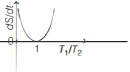
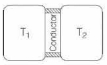
A thin piece of thermal conductor of constant thermal conductivity insulated on the lateral sides connects two reservoirs which are maintained at temperatures $T_{1}$ and $T_{2}$ as shown in the figure alongside. Assuming that the system is in steady state, which of the following plots best represents the dependence of the rate of change of entropy on the ratio of $T_{1} / T_{2}$ ?
  • A


  • C

  • D

Answer

Correct option: B.

b
$(b)$ Entropy change for a system or body is

$\Delta S=\frac{Q}{T}$

Now, for given system to be in steady state, heat lost by resorvoir at temperature $T_{1}=$ heat gained by resorvoir at temperature $T_{2}$ (=Q say).

So, change in entropy for heat conduction process is

$\Delta S-\frac{-Q}{}+\frac{(+Q)}{T_{1}}$

$\Rightarrow \quad \Delta S=Q\left(\frac{1}{T_{2}}-\frac{1}{T_{1}}\right)$

So, time rate of change of entropy is

$\frac{d S}{d t}=\frac{d}{d t}\left\{Q\left(\frac{1}{T_{2}}-\frac{1}{T_{1}}\right)\right\}$

$=\left(\frac{1}{T_{2}}-\frac{1}{T_{1}}\right) \cdot\left(\frac{d Q}{d t}\right)$

$\frac{d S}{d t}=\left(\frac{T_{1}}{T_{2}}-1\right) \cdot T_{1}\left(\frac{d Q}{d t}\right)$

As, $\quad \frac{d Q}{d t}=-k A\left(\frac{d T}{d x}\right)$

So, $\quad \frac{d S}{d t}=-k A \frac{d T}{d x} \cdot T_{1}\left(\frac{T_{1}}{T_{2}}-1\right)$

$\Rightarrow \quad \frac{d S}{d t}=k A T_{1} \cdot\left(1-\frac{T_{1}}{T_{2}}\right) \cdot \frac{d T}{d x}$

$=\frac{k A T_{1}}{x}\left(1-\frac{T_{1}}{T_{2}}\right)\left(T_{1}-T_{2}\right)$

$=\frac{k A T_{1}^{2}}{x}\left(1-\frac{T_{1}}{T_{2}}\right)\left(1-\frac{T_{2}}{T_{1}}\right)$

Clearly, at $\frac{T_{1}}{T_{2}}=1, \frac{d S}{d t}=0$.

Also, graph is asym metrical. So, correct option is $(b)$.
Need a full question paper?

Generate a complete, print-ready paper with questions like this in minutes — across 16+ boards, with answer keys.

Start Generating Free

Similar questions

Vapour is injected at a uniform rate in a closed veseel which was initially evacuated. The pressure in the vessel:
When forces $F_1, F_2, F_3$ are acting on a particle of mass $m$ such that $F_2$ and $F_2$ are mutually perpendicular, then the particle remain stationary. If the force $F_1$ is now removed, then the acceleration of the particle is:
A satellite is revolving around earth in a circular orbit at a uniform speed $v$. If gravitational force suddenly disappears, speed of the satellite will be ..............
A thin smooth rod of length $L$ and mass $M$ is rotating freely with angular speed ${\omega _0}$ about an axis perpendicular to the rod and passing through its centre. Two beads of mass $m$ and negligible size are at the centre of the rod initially. The beads are free to slide along the rod. The angular speed of the system, when the beads reach the opposite ends of the rod will be
Water rises up to a height $h$ in a capillary tube of certain diameter. This capillary tube is replaced by a similar tube of half the diameter. Now the water will rise to the height of
A block of mass $2 kg$ slides down an incline plane of inclination $30^o$. The coefficient of friction between block and plane is $0.5$. The contact force between block and plank is :
For a solid with a small expansion coefficient:
The magnitude of torque on a particle of mass $1\,kg$ is $2.5\, Nm$ about the origin. If the force acting on it is $1\,N$, and the distance of the particle from the origin is $5\,m$, the angle between the force and the position vector is (in radians)
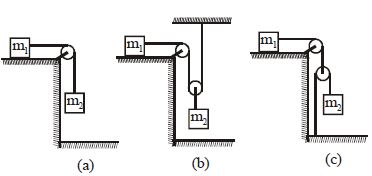
In each of the three arrangements, the block of mass $m_1$ is being pulled left with constant velocity. There is no friction any where. The strings are light and inextensible and pulleys are massless. The ratio of the speed of the block of mass $m_2$ in the three cases respectively is
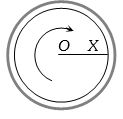
The diagram shows a cup of tea seen from above. The tea has been stirred and is now rotating without turbulence. A graph showing the speed $ v$ with which the liquid is crossing points at a distance $ X$  from $O $ along a radius $XO$  would look like