MCQ
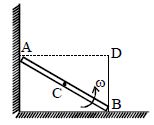
$A$ thin rod $AB$ is sliding between two fixed right angled surfaces. At some instant its angular velocity is $ \omega $. If $I_x$ represent moment of inertia of the rod about an axis perpendicular to the plane and passing through the point $X$ ($A, B, C$ or $D$), the kinetic energy of the rod is
  • A
    $\frac{1}{2} I_A \omega^2$ 
  • B
    $\frac{1}{2} I_B \omega^2$ 
  • C
    $\frac{1}{2} I_C \omega^2$ 
  • $\frac{1}{2} I_D \omega^2$ 

Answer

Correct option: D.
$\frac{1}{2} I_D \omega^2$ 
d
Point $'D'$ is $ICR$ pure rotation about $ICR.$

Need a full question paper?

Generate a complete, print-ready paper with questions like this in minutes — across 16+ boards, with answer keys.

Start Generating Free

Similar questions

A coil of resistance $10\, \Omega$ and an inductance $5\,H$ is connected to a $100\,volt$ battery. Then energy stored in the coil is
A particle of charge $q$ and mass $m$ moves in a circular orbit of radius $r$ with angular speed $\omega $. The ratio of the magnitude of its magnetic moment to that of its angular momentum depends on
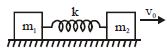
Two block of masses $m_1$ and $m_2$ connected with the help of a spring of spring constant $k$ initially to natural length as shown. A sharp impulse is given to mass $m_2$ so that it acquires a velocity $v_0$ towards right. If the system is kept an smooth floor then find the maximum elongation that the spring will suffer
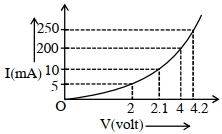
The $I-V$ characteristics of a $p - n$ junction diode in forward bias is shown in the figure. The ratio of dynamic resistance, corresponding to forward bias voltages of $2 \; V$ and $4 \; V$ respectively, is
Two particles $A$ and $B$ start moving with velocities $20 \,m / s$ and $30 \sqrt{2} \,m / s$ along $x$-axis and at an angle $45^{\circ}$ with $x$-axis respectively in $x y$-plane from origin. The relative velocity of $B$ w.r.t. $A$ is ........... $m / s$
A particle is moving in a circle with uniform speed. Its motion is
The earth's magnetic induction at a certain point is $7 \times {10^{ - 5}}\,Wb/{m^2}.$ This is to be annulled by the magnetic induction at the centre of a circular conducting loop of radius $5 \,cm$. The required current in the loop is......$A$
A ball hits a vertical wall horizontally at $10m/s$  bounces back at $10 m/s$ 
Kepler discovered
The half-life of a radioactive nuclide is $100 \,hours.$ The fraction of original activity that will remain after $150\, hours$ would be :