Question
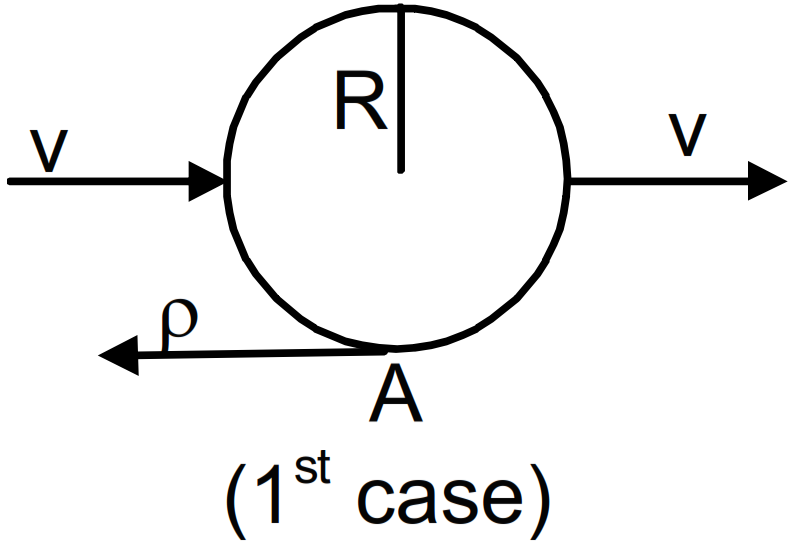
A thin spherical shell lying on a rough horizontal surface is hit by a cue in such a way that the line of action passes through the centre of the shell. As a result, the shell starts moving with a linear speed v without any initial angular velocity. Find the linear speed of the shell after it starts pure rolling on the surface.

Answer


The shell will move with a velocity nearly equal to v due to this motion a frictional force well act in the background direction, for which after some time the shell attains a pure rolling. If we consider moment about A, then it will be zero.
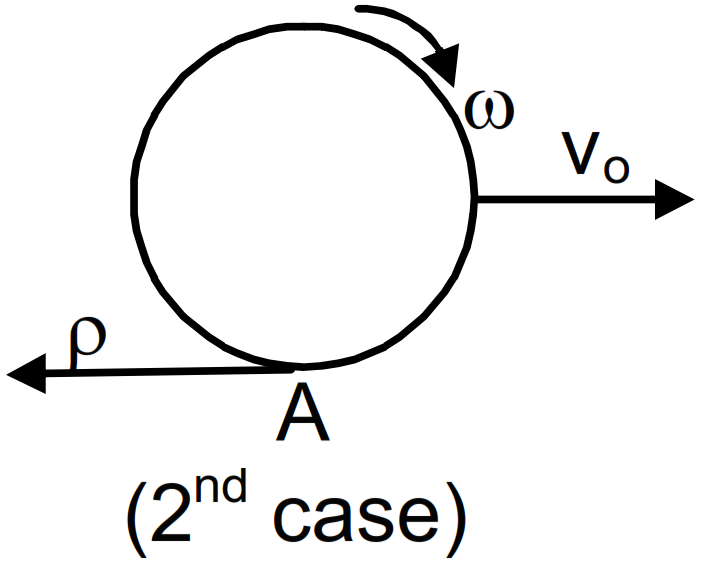
Therefore, Net angular momentum about A before pure rolling = net angular momentum after pure rolling.

Now, angular momentum before pure rolling about A = M(V × R) and angular momentum after pure rolling:

$\Big(\frac{2}{3}\Big)\text{MR}^2\times\Big(\frac{\text{V}_0}{\text{R}}\Big)+\text{MV}_0\text{R}$

(V0 = velocity after pure rolling)

$\Rightarrow\text{MVR}=\frac{2}3{}\text{MV}_0\text{R}+\text{MV}_0\text{R}$

$\Rightarrow\Big(\frac{5}{3}\Big)\text{V}_0=\text{V}$

$\Rightarrow\text{V}_0=\frac{3\text{V}}{5}$
Need a full question paper?

Generate a complete, print-ready paper with questions like this in minutes — across 16+ boards, with answer keys.

Start Generating Free

Similar questions

A coil of inductance 5.0mH and negligible resistance is connected to the oscillator of the previous problem. Find the peak currents in the circuit for $\omega=100\text{s}^{-1},500\text{s}^{-1},1000\text{s}^{-1}.$
The efficiency of an ideal engine is $\frac{1}{8}$ access. After reducing the temperature 100 K , increase to $\frac{1}{6}$ of access. Find the original and final temperature.
The flow rate of water from a tap of diameter 1.25 cm is $0.48 \frac{L}{ min }$. The coefficient of viscosity of water is $10^{-3}$ Pa s. After some time the flow rate is increased to $3 L / min$. Characterise the flow for both the flow rates.
A particle is moving along a straight line and its position is given by the relation $x=\left(t^3-6 t^2-15 t+40\right) m$ Find:
a. The time at which velocity is zero.
b. Position and displacement of the particle at that point.
c. Acceleration of the particle at that point.
A vector $\overrightarrow{\text{A}}$ makes an angle of 20° and $\overrightarrow{\text{B}}$ makes an angle of 110° with the X-axis. The magnitudes of these vectors are 3 m and 4 m respectively. Find the resultant.
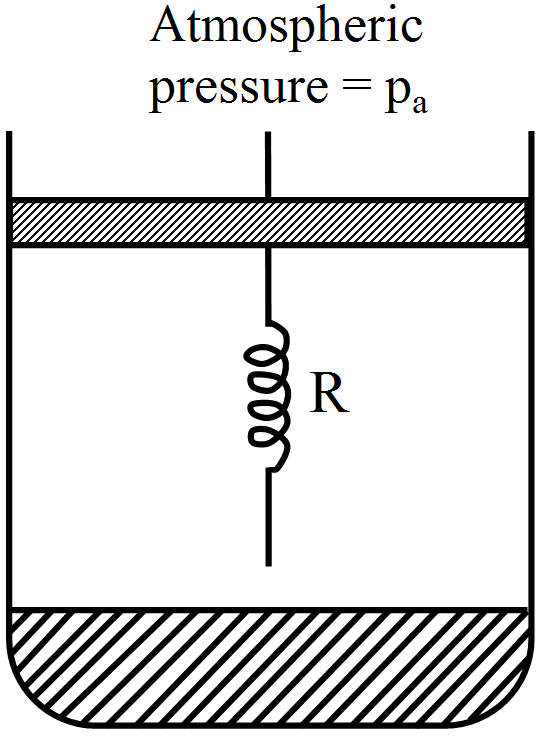
Consider one mole of perfect gas in a cylinder of unit cross-section with a piston attached (figure). A spring (spring constant k) is attached (unstretched length L) to the piston and to the bottom of the cylinder. Initially, the spring is unstretched and the gas is in equilibrium.
A certain amount of heat Q is supplied to the gas causing an increase of volume from V0 to V1.
  1. What is the initial pressure of the system?
  2. What is the final pressure of the system?
  3. Using the first law of thermodynamics, write down a relation between Q, Pa, V, V0, and k.
​​​​​​​
A river 400m wide is flowing at a rate of 2.0m/s. A boat is sailing at a velocity of 10m/s with respect to the water, in a direction perpendicular to the river.
  1. Find the time taken by the boat to reach the opposite bank.
  2. How far from the point directly opposite to the starting point does the boat reach the opposite bank?
Show that an adiabatic curve is always steaper than an isothermal curve.
Let $\overrightarrow{\text{A}}$ and $\overrightarrow{\text{B}}$ be the two vectors of magnitude 10 unit each. If they are inclined to the X-axis at angles 30° and 60° respectively, find the resultant.
State the law of conservation of momentum. Establish the same for a 'n' body system.