Question
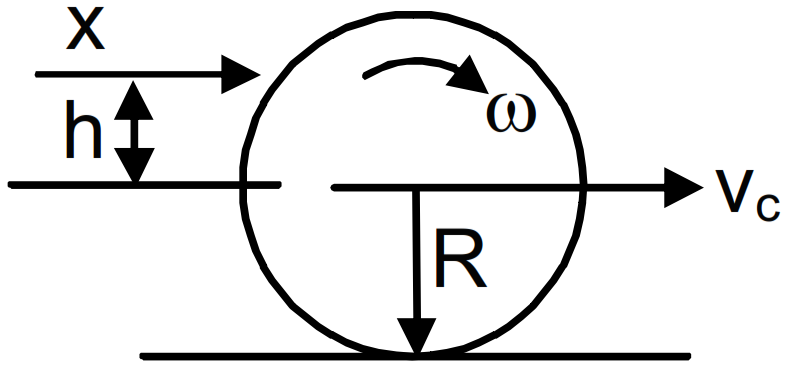
A thin spherical shell of radius R lying on a rough horizontal surface is hit sharply and horizontally by a cue. Where should it be hit so that the shell does not slip on the surface?
Answer


Let the cue strikes at a height ‘h’ above the centre, for pure rolling, $\text{V}_{\text{c}}=\text{R}_{\omega}$

Applying law of conservation of angular momentum at a point A,

$\text{mv}_{\text{c}}\text{h}-\ell\omega=0$

$\text{mv}_{\text{c}}\text{h}=\frac{2}{3}\text{mR}^2\times\Big(\frac{\text{v}_{\text{c}}}{\text{R}}\Big)$

$\text{h}=\frac{2\text{R}}{3}$

Need a full question paper?

Generate a complete, print-ready paper with questions like this in minutes — across 16+ boards, with answer keys.
Start Generating Free

Similar questions

In Exercise, let us take the position of mass when the spring is unstreched as x = 0, and the direction from left to right as the positive direction of x-axis. Give x as a function of time t for the oscillating mass if at the moment we start the stopwatch (t = 0), the mass is:
At the mean position.
In what way do these functions for SHM differ from each other, in frequency, in amplitude or the initial phase?
An immersion heater rated 1000W, 220V is used to heat 0.01m3 of water. Assuming that the power is supplied at 220V and 60% of the power supplied is used to heat the water, how long will it take to increase the temperature of the water from 15°C to 40°C?
The time period of a bundle floating in water is T. How will the periodic period of the same vessel be affected while floating in salty plank?
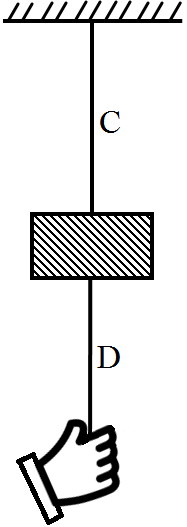
A block is supported by a cord C from a rigid support, and another cord D is attached to the bottom of the block. If you give a sudden jerk to D, it will break. But if you pull on D steadily, C will break. Why?

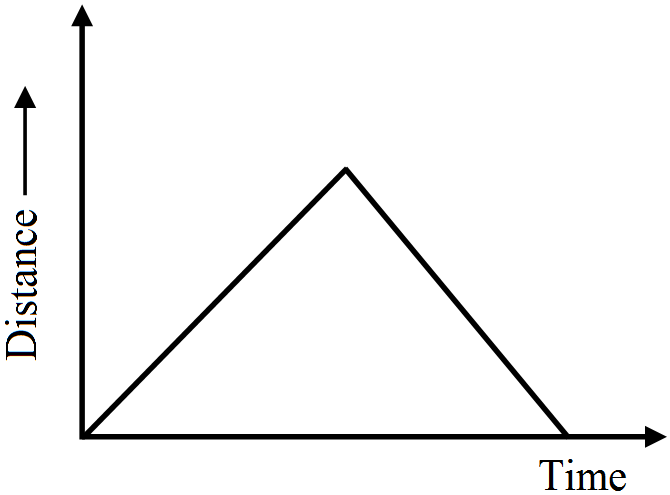
The graph between total path length and time for a particle moving along a straight line as shown in figure is not possible. Explain why?

From a capillary tube of insufficient length water does not spread outside, why?
Calculate the molecular K.E. of 1 gram of Helium (Molecular weight 4) at 127°C. Given R = 8.31J mol-1 K-1.
A ball is projected from a point on the floor with a speed of 15m/s at an angle of 60° with the horizontal. Will it hit a vertical wall 5m away from the point of projection and perpendicular to the plane of projection without hitting the floor? Will the answer differ if the wall is 22m away?
Ultrasonic waves of frequency 4.5MHz are used to detect tumour in soft tissues. The speed of sound in tissue is 1.5km/s and that in air is 340m/s. Find the wavelength of this ultrasonic wave in air and in tissue.
At what rate should the earth rotate so that the apparent g at the equator becomes zero? What will be the length of the day in this situation?