MCQ
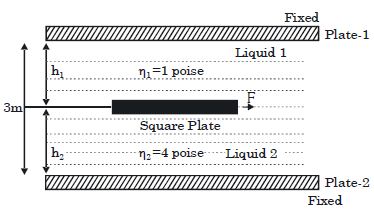
A thin square plate of side $2\ m$ is moving at the interface of two very viscous liquids of viscosities ${\eta _1} = 1$ poise and ${\eta _2} = 4$ poise respectively as shown in the figure. Assume a linear velocity distribution in each fluid. The liquids are contained between two fixed plates. $h_1 + h_2 = 3\ m$ . A force $F$ is required to move the square plate with uniform velocity $10\ m/s$ horizontally then the value of minimum applied force will be ........ $N$
  • A
    $6$
  • $12$
  • C
    $24$
  • D
    $40$

Answer

Correct option: B.
$12$
b
$\mathrm{f}=0.1 \times 4 \times \frac{10}{\mathrm{h}_{1}}+0.4 \times 4 \times \frac{10}{\mathrm{h}_{2}}$

$=\frac{0.1 \times 4 \times 10}{3-h_{2}}+\frac{0.4 \times 4 \times 10}{h_{2}}$

for $f_{\min } \frac{d f}{d h_{2}}=0$

$\mathrm{h}_{2}=2 \mathrm{m}$

$\mathrm{F}_{\min }=12 \mathrm{N}$

Need a full question paper?

Generate a complete, print-ready paper with questions like this in minutes — across 16+ boards, with answer keys.

Start Generating Free

Similar questions

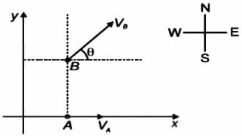
Figure shows two ships moving in $x-y$ plane with velocities $V_A$ and $V_B$. The ships move such that $B$ always remains north of $A$. The ratio $\frac{V_A}{V_B}$ is equal to ........
A $1 \,kg$ stone at the end of $1 \,m$ long string is whirled in a vertical circle at constant speed of $4\, m/sec$. The tension in the string is $6 \,N$, when the stone is at
At temperature $T$ , the power radiated by a body is $Q$ watts. At the temperature $3T$ the power radiated by it will be
The force required to keep a body in uniform circular motion is
An object may have:
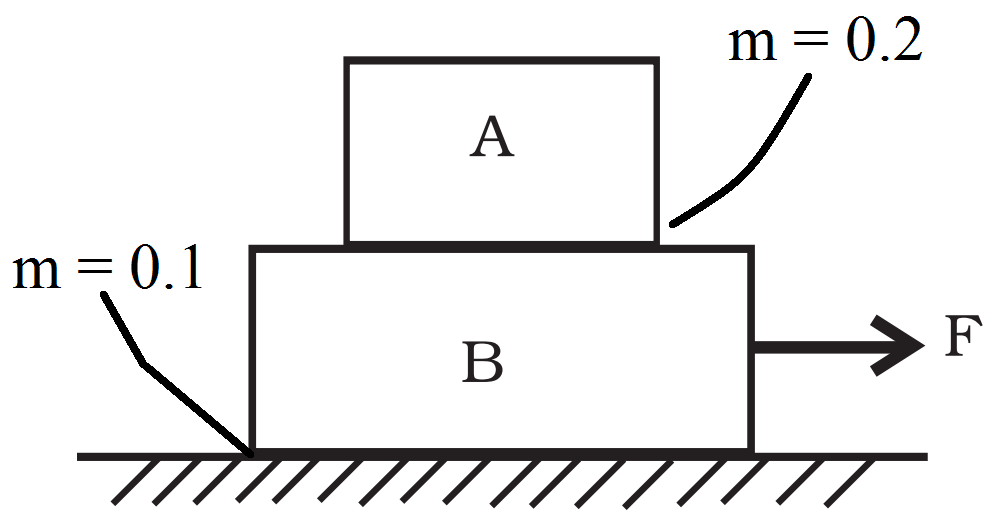
In the $co-$efficient of friction between the floor and the body $B$ is $0.1.$ The $co-$efficient of friction between the bodies $B$ and $A$ is $0.2. \ A$ force $F$ is applied as shown on $B.$ The mass of $A$ is $m^2$ and of $B$ is $m.$ Which of the following statements are true?
  1. a The bodies will move together if $F = 0.25\ mg.$
  2. The body $A$ will slip with respect to $B$ if $F = 0.5\ mg.$
  3. The bodies will be at rest if $F = 0.1\ mg.$
  4. The maximum value of $F$ for which the two bodies will move together is $0.45\ mg.$
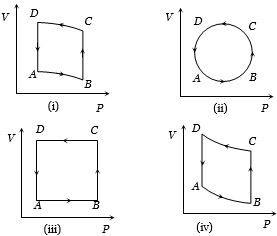
In the diagrams $(i)$ to $(iv)$ of variation of volume with changing pressure is shown. A gas is taken along the path $ABCD. $ The change in internal energy of the gas will be
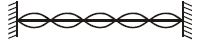
A string fixed at its both ends vibrates in $5\,\,loops$  as shown in the figure  

The total number of nodes and antinodes are respectively

If the tension and diameter of a sonometer wire of fundamental frequency $n$ are doubled and density is halved then its fundamental frequency will become
A gas may expand either adiabatically or isothermally. A number of $P-V$ curves are drawn for the two processes over different range of pressure and volume. It will be found that