A tightly wound $100$ turns coil of radius $10 \mathrm{~cm}$ carries a current of $7 \mathrm{~A}$. The magnitude of the magnetic field at the centre of the coil is (Take permeability of free space as $4 \pi \times 10^{-7} \mathrm{SI}$ units):
NEET 2024, Medium


Download our appand get started for free
Experience the future of education. Simply download our apps or reach out to us for more information. Let's shape the future of learning together!No signup needed.*
Similar Questions
- 1A $90\, cm$ long solenoid has six layers of windings of $450\, turns$ each. If the diameter of solenoid is $2.2\, cm$ and current carried is $6\, A$, then the magnitude of magnetic field inside the solenoid, near its centre isView Solution
- 2A conductor in the form of a right angle $ABC$ with $AB = 3\, cm$ and $BC = 4\, cm$ carries a current of $10\, A$. There is a uniform magnetic field of $5\, T$ perpendicular to the plane of the conductor. The force on the conductor will be......$N$View Solution
- 3A charged particle moves in a magnetic field $\vec B = 10\,\hat i$ with initial velocity $\vec u = 5\hat i + 4\hat j$ The path of the particle will beView Solution
- 4A long copper tube of inner radius $R$ carries a current $i$. The magnetic field $B$ inside the tube isView Solution
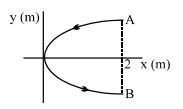
- 5A conducting wire bent in the form of a parabola $y^2 = 2x$ carries a current $i = 2 A$ as shown in figure. This wire is placed in a uniform magnetic field $\vec B = - 4\,\hat k$ $Tesla$. The magnetic force on the wire is (in newton)View Solution
- 6View SolutionIn a co-axial straight cable, the central conductor and the outer conductor carry equal currents in opposite directions. The magnetic field is zero.
- 7A cylindrical conductor of radius $'R'$ carries a current $'i'$. The value of magnetic field at a point which is $R/4$ distance inside from the surface is $10\,T$. Find the value of magnetic field at point which is $4R$ distance outside from the surfaceView Solution
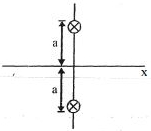
- 8Two straight infinitely long current carrying wires are kept along $z-$ axis at the coordinates $(0, a, 0)$ and $(0, -a, 0)$ respectively as shown in the figure. The current in each of the wire is equal and along negative $z-$ axis (into the plane of the paper). The variation of magnetic field on the $x-$ axis will be approximatelyView Solution
- 9View SolutionWhich of the following statement is wrong
- 10Two charged particles, having same kinetic energy, are allowed to pass through a uniform magnetic field perpendicular to the direction of motion. If the ratio of radii of their circular paths is $6: 5$ and their respective masses ratio is $9: 4$. Then, the ratio of their charges will be.View Solution