MCQ
A toroid having average diameter $2.5\,m ,$ number $A$ turns $400,$ current $=2 \,A$ and magnetic field has $10, T$ what will be induced magnetic field (in $amp/m)$
  • A
    $\frac{10^{5}}{4 \pi}$
  • $\frac{10^{8}}{4 \pi}$
  • C
    $\frac{10^{8}}{2 \pi}$
  • D
    $\frac{10^{2}}{2 \pi}$

Answer

Correct option: B.
$\frac{10^{8}}{4 \pi}$
b
The expression to calculate the induced magnetic field is given as,

$B =\mu_{0}( H + I )$

$=\mu_{0}\left(\frac{ N }{2 \pi r } \times i + I \right)$

Substitute the values.

$10=\mu_{0}\left(\frac{ N }{2 \pi r } \times i + I \right)$

$I=\frac{10}{4 \pi \times 10^{-7}}-\frac{400 \times 2 \times 2}{2 \pi \times 2.5}$

$=\frac{10^{8}}{4 \pi}$

Need a full question paper?

Generate a complete, print-ready paper with questions like this in minutes — across 16+ boards, with answer keys.

Start Generating Free

Similar questions

In Young's double slits experiment, the position of $5^{\text {th }}$ bright fringe from the central maximum is $5\,cm$. The distance between slits and screen is $1\,m$ and wavelength of used monochromatic light is $600\,nm$. The separation between the slits is $........\mu m$
When a plane mirror is rotated through an angle θ then the reflected ray turns through the angle 2θ then the size of the image
A triode is operated in the linear region of its characteristics. If the plate voltage is slightly increased, the dynamic plate resistance will:
In Rutherford's experiment, number of particles scattered at $90^{\circ}$ angle are $x$ per second. Number particles scattered per second at angle $60^{\circ}$ is
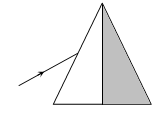
A light ray is incident upon a prism in minimum deviation position and suffers a deviation of 34°. If the shaded half of the prism is knocked off, the ray will
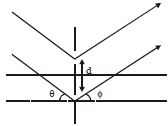
In the given figure light is incident at an angle $\theta$ with the normal to a plane containing two slits of separation $d$. Select the expression that correctly describes the positions of the interference maxima in terms of the incoming angle $\theta$ and outgoing angle $\phi$.
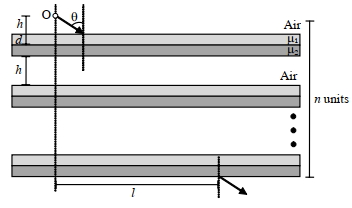
Consider a configuration of $n$ identical units, each consisting of three layers. The first layer is a column of air of height $h=\frac{1}{3} cm$, and the second and third layers are of equal thickness $d=\frac{\sqrt{3}-1}{2} cm$, and refractive indices $\mu_1=\sqrt{\frac{3}{2}}$ and $\mu_2=\sqrt{3}$, respectively. A light source $O$ is placed on the top of the first unit, as shown in the figure. A ray of light from $O$ is incident on the second layer of the first unit at an angle of $\theta=60^{\circ}$ to the normal. For a specific value of $n$, the ray of light emerges from the bottom of the configuration at a distance $l=\frac{8}{\sqrt{3}} cm$, as shown in the figure. The value of $n$ is. . . . . 
When a piece of aluminium wire of finite length is drawn through a series of dies to reduce its diameter to half its original value, its resistance will become ........ times
The de$-$Broglie wavelength of a tennis ball of mass $66 g$ moving with the velocity of $10$ metre per second approximately:
A transistor cannot be used as an