Question
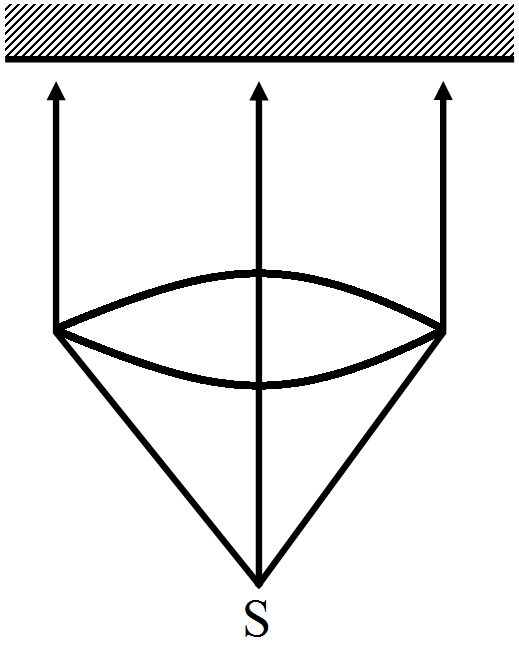
A totally reflecting, small plane mirror placed horizontally faces a parallel beam of light, as shown in the figure. The mass of the mirror is 20g. Assume that there is no absorption in the lens and that 30% of the light emitted by the source goes through the lens. Find the power of the source needed to support the weight of the mirror. Take g = 10m/s2.
Answer

m = 20g

The weight of the mirror is balanced. Thus force exerted by the photons is equal to weight

$\text{p}=\frac{\text{h}}{\lambda}$

$\text{E}=\frac{\text{hc}}{\lambda}=\text{pc}$

$\Rightarrow\frac{\text{E}}{\text{t}}=\frac{\text{p}}{\text{t}}\text{c}$

⇒ Rate of change of momentum $=\frac{\text{power}}{\text{C}}$

30% of light passes through the lens.

Thus it exerts force. 70% is reflected.

$\therefore$ Force exerted = 2(rate of change of momentum)

$=2\times\frac{\text{power}}{\text{C}}$

$30\%\Big(\frac{2\times\text{power}}{\text{C}}\Big)=\text{mg}$

$\Rightarrow\text{power}=\frac{20\times10^{-3}\times10\times3\times10^{8}\times10}{2\times3}$

$=10\text{W}=100\text{MW.}$

Need a full question paper?

Generate a complete, print-ready paper with questions like this in minutes — across 16+ boards, with answer keys.

Start Generating Free

Similar questions

The magnifying power of a converging lens used as a simple microscope is $\Big(1+\frac{\text{D}}{\text{f}}\Big).$ A compound microscope is a combination of two such converging lenses. Why don't we have magnifying power $\Big(1+\frac{\text{D}}{\text{f}_\text{o}}\Big) \Big(1+\frac{\text{D}}{\text{f}_\text{o}}\Big)?$ In other words, why can the objective not be treated as a simple microscope but the eyepiece can?
What will be the mean free path of nitrogen gas at STP of given diameter of nitrogen molecule $=2\mathring{\text{A}}?$
Two loudspeakers have been installed in an open space to listen to a speech. When both the loudspeakers are in operation, a listener sitting at a particular place receives a very feeble sound. Why? What will happen if one loudspeaker is kept off?
Briefly explain Magnus effect.
To what depth must a rubber ball be taken in deep sea so that its volume is decreased by 0.1%.
(The bulk modulus of rubber is 9.8 × 10⁸N m-2, and the density of sea water is 103kg m-3.)
The spring shown in figure is unstretched when a man starts pulling on the cord. The mass of the block is M. If the man exerts a constant force F, find
  1. The amplitude and the time period of the motion of the block,
  2. The energy stored in the spring when the block passes through the equilibrium position and,
  3. The kinetic energy of the block at this position.

A particle of mass m is projected with a speed u at an angle $\theta$ with the horizontal. Find the torque of the weight of the particle about the point of projection when the particle is at the highest point.
A 2.00m long rope, having a mass of 80g, is fixed at one end and is tied to a light string at the other end. The tension in the string is 256N.
  1. Find the frequencies of the fundamental and the first two overtones.
  2. Find the wavelength in the fundamental and the first two overtones.
Write the main points of efficiency of Carnot engine.
Mars has approximately half of the earth’s diameter. When it is closest to the earth it is at about $\frac{1}{2}$ A.U. from the earth. Calculate what size it will appear when seen through the same telescope.