Rajasthan BoardEnglish MediumSTD 11 SciencePhysicsModel Paper 93 Marks
Question
Briefly explain Magnus effect.
✓
Answer
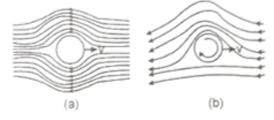
Magnus effect, generation of a sidewise force on a spinning cylindrical or spherical solid immersed in a fluid (liquid or gas) when there is relative motion between the spinning body and the fluid. It is responsible for the "curve" of a served tennis ball or a driven golf ball and affects the trajectory of a spinning artillery shell. A spinning object moving through a fluid departs from its straight path because of pressure differences that develop in the fluid as a result of velocity changes induced by the spinning body. The Magnus effect is a particular manifestation of Bernoulli's theroem, fluid pressure decreases at points where the speed of the fluid increases. In the case of a ball spinning through the air, the turning ball drags some of the air around with it. Viewed from the position of the ball, the air is rushing by on all sides. The drag of the side of the ball turning into the air (into the direction the ball is traveling) retards the airflow, whereas on the other side the drag speeds up the airflow. Greater pressure on the side where the airflow is slowed down forces the ball in the direction of the low-pressure region on the opposite side, where a relative increase in airflow occurs.
Need a full question paper?
Generate a complete, print-ready paper with questions like this in minutes — across 16+ boards, with answer keys.