MCQ
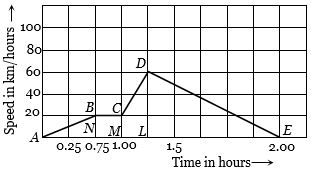
A train moves from one station to another in $2$ hours time. Its speed-time graph during this motion is shown in the figure. The maximum acceleration during the journey is.............$km\, h^{-2}$
  • A
    $140$
  • $160$
  • C
    $100$
  • D
    $120$

Answer

Correct option: B.
$160$
b
(b) Maximum acceleration will be represented by $CD$ part of the graph

Acceleration $ = \frac{{dv}}{{dt}} = \frac{{(60 - 20)}}{{0.25}} = 160\;km/{h^2}$

Need a full question paper?

Generate a complete, print-ready paper with questions like this in minutes — across 16+ boards, with answer keys.
Start Generating Free

Similar questions

If the Earth has no rotational motion, the weight of a person on the equator is $W$. Determine the speed with which the earth would have to rotate about its axis so that the person at the equator will weight $\frac{3}{4}\,W$ . Radius of the Earth is $6400\, km$ and $g = 10\, m/s^2$
A beaker of radius $15\, cm$ is filled with a liquid of surface tension $0.075\, N/m.$ Force  across an imaginary diameter on the surface of the liquid is:-
Calorimeters are made of which of the following
A wire suspended vertically from one of its ends is stretched by attaching a weight of $200\, N$ to the lower end. The weight stretches the wire by $1\, mm$ Then the elastic energy stored in the wire is ........ $J$
Two gases have the same initial pressure, volume and temperatue. They expand to the same final volume, one adiabatically and the other isothermally, if the two gases are compressed to the same final volume
At what speed, the velocity head of water is equal to pressure head of $40 \,cm$ of mercury is ........ $m / s$
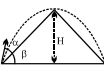
A shell fired from the base of a mountain just clears it. If $\alpha$ is the angle of projection then the angular elevation of the summit $\beta$ is
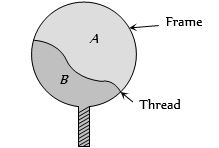
A thread is tied slightly loose to a wire frame as in figure and the frame is dipped into a soap solution and taken out. The frame is completely covered with the film. When the portion $A$ punctured with a pin, the thread.
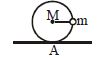
A uniform body of mass $M$  radius $R$ has a small mass $m$ attached at edge as shown in the figure. The system is placed on a perfectly rough horizontal surface such that mass $m$ is at the same horizontal level as the centre of body. It is assumed that there is no slipping at point $A$. If $I_A$ is the moment of the inertia of combined system about point of contact $A$ then the normal reaction at point $A$ just after the system is released from rest is ........ $N$. ($M = 6\ kg$, $m = 2\ kg,$ $I_A = 4\ kg\ m^2$, $R = 1\ m$, $g=10\ m/s^2$)
A straight rod of length $L$ extends from $x = a$ to $x = L + a$. The gravitational force it exerts on a point mass $‘m’$ at $x = 0$, if the mass per unit length of the rod is $A + Bx^2$, is given by