MCQ
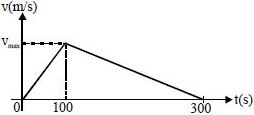
A train starting from rest accelerates uniformly for $100\,\,s,$  then comes to a stop with a uniform retardation in the next $200\,\,s.$  During the motion, it covers a distance of $3\,\,km.$  Choose the wrong option
  • A
    Its acceleration is $0.2\,\,m/s^2$
  • B
    Its retardation is $0.1\,\,m/s^2$
  • C
    The maximum velocity is $20\,\,m/s$
  • The maximum velocity is $10\,\,m/s$

Answer

Correct option: D.
The maximum velocity is $10\,\,m/s$
d
$\frac{1}{2} \times 300 \times V_{\max }=3000$

$\therefore \mathrm{V}_{\max }=20 \mathrm{m} / \mathrm{s}$


Need a full question paper?

Generate a complete, print-ready paper with questions like this in minutes — across 16+ boards, with answer keys.

Start Generating Free

Similar questions

Gravitational mass is proportional to gravitational
The displacement of a particle along the $x-$ axis is given by $x=asin^2$$\omega t$ . The motion of the particle corresponds to 
A body travels uniformly a distance of $ (13.8 \pm 0.2)\,m$ in a time $(4.0 \pm 0.3)\, s$. The percentage error is  ......... $\%$
A plank with a box on it at one end is gradually raised about the other end. As the angle of inclination with the horizontal reaches $30^o $, the box starts to slip and slides $4.0\, m $ down the plank in $4.0\, s.$ The coefficients of static and kinetic friction between the box and the plank will be, respectively 
Consider the motion of the tip of the second hand of a clock. In one minute (R be the length of second hand), its ......
The work done by a force $\vec F = \left( { - 6{x^3}\hat i} \right)\,N$, in displacing a particle from $x = 4\, m$ to $x = -2\, m$ is  ................ $\mathrm{J}$
Ionization energy of a hydrogen$-$like ion $A$ is greater than that of another hydrogen$-$like ion $B$. Let $r, u, E$ and $L$ represent the radius of the orbit, speed of the electron, energy of the atom and orbital angular momentum of the electron respectively. In ground state:
Four particles each of mass $M$, are located at the vertices of a square with side $L$. The gravitational potential due to this at the centre of the square is
A system consists of two identical spheres each of mass $1.5\, {kg}$ and radius $50\, {cm}$ at the end of light rod. The distance between the centres of the two spheres is $5\, {m}$. What will be the moment of inertia of the system about an axis perpendicular to the rod passing through its midpoint ? (in ${kgm}^{2}$)
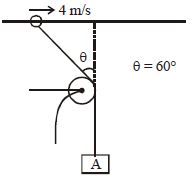
For the given fig. find the speed of block $A$ when $\theta  = {60^o}$