MCQ
A body travels uniformly a distance of $ (13.8 \pm 0.2)\,m$ in a time $(4.0 \pm 0.3)\, s$. The percentage error is  ......... $\%$
  • A
    $7$
  • B
    $5.95$
  • $8.95$
  • D
    $9.85$

Answer

Correct option: C.
$8.95$
c
(c) $\%$ error in velocity$ = \%$ error in $L + \%$ error in $t$

$ = \frac{{0.2}}{{13.8}} \times 100 + \frac{{0.3}}{4} \times 100$

$= 1.44 + 7.5 = 8.94 \%$

Need a full question paper?

Generate a complete, print-ready paper with questions like this in minutes — across 16+ boards, with answer keys.
Start Generating Free

Similar questions

Which of the following statements are true about acceleration due to gravity?
$(a)\, 'g'$ decreases in moving away from the centre if $r > R$
$(b)\, 'g'$ decreases in moving away from the centre if $r < R$
$(c)\, 'g'$ is zero at the centre of earth 
$(d)\, 'g'$ decreases if earth stops rotating on its axis
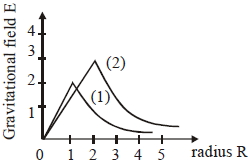
Consider two solid spheres of radii $\mathrm{R}_{1}=1 \;\mathrm{m}$ $\mathrm{R}_{2}=2\; \mathrm{m}$ and masses $\mathrm{M}_{1}$ and $\mathrm{M}_{2},$ respectively. The gravitational field due to sphere $(1)$ and $(2)$ are shown. The value of $\frac{\mathrm{M}_{1}}{\mathrm{M}_{2}}$ is
If $R$ and $H$ represent the horizontal range and the maximum height achieved by a projectile then which of the relation exists?
When the separation between two charges is increased the electric potential energy of the charges.
If $g \propto \frac{1}{{{R^3}}}$ (instead of $\frac{1}{{{R^2}}}),$ then the relation between time period of a satellite near earth's surface and radius $R$ will be
In a car race on straight road, car $A$ takes a time $t$ less than car $B$ at the finish and passes finishing point with a speed $v$ more than that of car $B.$ Both the cars start from rest and travel with constant acceleration $a_1$ and $a_2$ respectively. Then $v$ is equal to
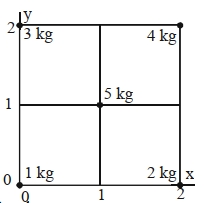
Five masses are placed in a plane as shown in figure. The coordinates of the centre of mass are nearest to.
If the time of acceleration is $t_1$​, then the speed of the car at $t = t_1$​ is:
The potential energy of a body of mass $m$ is given by $U = ax + by$, where $x$ and $y$ are the position coordinates of the particle. The acceleration of the particle is
If in a stationary lift, a man is standing with a bucket full of water, having a hole at its bottom. The rate of flow of water through this hole is ${R_0}.$ If the lift starts to move up and down with same acceleration and then that rates of flow of water are ${R_u}$ and ${R_d},$ then