MCQ
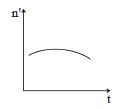
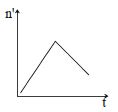
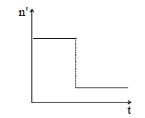
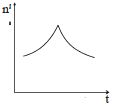
A train whistling at constant frequency is moving towards a station at a constant speed $V$ . The train goes past a stationary observer on the station. The frequency $n'$ of the sound as heard by the observer is plotted as a function of time $t$ (Fig.) . Identify the expected curve
  • A

  • B


  • D

Answer

Correct option: C.

c
Approaching source $\mathrm{n}^{\prime}=\mathrm{n}\left[\frac{\mathrm{V}}{\mathrm{V}-\mathrm{V}_{\mathrm{s}}}\right]$ constant

Receading source $\mathrm{n}^{\prime}=\left[\frac{\mathrm{V}}{\mathrm{V}+\mathrm{V}_{\mathrm{s}}}\right]$ constant.

Need a full question paper?

Generate a complete, print-ready paper with questions like this in minutes — across 16+ boards, with answer keys.

Start Generating Free

Similar questions

A particle moves for $20 \,seconds$ with velocity $3 \,m/s$ and then velocity $4\, m/s$ for another $20 \,seconds$ and finally moves with velocity $5 \,m/s$ for next $20\, seconds$. What is the average velocity of the particle..........$m/s$
A jat plane is travelling towards west at a speed of $1800\, km/h$. What is the voltage difference developed between the ends of the wing having a span of $25\,m$, if the Earth's magnetic field at the location has a magnitude of $5\times10^{-4}\, T$ and the dip angle is $30^o$
A spring-mass system vibrates such that mass travel on surface of coefficient of friction  $\mu$. Mass is released after compressing the spring by distance a and it travels upto  distance $b$ after its equilibrium position, then travelling from $x = -a$ to $x = b$ the reduction in its amplitude will be :-
Two discs of same mass and different radii are made of different materials such that their thicknesses are $1\,cm$ and $0.5\,cm$ respectively. The densities of materials are in the ratio $3: 5$. The moment of inertia of these discs respectively about their diameters will be in the ratio of $\frac{x}{6}$. The value of $x$ is $.......$.
A taut string at both ends vibrates in its $n^{th}$ overtone. The distance between adjacent Node and Antinode is found to be $'d'$. If the length of the string is $L,$ then
The time dependence of the position of a particle of mass $m = 2$ is given by $\vec r\,(t)\, = \,2t\,\hat i\, - 3{t^2}\hat j$ Its angular momentum with respect to the origin at time $t = 2$ is
A free hydrogen atom after absorbing a photon of wavelength $\lambda_{ a }$ gets excited from the state $n =1$ to the state $n =4$. Immediately after that the electron jumps to $n=m$ state by emitting a photon of wavelength $\lambda_{\text {. }}$. Let the change in momentum of atom due to the absorption and the emission are $\Delta p_2$, and $\Delta p_\theta$, respectively. If $\lambda_2 / \lambda_0=\frac{1}{5}$. Which of the option(s) is/are correct ?

[Use $hc =1242 eV nm ; 1 nm =10^{-9} m , h$ and $c$ are Planck's constant and speed of light, respectively]

$(1)$ $\lambda_0=418 nm$

$(2)$ The ratio of kinetic energy of the electron in the state $n = m$ to the state $n =1$ is $\frac{1}{4}$

$(3)$ $m =2$

$(4)$ $\Delta p_{ a } / \Delta p _{ o }=\frac{1}{2}$

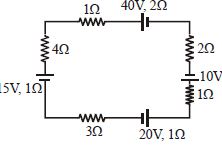
Find the current in the loop.
Which of the following is the disadvantage of $FM$ over $AM$
In a step-up transformer the turn ratio is $1:10$. A resistance of $200 \,ohm$ connected across the secondary is drawing a current of $0.5$ A. What is the primary voltage and current