Question
A transformer is an electrical device which is used for changing the a.c. voltages. It is based on the phenomenon of mutual induction i.e. whenever the amount of magnetic flux linked with a coil changes, an $\text{e.m.f.}$ is induced in the neighbouring coil. For an ideal transformer, the resistances of the primary and secondary windings are negligible.
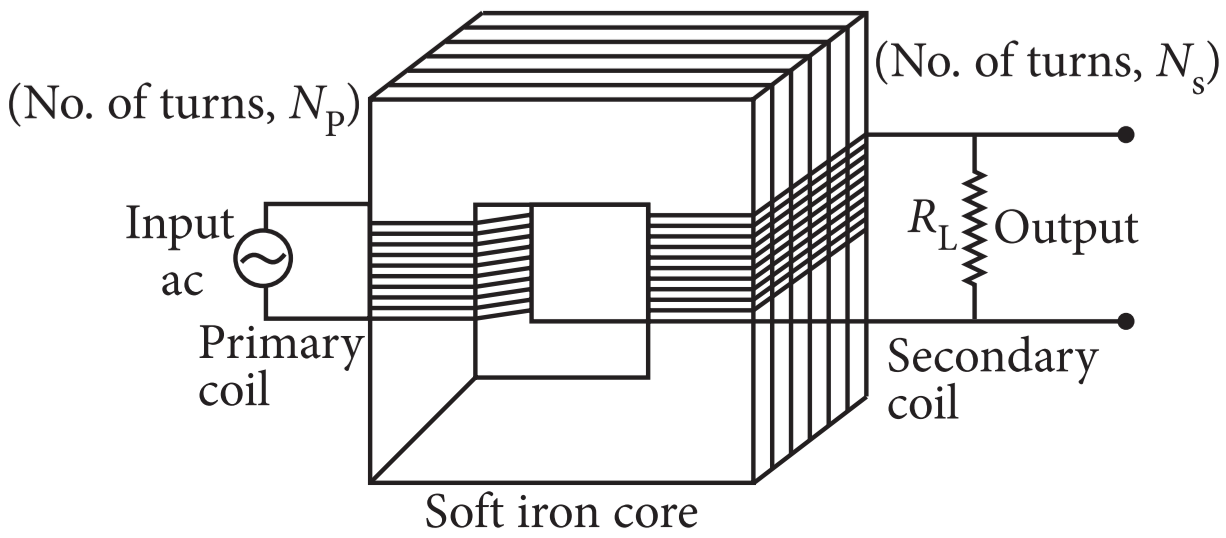
It can be shown that $\frac{\text{E}_\text{S}}{\text{E}_\text{P}}=\frac{\text{I}_\text{P}}{\text{I}_\text{S}}=\frac{\text{n}_\text{S}}{\text{n}_\text{P}}=\text{K}$
where the symbols have their standard meanings.
For a step up transformer, $\text{n}_\text{S} > \text{n}_\text{P}; \text{E}_\text{S} > \text{E}_\text{P}; \text{k} > \text{I}; \therefore \text{I}_\text{S} < \text{I}_\text{P}$
For a step down transformer, $\text{n}_\text{S} > \text{n}_\text{P}; \text{E}_\text{S} > \text{E}_\text{P}; \text{k} > \text{I};$
The above relations are on the assumptions that efficiency of transfonner is $100\%.$
lnfact, efficiency $\eta=\frac{\text{output power}}{\text{intput power }}=\frac{\text{E}_\text{S}\text{I}_\text{S}}{\text{E}_\text{P}\text{I}_\text{P}}$
  1. Which of the following quantity remains constant in an ideal transformer?
  1. Current.
  2. Voltage.
  3. Power.
  4. All of these.
  1. Transformer is used to.
  1. Convert ac to de voltage.
  2. Convert de to ac voltage.
  3. Obtain desired de power.
  4. Obtain desired ac voltage and current.
  1. The number of tums in primary coil of a transformer is 20 and the number of turns in a secondary is 10. If the voltage across the primary is ac 220V, what is the voltage across the secondary?
  1. $ac\ 100V$
  2. $ac\ 120V$
  3. $ac\ 110V$
  4. $ac\ 220V$
  1. In a transformer the number of primary turns is four times that of the secondary turns. Its primary is connected to an a.c. source of voltage $V.$ Then,
  1. Current through its secondary is about four times that of the current through its primary.
  2. Voltage across its secondary is about four times that of the voltage across its primary.
  3. Voltage across its secondary is about two times that of the voltage across its primary.
  4. voltage across its secondary is about $\frac{1}{2\sqrt{2}}$ times that of the voltage across its primary.
  1. A transformer is used to light $100W-110V$ lamp from $220V$ mains. If the main current is $0.5A$, the efficiency of the transformer is:
  1. $95\%$
  2. $99\%$
  3. $90\%$
  4. $96\%$

Answer

  1. $(c)$ Power
In an ideal transformer, there is no power loss. The efficiency of an ideal transformer is $\eta=1 ($i.e $100\%)$ i.e. input power $=$ output power.
  1. $(d)$ Obtain desired ac voltage and current.
Transformer is used to obtain desired ac voltage and current.
  1. $(c)\ ac\ 110V$
For a transformer, $\frac{\text{V}_\text{S}}{\text{V}_\text{p}}=\frac{\text{n}_\text{S}}{\text{n}_\text{p}}$
Where $N$ denotes number of turns and $V =$ voltage.
$\therefore{\text{V}_\text{S}}={\text{ac}\ 110}{\text{V}}$
  1. $(a)$ Current through its secondary is about four times that of the current through its primary.
In a transformer the primary and secondary currents are related by,
$\text{I}_\text{S}=\Big(\frac{\text{N}_\text{S}}{\text{N}_\text{P}}\Big)\text{I}_\text{P}$
And the Voltage are related by,
$\text{V}_\text{S}=\Big(\frac{\text{N}_\text{P}}{\text{N}_\text{S}}\Big)\text{V}_\text{P}$
where subscripts p and s refer to the primary and secondary of the transformer.
Here, $\text{V}_\text{P}=\text{V},\frac{\text{N}_\text{P}}{\text{N}_\text{S}}=4\ \therefore\text{I}_\text{P}=4\text{I}_\text{P}$
and, $\text{V}_\text{S}=\Big(\frac{1}{4}\Big)\text{V}=\frac{\text{V}}{4}$
  1. $(c)\ 90\%$
The efficiency of the transformer is:
$\eta=\frac{\text{output power}(\text{p}_\text{out})}{\text{intput power}(\text{p}_\text{in})}\times100$
Here, $P_{out }= 100W, P_{in }= (220V)(0.5A) = 110W$
$\therefore\eta=\frac{100\text{W}}{110\text{W}}\times100=90\%$

Need a full question paper?

Generate a complete, print-ready paper with questions like this in minutes — across 16+ boards, with answer keys.

Start Generating Free

Similar questions

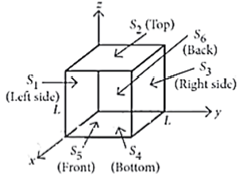
Net electric flux through a cube is the sum of fluxes through its six faces. Consider a cube as shown in figure, having sides of length $L =10.0 \ cm$. The electric field is uniform, has a magnitude $E =4.00 \times 10^3\ NC ^{-1}$ and is parallel to the $xy$ plane at an angle of $37^{\circ}$ measured from the $+ x -$axis towards the $+ y -$axis.
Image
$(i)$ Electric flux passing through surface $S_6$ is
$(a)\ -24 Nm ^2 C ^{-1}$
$(b)\ 32 Nm ^2 C ^{-1}$
$(c)\ -32 Nm ^2 C ^{-1}$
$(d)\ 24 Nm ^2 C ^{-1}$
$(ii)$ Electric flux passing through surface $S_1$ is
$(a)\ -32\  Nm ^2 C ^{-1}$
$(b)\ -24 \ Nm ^2 C ^{-1}$
$(c)\ 32 \ Nm ^2 C ^{-1}$
$(d)\ 24 \ Nm ^2 C ^{-1}$
$(iii)$ The surfaces that have zero flux are
$(a)\ S _2$ and $S _4$
$(b)\ S_3$ and $S_6$
$(c)\ S _1$ and $S _2$
$(d)\ S _1$ and $S _3$
$(iv)$ he total net electric flux through all faces of the cube is $(a)24\ Nm 2 C-1 (c)-8\ Nm2 C-1 b$
$(a)\ 24\ Nm ^2 C ^{-1}$
$(b)\ 8\ Nm ^2 C ^{-1}$
$(c)\ -8\ Nm ^2 C ^{-1}$
$(d)$ zero
$OR$
The dimensional formula of surface integral $\oint \vec{E} \cdot d \vec{S}$ of an electric field is
$(a)\ \left[ M ^{-1} L^3 T^{-3} A\right]$
$(b)\ \left[ M L ^2 T^{-2} A^{-1}\right]$
$(c) \ \left[ ML ^3 T^{-3} A^{-1}\right]$
$(d)\ \left[ M L ^{-3} T^{-3} A^{-1}\right]$
A bar magnet makes 40 oscillations per minute in an oscillation magnetometer. An identical magnet is demagnetized completely and is placed over the magnet in the magnetometer. Find the time taken for 40 oscillations by this combination. Neglect any induced magnetism.
Explain (/ Discuss) the variation in intensity of the light transmitted through two polaroids. And from that derive Malus' law.
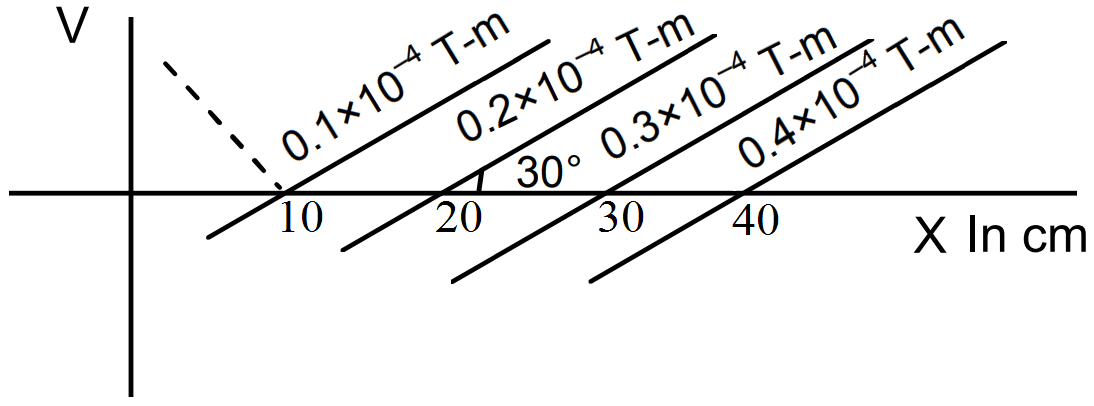
Figure shows some of the quipotential surfaces of the magnetic scalar potential. Fmd the magnetic field $B$ at a point in the region.
Two submarines are approaching each other in a calm sea. The first submarine travels at a speed of $36\ km/h$ and the other at $54\ km/h$ relative to the water. The first submarine sends a sound signal $($sound waves in water are also called sonar$)$ at a frequency of $2000\ Hz.$
  1. At what frequency is this signal received by the second submarine?
  2. The signal is reflected from the second submarine. At what frequency is this signal received by the first submarine. Take the speed of the sound wave in water to be $1500\ m/s.$
Two q charges of the same nature are located at a distance d from each other, the third charge of value Q Coulomb is at the mid-point of the line joining them. For what value of Q will the system be in equilibrium?
In motor vehicles, a convex mirror is attached near the driver's seat to give him the view of the traffic behind. What is the special function of this convex mirror which a plane mirror can not do?
Write the equation of average power for $L - C - R$ series $AC$ circuit and discuss its special cases.
A van is standing on a frictionless portion of a horizontal road. To start the engine, the vehicle must be set in motion in the forward direction. How can the persons sitting inside the van do it without coming out and pushing from behind?
A uniform magnetic field of $1.5 T$ exists in a cylindrical region of radius $10.0 \ cm,$ its direction parallel to the axis along east to west. $A$ wire carrying current of $7.0 A $ in the north to south direction passes through this region. What is the magnitude and direction of the force on the wire if,
  1. The wire intersects the axis,
  2. The wire is turned from $N-S$ to northeast $-$ northwest direction,
  3. The wire in the $N-S$ direction is lowered from the axis by a distance of $6.0 \ cm$?