Question
A transformer is essentially an a.c. device. It cannot work on d.c. It changes altemating voltages or currents. It does not affect the frequency of a.c. It is based on the phenomenon of mutual induction. A transformer essentially consists of two coils of insulated copper wire having different number of tums and wound on the same soft iron core.
The number of turns in the primary and secondary coils of an ideal transfonner are 2000 and 50 respectively. The primary coil is connected to a main supply of 120V and secondary coil is connected to a bulb of resistance $0.6\Omega.$
  1. The value of voltage across the secondary coil is:
  1. 5V
  2. 2V
  3. 3V
  4. 10V
  1. The value of current in the bulb is:
  1. 7A
  2. 15A
  3. 3A
  4. 5A
  1. The value of current in primary coil is:
  1. 0.125A
  2. 2.52A
  3. 1.51A
  4. 3.52A
  1. Power in primary coil is:
  1. 20W
  2. 5W
  3. 10W
  4. 15W
  1. Power in secondary coil is:
  1. 15W
  2. 20W
  3. 7W
  4. 8W

Answer

  1. (c) 3V
Explanation:
As, $\frac{\text{E}_\text{s}}{\text{E}_\text{p}}=\frac{\text{n}_\text{s}}{\text{n}_\text{p}}$
$\Rightarrow\text{E}_\text{s}=\text{E}_\text{p}\times\frac{\text{n}_\text{p}}{\text{n}_\text{p}}$
$=\frac{120\times50}{2000}=3\text{V}$
  1. (d) 5A
Explanation:
$\text{I}_0=\frac{\text{E}_\text{S}}{\text{R}}\Rightarrow\text{I}_0=\frac{3}{0.6}=5\text{A}$
  1. (a) 0.125A
Explanation:
As, $\frac{\text{I}_\text{P}}{\text{I}_\text{S}}=\frac{\text{E}_\text{S}}{\text{E}_\text{P}}$
$\Rightarrow\text{I}_\text{p}=\frac{\text{E}_\text{S}}{\text{E}_\text{P}}\times\text{I}_\text{S}=\frac{3}{120}\times5=0.125\text{A}$
  1. (d) 15W
Explanation:
Power in primary, $P_P= E_P \times I_P= 120 \times 0.125$
= 15W
  1. (a) 15W
Explanation:
Power in secondary coil, $P_S = E_S \times I_S = 3 \times 5$
= 15W

Need a full question paper?

Generate a complete, print-ready paper with questions like this in minutes — across 16+ boards, with answer keys.

Start Generating Free

Similar questions


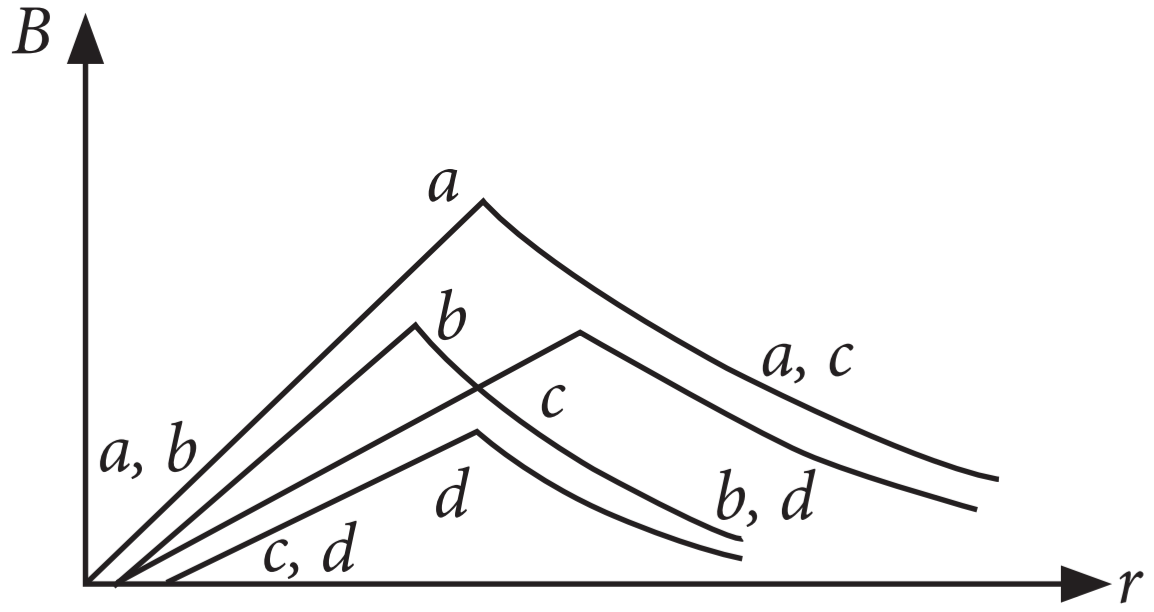
The field of a hollow wire with constant current is homageneous.
Curves in the graph shown give, as functions of radius distance r, the magnitude B of the magnetic field inside and outside four long wires a, b, c and d, carrying currents that are uniformly distributed across the cross sections of the wires. Overlapping portions of the plots are indicated by double labels.
  1. Which wire has the greatest magnitude of the magnetic field on the surface?
  1. a
  2. b
  3. c
  4. d
  1. The current density in a wire a is:
  1. Greater than in wire c.
  2. Less than in wire c.
  3. Equal to that in wire c.
  4. Not comparable to that of in wire c due to lack of information.
  1. Which wire has the greatest radius?
  1. a
  2. b
  3. c
  4. d
  1. A direct current I flows along the length of an infinitely long straight thin walled pipe, then the magnetic field is:
  1. Uniform throughout the pipe but not zero.
  2. Zero only along the axis of the pipe.
  3. Zero at any point inside the pipe.
  4. Maximum at the centre and minimum at the edges.
  1. In a coaxial, straight cable, the central conductor and the outer conductor carry equal currents in opposite direction. The magnetic field is zero.
  1. Outside the cable.
  2. Inside the inner conductor.
  3. Inside the outer conductor.
  4. In between the two conductor.
While watering a distant plant, a gardener partially water than in fresh closes the exit hole of the pipe by putting his finger on it. Explain why this results in the water stream goirig to a larger distance.
The half-life of $^{226}Ra$ is $1602y$. Calculate the activity of 0.1g of $RaCl_2$ in which all the radium is in the form of $^{226}Ra.$ Taken atomic weight of Ra to be $226g/mol^{-1}$ and that of Cl to be $35.5g/mol^{-1}.$
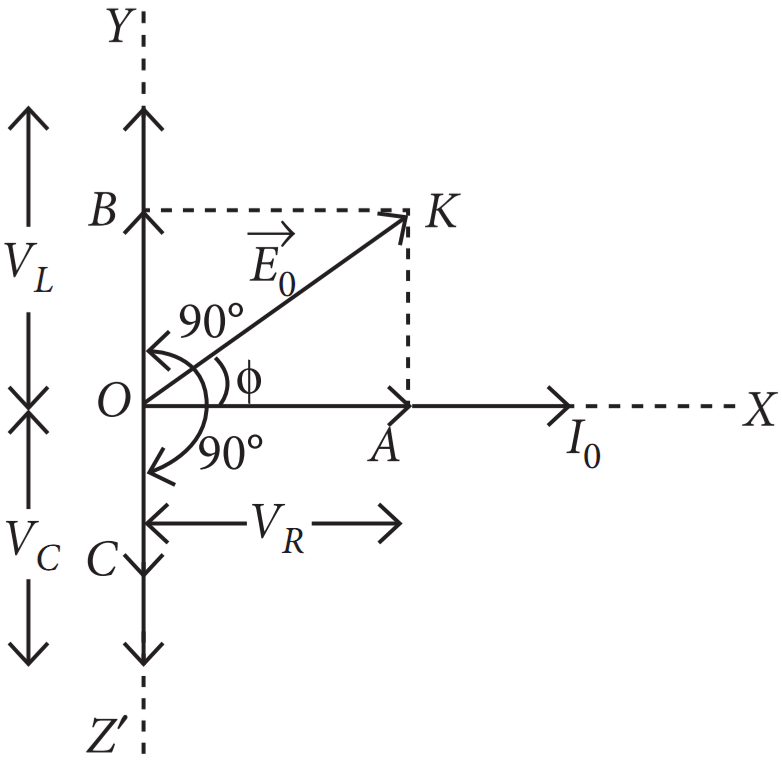
When a pure resistance R, pure inductor L and an ideal capacitor of capacitance C is connected in series to a source of alternating e.m.f., then current at any instant through the three elements has the same amplitude and is represented as $\text{I} = \text{I}_0\sin\omega\text{t}.$ However, voltage across each element has a different phase relationship with the current as shown in graph. The effective resistance of RLC circuit is called impedance (Z) of the circuit and the voltage leads the current by a phase angle $\phi.$

A resistor of $12\Omega,$ a capacitor ofreactance $14\Omega,$ and a pure inductor of inductance 0.1H are joined in series and placed across 200V, 50Hz a.c. supply.
  1. The value of inductive reactance is:
  1. $15\Omega$
  2. $31.4\Omega$
  3. $20\Omega$
  4. $30\Omega$
  1. The value of impedance is:
  1. $20\Omega$
  2. $15\Omega$
  3. $30\Omega$
  4. $21.13\Omega$
  1. What is the value of current in the circuit?
  1. $5A$
  2. $15A$
  3. $10A$
  4. $9.46A$
  1. What is the value of the phase angle between current and voltage?
  1. $53º9'$
  2. $63º9'$
  3. $55º4'$
  4. $50º$
  1. From graph, which one is true from following?
  1. $V_L \geq V_C$
  2. $V_L < V_C$
  3. $V_L < V_C$
  4. $V_L < V_C$
A player hits a baseball at some angle. The ball goes high up in space. The player runs and catches the ball before it hits the ground. Which of the two (the player or the ball) has greater displacement?
A prism is a portion of a transparent medium bounded by two plane faces inclined to each other at a suitable angle. A ray of light suffers two refractions on passing through a prism and hence deviates through a certain angle from its original path. The angle of deviation of a prism is, $\delta=(\mu-1)\text{A},$ through which a ray deviates on passing through a thin prism of small refracting angle A.
If $\mu$ is refractive index of the material of the prism, then prism formula is, $\mu=\frac{\frac{\sin(\text{A}\delta_\text{m})}{2}}{\frac{\sin\text{A}}{2}}$
  1. For which colour, angle of deviation is minimum?
  1. Red
  2. Yellow
  3. Violet
  4. Blue
  1. When white light moves th rough vacuum:
  1. All colours have same speed.
  2. Different colours have different speeds.
  3. Violet has more speed than red.
  4. Red has more speed than violet.
  1. The deviation through a prism is maximum when angle of incidence is:
  1. 45º
  2. 70º
  3. 90º
  4. 60c
  1. What is the deviation produced by a prism of angle 6º? (Refractive index of the material of the prism is 1.644).
  1. 3.864º
  2. 4.595º
  3. 7.259º
  4. 1.252º
  1. A ray of light falling at an angle of 50º is refracted through a prism and suffers minimum deviation. If the angle of prism is 60º, then the angle of minimum deviation is:
  1. 45º
  2. 75º
  3. 50º
  4. 40º
The distance between the centres of two insulated charged copper spheres ' $A$ ' and ' $B$ ' which are identical in size is 50 cm and the charge on each is $6.5 \times 10^{-7} C$. A third uncharged sphere ' C ' of the same size was first brought in contact with the sphere ' $A$ ', and then brought in contact with the second sphere ' $B$ ' and finally separated from both. Then find the magnitude of repulsive foce between ' $A$ ' and ' $B$ '.
Photoelectric effect is the phenomenon of emission of electrons from a metal surface, when radiations of suitable frequency fall on them. The emitted electrons are called photoelectrons and the current so produced is called photoelectric current.
  1. With the increase of intensity of incident radiations on photoelectrons emitted by a photo tube, the number of photoelectrons emitted per unit time is:
  1. Increases.
  2. Decreases.
  3. Remains same.
  4. None of these.
  1. It is observed that photoelectron emission stops at a certain time t after the light source is switched on. The stopping potential (V) can be represented as:
  1. $2(KE_{max}/e)$
  2. $(KE_{max}/e)$
  3. $(KE_{max}/3e)$
  4. $(KE_{max}/2e)$
  1. A point source of light of power $3.2 \times 10^{-3} W$ emits monoenergetic photons of energy 5.0eV and work function 3.0eV. The efficiency of photoelectron emission is 1 for every $10^6$ ncident photons. Assume that photoelectrons are instantaneously swept away after emission. The maximum kinetic energy of photon is:
  1. 4eV
  2. 5eV
  3. 2eV
  4. Zero
  1. Which of the following device is the application of Photoelectric effect?
  1. Light emitting diode.
  2. Diode.
  3. Photocell.
  4. Transistor.
  1. If the frequency of incident light falling on a photosensitive metal is doubled, the kinetic energy of the emitted photoelectron is:
  1. Unchanged.
  2. Halved.
  3. Doubled.
  4. More than twice its initial value.