Question
While watering a distant plant, a gardener partially water than in fresh closes the exit hole of the pipe by putting his finger on it. Explain why this results in the water stream goirig to a larger distance.

Answer

Area reduces, therefore speed increase, therefore range increases.

Need a full question paper?

Generate a complete, print-ready paper with questions like this in minutes — across 16+ boards, with answer keys.
Start Generating Free

Similar questions

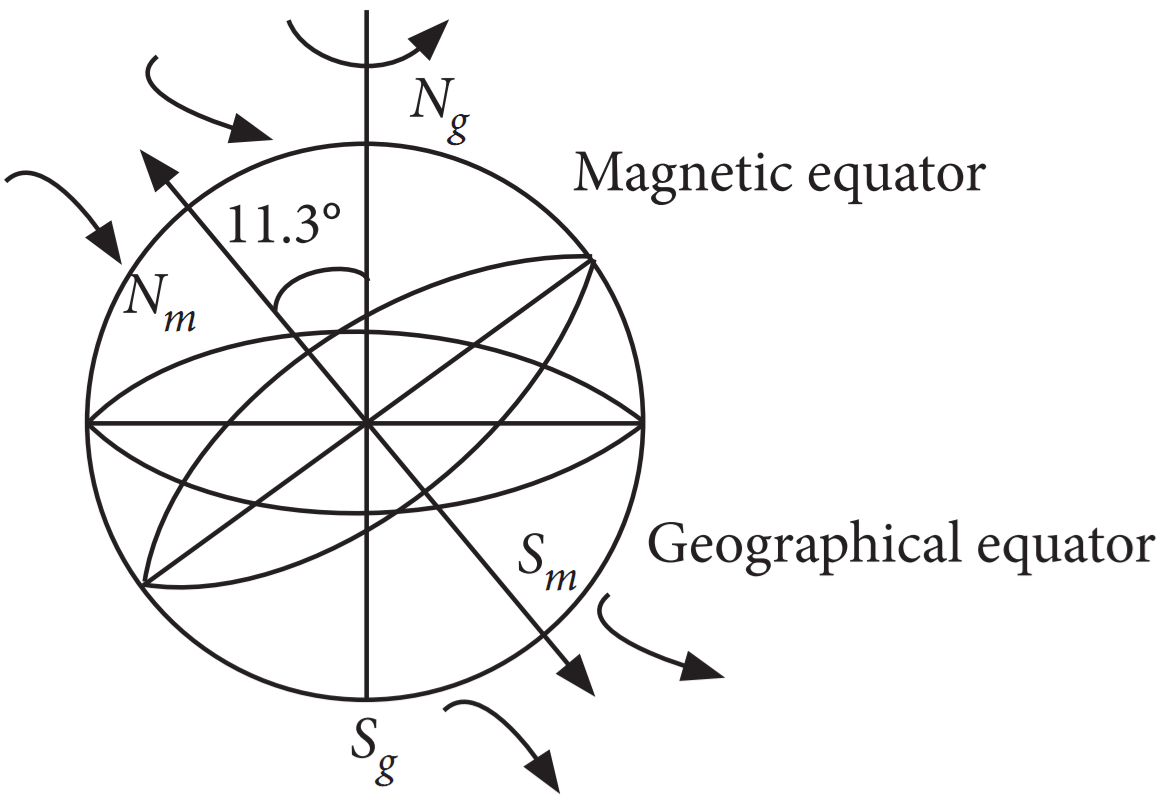
The magnetic field lines of the earth resemble that of a hypothetical magnetic dipole located at the centre of the earth. The axis of the dipole is presently tilted by approximately 11.3° with respect to the axis of rotation of the earth.

The pole near the geographic North pole of the earth is called the North magnetic pole and the pole near the geographic South pole is called South magnetic pole.
  1. Magnetization of a sample is:
  1. $10^5T$
  2. $10^{-6}T$
  3. $10^{-5}T$
  4. $10^8T$
  1. A bar magnet is placed North-South with its North-pole due North. The points of zero magnetic field will be in which direction from centre of magnet?
  1. North-South
  2. East- West
  3. North-East and South-West
  4. None of these.
  1. The value of angle of dip is zero at the magnetic equator because on it:
  1. V and Hare equal.
  2. The values of V and H zero.
  3. The value of V is zero.
  4. The value of His zero.
  1. The angle of dip at a certain place, where the horizontal and vertical components of the earth's magnetic field are equal, is:
  1. $30^\circ$
  2. $90^\circ$
  3. $60^\circ$
  4. $45^\circ$
  1. At a place, angle of dip is 300. lf horizontal component of earth's magnetic field is H, then the total intensity of magnetic field will be.
  1. $\frac{\text{H}}{2}$
  2. $\frac{2\text{H}}{\sqrt{3}}$
  3. $\text{H}\sqrt{\frac{3}{2}}$
  4. $2\text{H}$
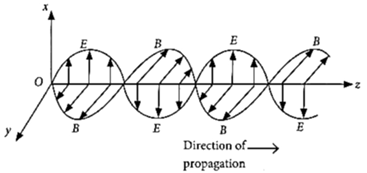
A stationary charge produces only an electrostatic field while a charge in uniform motion produces a magnetic field, that does not change with time. An oscillating charge is an example of accelerating charge. It produces an oscillating magnetic field, which in turn produces an oscillating electric fields and so on. The oscillating electric and magnetic fields regenerate each other as a wave which propagates through space.
Image
$(i).$ Magnetic field in a plane electromagnetic wave is given by $\vec{B}= B _0 \sin ( kx +\omega t ) \hat{j} T$Expression for corresponding electric field will be (Where c is speed of light.)
$(a) \vec{E}= B _0 c \sin ( kx +\omega t ) \hat{k} V / m$
$(b) \vec{E}=- B _0 c \sin ( kx -\omega t ) \hat{k} V / m$
$(c) \vec{E}=- B _0 c \sin ( kx +\omega t ) \hat{k} V / m$
$(d) \vec{E}=\frac{B_0}{c} \sin ( kx +\omega t ) \hat{k} V / m$
$(ii)$ The electric field component of a monochromatic radiation is given by $\vec{E}=2 E _0 \hat{i} \cos kz \cos \omega t$. Its magnetic field $\vec{B}$ is then given by
$(a) -\frac{2 E_0}{c} \hat{j} \sin kz \sin \omega t$
$(b) \frac{2 E_0}{c} \hat{j} \sin kz \sin \omega t$
$(c) \frac{2 E_0}{c} \hat{j} \sin kz \cos \omega t$
$(d) \frac{2 E_0}{c} \hat{j} \cos kz \cos \omega t$
$(iii)$ A plane em wave of frequency $25 \ MHz$ travels in a free space along $x -$direction. At a particular point in space and time, $E =(6.3 \hat{j}) V / m$. What is magnetic field at that time?
$(a) \ 0.089 \mu T$
$(b) \ 0.124 \mu T$
$(c) \ 0.021 \mu T$
$(d) \ 0.095 \mu T$
OR
A plane electromagnetic wave travels in free space along $x-$axis. At a particular point in space, the electric field along $y$-axis is $9.3 V m ^{-1}$. The magnetic induction $(B)$ along $z -$axis is
$(a) \ 3.1 \times 10^{-8} T$
$(b) \ 3 \times 10^{-5} T$
$(c) \ 3 \times 10^{-6} T$
$(d) \ 9.3 \times 10^{-6} T$
$(iv)$ A plane electromagnetic wave travelling along the $x-$direction has a wavelength of $3 \ mm$ . The variation in the electric field occurs in the $y-$direction with an amptitude $66 V m ^{-1}$. The equations for the electric and magnetic fields as a function of $x$ and $t$ are respectively
$ \text { a) } E_y =11 \cos 2 \pi \times 10^{11}\left(t-\frac{x}{c}\right), \text { b) } E_y =66 \cos 2 \pi \times 10^{11}\left(t-\frac{x}{c}\right),$
$B_y =11 \times 10^{-7} \cos 2 \pi \times 10^{11}\left(t-\frac{x}{c}\right) B_z =2.2 \times 10^{-7} \cos 2 \pi \times 10^{11}\left(t-\frac{x}{c}\right)$
$\text { c) } E_x =33 \cos \pi \times 10^{11}\left(t-\frac{x}{c}\right), \text { d) } E_y =33 \cos \pi \times 10^{11}\left(t-\frac{x}{c}\right),$
$B_x =11 \times 10^{-7} \cos \pi \times 10^{11}\left(t-\frac{x}{c}\right) B_z =1.1 \times 10^{-7} \cos \pi \times 10^{11}\left(t-\frac{x}{c}\right)$
Maxwell showed that the speed of an electromagnetic wave depends on the permeability and permittivity of the medium through which it travels. The speed of an electromagnetic wave in free space is given by  $C=\frac{1}{\sqrt{\mu_0 \varepsilon_0}}$ The fact led Maxwell to predict that light is an electromagnetic wave. The emergence of the speed of light from purely electromagnetic considerations is the crowning achievement of Maxwell’s electromagnetic theory. The The fact led Maxwell to predict that light is an electromagnetic wave. The emergence of the speed of light from purely electromagnetic considerations is the crowning achievement of Maxwell’s electromagnetic theory. The speed of an electromagnetic wave in any medium of permeability $\mu$ and permittivity $\varepsilon$ will be$\frac{c}{\sqrt{K \mu_r}}$ where K is the dielectric constant of the medium and $\mu_r$ is the relative permeability.

(i) The dimensions of $\frac{1}{2} \varepsilon_0 E^2$ ( $\varepsilon_0$ : permittivity of free space; $E =$ electric field $)$ is
(a) $MLT ^{-1}$ (b) $ML ^{-1} T^{-2}$ (c) $ML ^2 T^{-2}$ (d) $ML ^2 T^{-1}$

(ii) Let $\left[\varepsilon_0\right]$ denote the dimensional formula of the permittivity of the vacuum. If $M =$ mass, $L =$ length, $T =$ time and $A =$ electric current, then
(a) $\left[\varepsilon_0\right]= ML ^2 T^{-1}$
(b) $\left[\varepsilon_0\right]= MLT ^{-2} A^{-2}$
(c) $\left[\varepsilon_0\right]= M ^{-1} L^{-3} T^4 A^2$
(d) $\left[\varepsilon_0\right]= M ^{-1} L^{-3} T^2 A$

(iii) An electromagnetic wave of frequency 3 MHz passes from vacuum into a dielectric medium with permittivity $\varepsilon=4$. Then
(a) wavelength is halved and the frequency remains unchanged.
(b) wavelength and frequency both remain unchanged
(c) wavelength is doubled and the frequency remains unchanged
(d) wavelength is doubled and the frequency becomes half

OR

The electromagnetic waves travel with
(a) the speed of light $c =3 \times 10^8 m s ^{-1}$ in
(b) the speed of light $c =3 \times 10 m s ^{-1}$ in fluid medium. solid medium
(c) the speed of light $c =3 \times 10^8 m s ^{-1}$ in
(d) the same speed in all media free space

(iv) Which of the following are not electromagnetic waves?
cosmic rays, $\gamma$-rays, $\beta$-rays, X-rays
(a) $\beta$-rays (b) X-rays (c) $\gamma$-rays (d) cosmic rays
TV signals broadcast by Delhi studio cannot be directly received at Patna which is about 1000km away. But the same signal goes some 36000km away to a satellite, gets reflected and is then received at Patna. Explain.
A police jeep is chasing a culprit going on a motorbike. The motorbike crosses a turning at a speed of 72km/h. The jeep follows it at a speed of 90km/h, crossing the turning ten seconds later than the bike. Assuming that they travel at constant speeds, how far from the turning will the jeep catch up with the bike?
The reduction factor K of a tangent galvanometer is written on the instrument. The manual says that the current is obtained by multiplying this factor to tane. The procedure works well at Bhuwaneshwar. Will the procedure work if the instrument is taken to Nepal? If there is some error, can it be corrected by correcting the manual or the instrument will have to be taken back to the factory?
A ladder is resting with one end on a vertical wall and the other end on a horizontal floor. Is it more likely to slip when a man stands near the bottom or near the top?
A child has near point at 10cm. What is the maximum angular magnification the child can have with a convex lens of focal length 10cm?
Total internal reflection is the phenomenon of reflection of light into denser medium at the interface of denser medium with a rarer medium. For this phenomenon to occur necessary condition is that light must travel from denser to rarer and angle of incidence in denser medium must be greater than critical angle (C) for the pair of media in contact. Critical angle depends on nature of medium and wavelength of tight. We can show that $\mu=\frac{1}{\sin\text{C}}.$
  1. Critical angle for glass air interface, where ft of glass is $\frac{3}{2}$ is,
  1. 41.8
  2. 60º
  3. 30º
  4. 15º
  1. Critical angle for water air interface is 48.6º. What is the refractive index of water?
  1. $1$
  2. $\frac{3}{2}$
  3. $\frac{4}{3}$
  4. $\frac{3}{4}$
  1. Critical angle for air water interface for violet colour is 49º. Its value for red colour would be:
  1. 49º
  2. 50º
  3. 48º
  4. Cannot say.
  1. Which of the following is not due to total internal reflection?
  1. Working of optical fibre.
  2. Difference between apparent and real depth of a pond.
  3. Mirage on hot summer days.
  4. Brilliance of diamond.
  1. Critical angle of glass is $\theta_1$ and that of water is $\theta_2$The critical angle for water and glass surface would be $(\mu_\text{g}=\frac{3}{2},\ \mu_\text{w}=\frac{4}{3})$
  1. Less than $\theta_2$
  2. Between $\theta_1$ and $\theta_2$
  3. Greater than $\theta_2$
  4. Less than $\theta_1$
In motor vehicles, a convex mirror is attached near the driver's seat to give him the view of the traffic behind. What is the special function of this convex mirror which a plane mirror can not do?