MCQ
A transistor has three impurity regions. All the three regions have different doping levels. In order of increasing doping level, the regions are :
  • A
    Emitter, base and collector.
  • B
    Collector, base and emitter.
  • C
    Base, emitter and collector.
  • Base, collector and emitter.

Answer

Correct option: D.
Base, collector and emitter.

Need a full question paper?

Generate a complete, print-ready paper with questions like this in minutes — across 16+ boards, with answer keys.

Start Generating Free

Similar questions

The resistance per centimeter of a meter bridge wire is $\mathrm{r}$, with $\mathrm{X}\  \Omega$ resistance in left gap. Balancing length from left end is at $40 \mathrm{~cm}$ with $25\  \Omega$ resistance in right gap. Now the wire is replaced by another wire of $2 \mathrm{r}$ resistance per centimeter. The new balancing length for same settings will be at
The flat face of a plano-convex lens of focal length $10 cm$ is silvered. A point source placed $30 \,cm$ in front of the curved surface will produce a
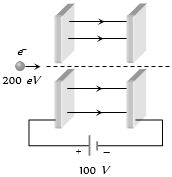
Two large parallel plates are connected with the terminal of $100\, V$ power supply. These plates have a fine hole at the centre. An electron having energy $200\, eV$ is so directed that it passes through the holes. When it comes out it's de-Broglie wavelength is ............. $\mathop {\rm{A}}\limits^o $
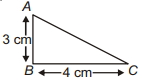
$A B C$ is a right angled triangle situated in a uniform electric field $\vec{E}$ which is in the plane of the triangle. The points $A$ and $B$ are at the same potential of $15 \,V$ while the point $C$ is at a potential of $20 \,V . A B=3 \,cm$ and $B C=4 \,cm$. The magnitude of electric field is (in $S.I.$ Units)
In Young's double$-$slit experiment, the intensity of light at a point on the screen where the path difference is $\lambda$ is $k ( \lambda$ being the wavelength of light used$).$ The intensity at a point where the path difference is $\frac{\lambda}{4}$, will be
To measure which of the following, is a tangent galvanometer used
Copper and silicon is cooled from $300\; K$ to $60\; K$, the specific resistance
An LR circuit with a battery is connected at t = 0. Which of the following quantities is not zero just after the connection?
An elementary particle of mass m and charge +e is projected with velocity v at a much more massive particle of charge Ze, where Z > 0. What is the closest possible approach of the incident particle 
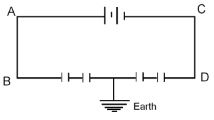
Four equal capacitors are connected to a battery as shown in the adjoining figure. The potential of $A$ and $B$ are