MCQ
A transistor having $\alpha=0.99$ is used in a common base amplifier. If the load resistance is $4.5 \,k \Omega$ and the dynamic resistance of the emitter junction is $50 \,\Omega$ the voltage gain of the amplifier will be
  • A
    $79.1$
  • $89.1$
  • C
    $78.2$
  • D
    $450$

Answer

Correct option: B.
$89.1$
b
(b)

$\alpha=0.99 \quad R_L=4.5 \,k \Omega \quad R_I=50 \,\Omega$

$A_v=\alpha \cdot \frac{R_L}{R_I}=0.99 \times \frac{4.5}{50} \times 10^3$

$\therefore A_v=0.0891 \times 10^3=89.1$

Need a full question paper?

Generate a complete, print-ready paper with questions like this in minutes — across 16+ boards, with answer keys.

Start Generating Free

Similar questions

Assume that a drop of liquid evaporates by decrease in its surface energy, so that its temperature remains unchanged. What should be the minimum radius of the drop for this to be possible? The surface tension is $T$, density of liquid is $\rho$ and $L$ is its latent heat of vaporization
Statement$-1:$ Two longitudinal waves given by equations $y _{1}( x , t )=2 a \sin (\omega t - kx )$ and $y _{2}( x , t )= a \sin (2 \omega t -2 kx )$ will have equal intensity.

Statement$-2:$ Intensity of waves of given frequency in same medium is proportional to square of amplitude only.

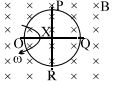
$A$ conducting ring of radius a is rotated about a point $O$ on its periphery as shown in the figure in a plane perpendicular to uniform magnetic field $B$ which exists everywhere. The rotational velocity is $\omega .$ Choose the correct statement $(s)$ related to the magnitude of potential differences
A ball is dropped from an elevator moving upward with acceleration ' $a$ ' by a boy standing in it. The acceleration of ball with respect to [Take upward direction positive]
From Ampere's circuital law for a long straight wire of circular cross-section carrying a steady current, the variation of magnetic field in the inside and outside region of the wire is :
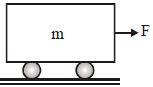
A car of mass $m$ is accelerating on a level smooth road under the action of a single force $F$. The power delivered to the car is constant and equal to $P$. If the velocity of the car at an instant is $v$ , then after travelling how much distance it becomes double?
Water is flowing on a horizontal fixed surface, such that its flow velocity varies with $y$ (vertical direction) as $v=k\left(\frac{2 y^2}{a^2}-\frac{y^3}{a^3}\right)$. If coefficient of viscosity for water is $\eta$, what will be shear stress between layers of water at $y=a$. 
The plates of a capacitor are charged to a potential difference of $320 \, volts$ and are then connected across a resistor. The potential difference across the capacitor decays exponentially with time. After $1 $ second the potential difference between the plates of the capacitor is $240 \, volts$, then after $2$ and $3$ seconds the potential difference between the plates will be
The nuclei ${ }_{6} C^{13}$ and ${ }_{7} N^{14}$ can be described as
A body is executing $S.H.M.$ When its displacement from the mean position is $4\, cm$ and $5\, cm$, the corresponding velocity of the body is $10 \,cm/sec$ and $8\, cm/sec$. Then the time period of the body is