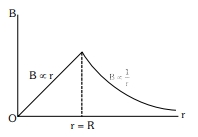
From Ampere's circuital law for a long straight wire of circular cross-section carrying a steady current, the variation of magnetic field in the inside and outside region of the wire is :
NEET 2022, Medium


Download our appand get started for free
Experience the future of education. Simply download our apps or reach out to us for more information. Let's shape the future of learning together!No signup needed.*
Similar Questions
- 1A milliammeter of range $10\, mA$ has a coil of resistance $1 \,\Omega$. To use it as voltmeter of range $10\, volt$, the resistance that must be connected in series with it, will be ............. $\Omega $View Solution
- 2A charged particle moves along circular path in a uniform magnetic field in a cyclotron. The kinetic energy of the charged particle increases to $4$ times its initial value. What will be the ratio of new radius to the original radius of circular path of the charged particleView Solution
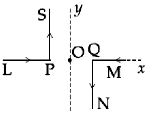
- 3As shown in the figure, two infinitely long, identical wires are bent by $90^o$ and placed in such a way that the segments $LP$ and $QM$ are along the $x-$ axis, while segments $PS$ and $QN$ are parallel to the $y-$ axis. If $OP = OQ = 4\, cm$, and the magnitude of the magnetic field at $O$ is $10^{-4}\, T$, and the two wires carry equal current (see figure), the magnitude of the current in each wire and the direction of the magnetic field at $O$ will be $(\mu_ 0 = 4\pi \times10^{-7}\, NA^{-2})$View Solution
- 4A galvanometer having a coil resistance of $30\,\Omega $ shows full scale deflection when a current of $2\,A$ passes through it. It can be converted into an ammeter to read currents upto $10\,A$ byView Solution
- 5A galvanometer having a coil resistance of $30\,\Omega $ shows full scale deflection when a current of $2\,A$ passes through it. It can be converted into an ammeter to read currents upto $10\,A$ byView Solution
- 6The electrostatic force $\left(\vec{F}_1\right)$ and magnetic force $\left(\vec{F}_2\right)$ acting on a charge $q$ moving with velocity $v$ can be written :View Solution
- 7One of the two identical conducing wires of length $L$ is bent in the form of a circular loop and the other one into a circular coil of $N$ identical turns. If the same current is passed in both, the ratio of the magnetic field at the central of the loop $(B_L)$ to that at the centre of the coil $(B_C),$; $.\,\frac {B_L}{B_C}$ will beView Solution
- 8A closely wounded circular coil of radius $5\,cm$ produces a magnetic field of $37.68 \times 10^{-4}\,T$ at its center. The current through the coil is $......A$. [Given, number of turns in the coil is $100$ and $\pi=3.14]$View Solution
- 9A conductor of length $l$ and mass $m$ is placed along the east-west line on a table. Suddenly a certain amount of charge is passed through it and it is found to jump to a height $h$. The earth’s magnetic induction is $B$. The charge passed through the conductor is:View Solution
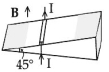
- 10As shown in the figure, a metallic rod of linear density $0.45\,kg\,m ^{-1}$ is lying horizontally on a smooth incline plane which makes an angle of $45^{\circ}$ with the horizontal. The minimum current flowing in the rod required to keep it stationary, when $0.15\,T$ magnetic field is acting on it in the vertical upward direction, will be $....A$ $\left\{\right.$ Use $\left.g=10 m / s ^{2}\right\}$View Solution