MCQ
A transverse progressive wave on a stretched string has a velocity of $10\,m{s^{ - 1}}$ and a frequency of $100 Hz.$ The phase difference between two particles of the string which are $2.5 cm$ apart will be
  • A
    $\frac{\pi }{8}$
  • B
    $\frac{\pi }{4}$
  • C
    $\frac{{3\pi }}{8}$
  • $\frac{\pi }{2}$

Answer

Correct option: D.
$\frac{\pi }{2}$
d
(d) $v = n\lambda \Rightarrow \lambda = 10\,\,cm$

Phase difference $\frac{{2\pi }}{\lambda } \times $ Path difference

=$\frac{{2\pi }}{{10}} \times 2.5$= $\frac{\pi }{2}$

Need a full question paper?

Generate a complete, print-ready paper with questions like this in minutes — across 16+ boards, with answer keys.

Start Generating Free

Similar questions

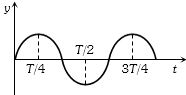
The graph shows the variation of displacement of a particle executing S.H.M. with time. We infer from this graph that
For a transverse wave travelling along a straight line, the distance between two peaks (crests) is $5 \,m ,$ while the distance between one crest and one trough is $1.5 \,m$ The possible wavelengths (in $m$ ) of the waves are
Let $\overrightarrow{\text{C}}=\overrightarrow{\text{A}}+\overrightarrow{\text{B}}.$
If the length of a clock pendulum increases by $0.2 \%$ due to atmospheric temperature rise, then the loss in time of clock per day is ........... $s$
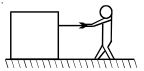
A man pulls a block heavier than himself with a light horizontal rope. The coefficient of friction is the same between the man and the ground, and between the block and the ground
A tunning fork produces $5\, beats/sec$ when the length of a sonometer wire is either $1\, m$ or $1.05\, m$. Calculate the frequency of tunning fork  .... $Hz$
A non-isotropic solid metal cube has coefficients of linear expansion as:

$5 \times 10^{-5} /^{\circ} \mathrm{C}$ along the $\mathrm{x}$ -axis and $5 \times 10^{-6} /^{\circ} \mathrm{C}$ along the $y$ and the $z-$axis. If the coefficient of volume expansion of the solid is $\mathrm{C} \times 10^{-6} /^{\circ} \mathrm{C}$ then the value of $\mathrm{C}$ is

A constant torque acting on a uniform circular wheel changes its angular momentum from $A_0$ to $4 A_0$ in $4$ seconds. The magnitude of this torque is ...........
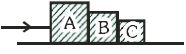
Three blocks $A, B$ and $C$ of masses $4\, kg$, $2\, kg$ and $1\, kg$ respectively, are in contact on a frictionless surface, as shown. If a force of $14\, N$ is applied on the $4\, kg$ block, then the contact force between $A$ and $B$ is .......... $N$
Force acting on a particle moving in a straigth line varies with the velocity of the particle as $F =\frac {K}{v},$ where $K$ is a constant. The work done by this force in time $t$ is